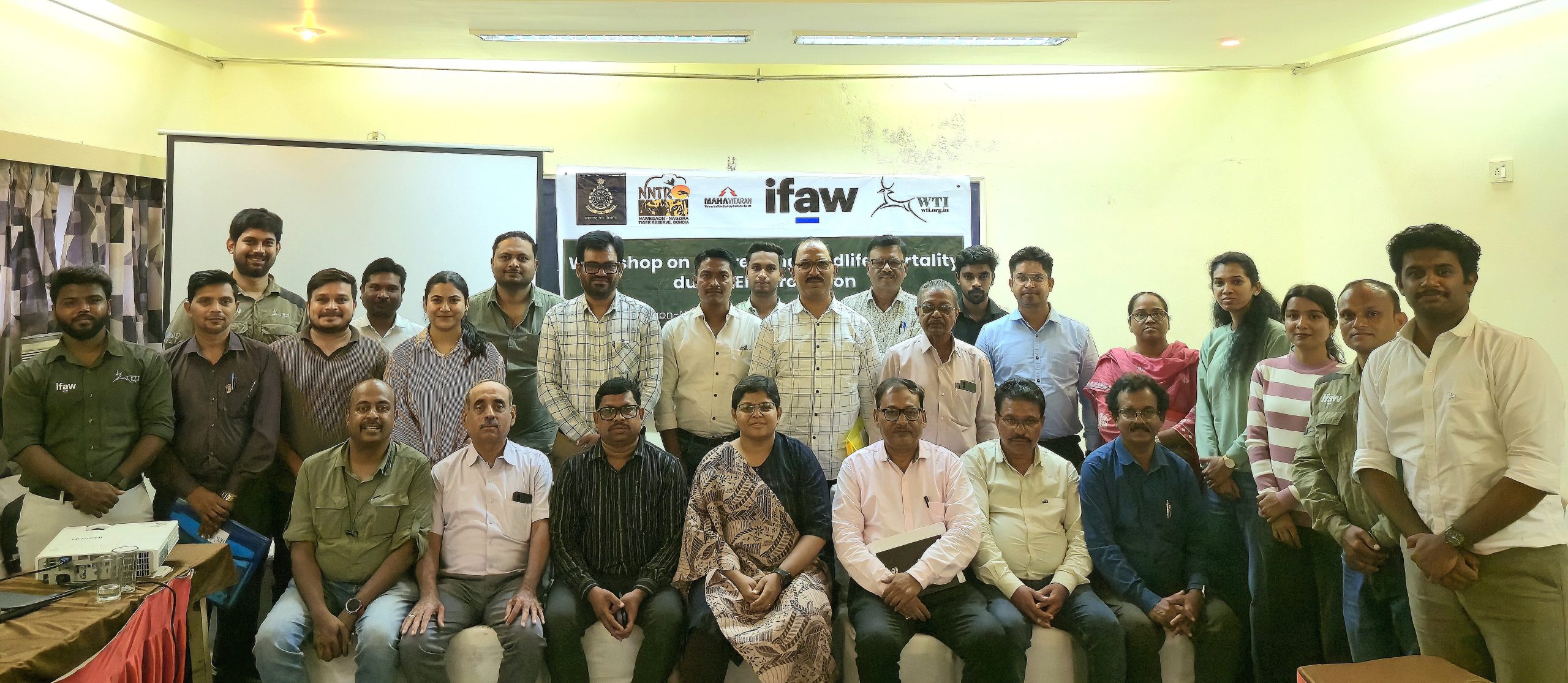
WTI hosts consultative workshop on addressing wildlife mortality due to electrocution at NNTR
Gondia, Maharashtra, 25th June 2026: Wildlife Trust of India (WTI), under its Central India Tiger Corridor Securement Project, organised a day-long consultative workshop titled ‘Addressing Wildlife Mortality due to Electrocution: Challenges and Solutions’ in Gondia, Maharashtra. Conducted in collaboration with the Nawegaon Nagzira Tiger Reserve (NNTR) and supported by the International Fund for Animal Welfare (IFAW), the workshop brought together officers from the Maharashtra Forest Department, Maharashtra State Electricity Distribution Company Limited (MSEDCL), district administration, conservation organisations and field practitioners to discuss practical measures for addressing wildlife mortality caused by electrocution across the Central Indian landscape.
The workshop commenced with a welcome address by Smt. Piyusha Jagtap, IFS, Field Director, NNTR. She emphasised that protecting animals from electrocution must remain the top priority. She noted that ensuring the safety of wildlife is fundamental to recovering prey populations and sustaining the broader ecosystem. Mr. Ankit Thakur, WTI, welcomed the participants and described the meeting as an important first step towards developing practical, field-ready interventions for the Gondia–Bhandara–NNTR landscape.
Between 2018 and 2026, at least 9 tigers were documented to have died due to electrocution in Gondia and Bhandara districts alone. The numbers are likely to be considerably higher when neighbouring landscapes are also considered.
The first session was conducted by Mr. Milind Pariwakam, WTI, who provided an overview of Central India’s extensive corridor network. He explained that NNTR, sitting at the tri-junction of Maharashtra, Madhya Pradesh, and Chhattisgarh, plays an important role in connecting several Protected Areas across the region. His session highlighted that electrocution poses a direct threat to this connectivity, as tigers moving through the landscape, especially young males dispersing from their natal territories, are highly vulnerable to live wire encounters in the agricultural areas that lie between forests.
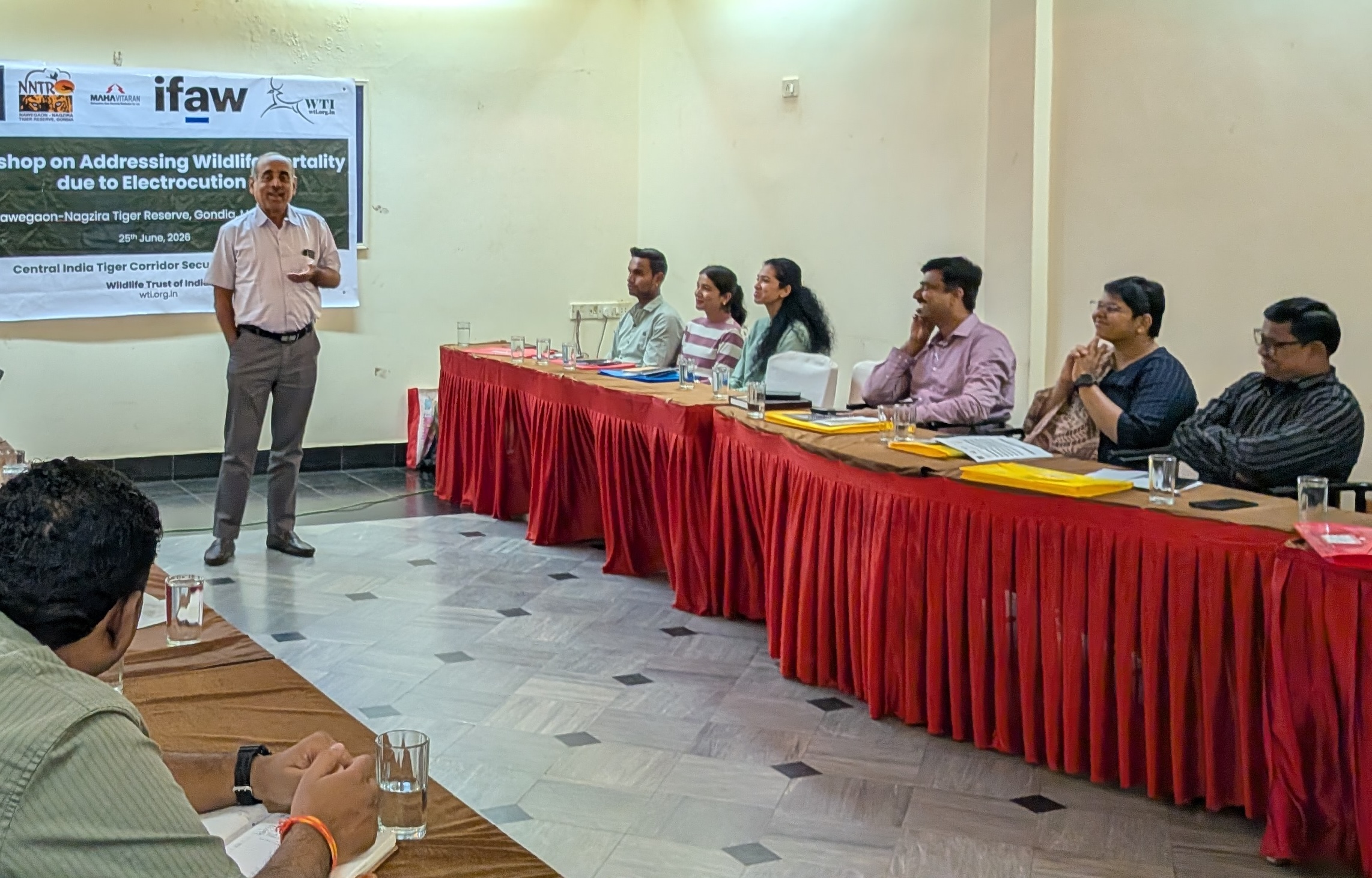
Session on overview of electrocution in India by Mr. Nitin Desai, Director, WPSI | Photo © Team WTI
The second session, delivered by Mr. Nitin Desai, Director, Wildlife Protection Society of India (WPSI), provided a detailed account of the scale and pattern of electrocution incidents across India. He walked participants through the different forms of illegal electrification, the modus operandi used by those setting live wire traps, and the critical gaps in investigation, documentation, and prosecution that allow perpetrators to go unpunished. Drawing on WPSI’s national data, he noted that approximately one in every three tiger electrocution deaths in the country occurs in Maharashtra, underscoring the particular urgency of the problem in this region.
Mr. Desai’s session also addressed the use of electrocution for poaching wild meat. He noted that live wires are now being laid deliberately inside forest areas, in some cases stretching over seven kilometres, tapped directly from 11 kV overhead lines running through forested tracts. He highlighted that those setting such traps have begun tapping into 33 kV lines to avoid detection, aware that electricity department officials monitor 11 kV trip data to identify illegal connections. The workshop also drew attention to the serious human costs of illegal electrification. Farmers returning to their fields before dawn, family members unaware that a fence had been energised, and children straying near field boundaries have all lost their lives to the same wires set out to protect crops. Within a single year, Chandrapur district recorded 13 human deaths linked to illegal farm electric fencing, while seven fatalities were documented from Gondia and Bhandara between 2024 and 2025.
The third session was presented by Mr Idris Ahmed, Field Officer, WTI, who shared findings from joint Anti-Snare and Anti-Electrocution Walks undertaken by WTI in collaboration with the Maharashtra Forest Department across NNTR. The presentation highlighted field observations, the methodology adopted for systematically detecting illegal live wire setups, and the importance of regular joint patrols in identifying threats before wildlife mortality occurs. Drawing on field experiences, he emphasised that if institutionalised as a standard field practice, these walks have the potential to significantly strengthen the detection of illegal electrification and support timely intervention across the landscape.
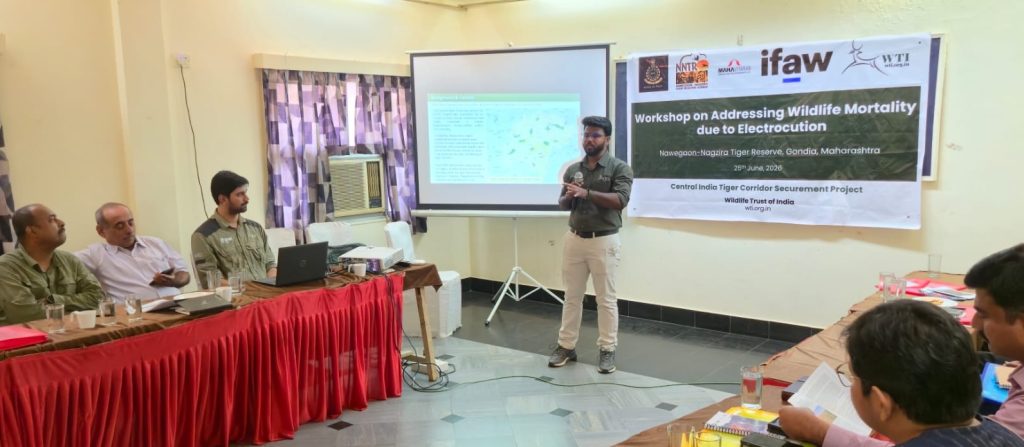
Session on field findings from joint Anti-Snare and Anti-Electrocution Walks, presented by Mr. Idris Ahmed, Field Officer, WTI | Photo © Team WTI
The afternoon open discussion, facilitated by Mr Ankit Thakur, WTI, brought participants together to identify key challenges and develop a shared response strategy. Among the issues discussed were the limitations of routine daytime patrols in detecting illegal live wire setups, the risks associated with conducting patrols at night, the absence of mapped 11 kV power line data for forest areas, weak intelligence gathering at the field level, and an inadequate compensation framework for crop damage. Participants also explored the potential of technology-based solutions, including live wire detection devices, location-based alert systems and drone surveillance, to strengthen monitoring and improve the detection of illegal electrification in high-risk areas.
The workshop concluded with the consolidation of a set of agreed action points. These included conducting joint night operations between the Electricity Department and Forest Department to detect illegal power tapping; invoking enforcement action against violators under Section 135 of the Electricity Rules, 2003; integrating 11 kV line data into MSTRIPES to enable targeted corridor patrolling; establishing a reward-based informer system using MSEDCL linemen with a dedicated confidential contact; piloting drone surveillance in forest-fringe villages to create a deterrent effect; and including solar fencing as an endorsed measure in the micro-plans of Eco-Development Committees, offering communities a safe, legal alternative to illegal electrification.
Speaking at the close of the workshop, Mr. Ankit Thakur, WTI, said, “The Gondia–Bhandara–NNTR landscape presents both a serious challenge and a genuine opportunity. The lessons we develop and test here, on detection, documentation, enforcement, and community engagement, can inform approaches across Central India. Today was a beginning. The real work lies in what each stakeholder takes back to the field.”
WTI’s Central India Tiger Corridor Securement Project works to protect and maintain the functional connectivity of tiger habitats across Central India, where Protected Areas such as Nawegaon-Nagzira Tiger Reserve, Tadoba – Andhari Tiger Reserve, Achanakmar Tiger Reserve and Kanha Tiger Reserve are linked through forests threading across Gondia, Bhandara, Chandrapur, and Gadchiroli. Electrocution in the spaces between these reserves, where tigers disperse between habitats, remains one of the most significant threats to maintaining landscape connectivity.