Project Info



Project Description
The Wildlife Trust of India’s Hangul Recovery Project aims to secure hangul corridors in the Kashmir Himalayas, enabling safe movement between fragmented habitats and restoring connectivity across the once contiguous population of the species. The project seeks to achieve this by generating precise knowledge on corridor usage, identifying the prevalent threats and protecting the population from these threats by taking appropriate measures, especially by involving local communities, the local government and non-government organisations.

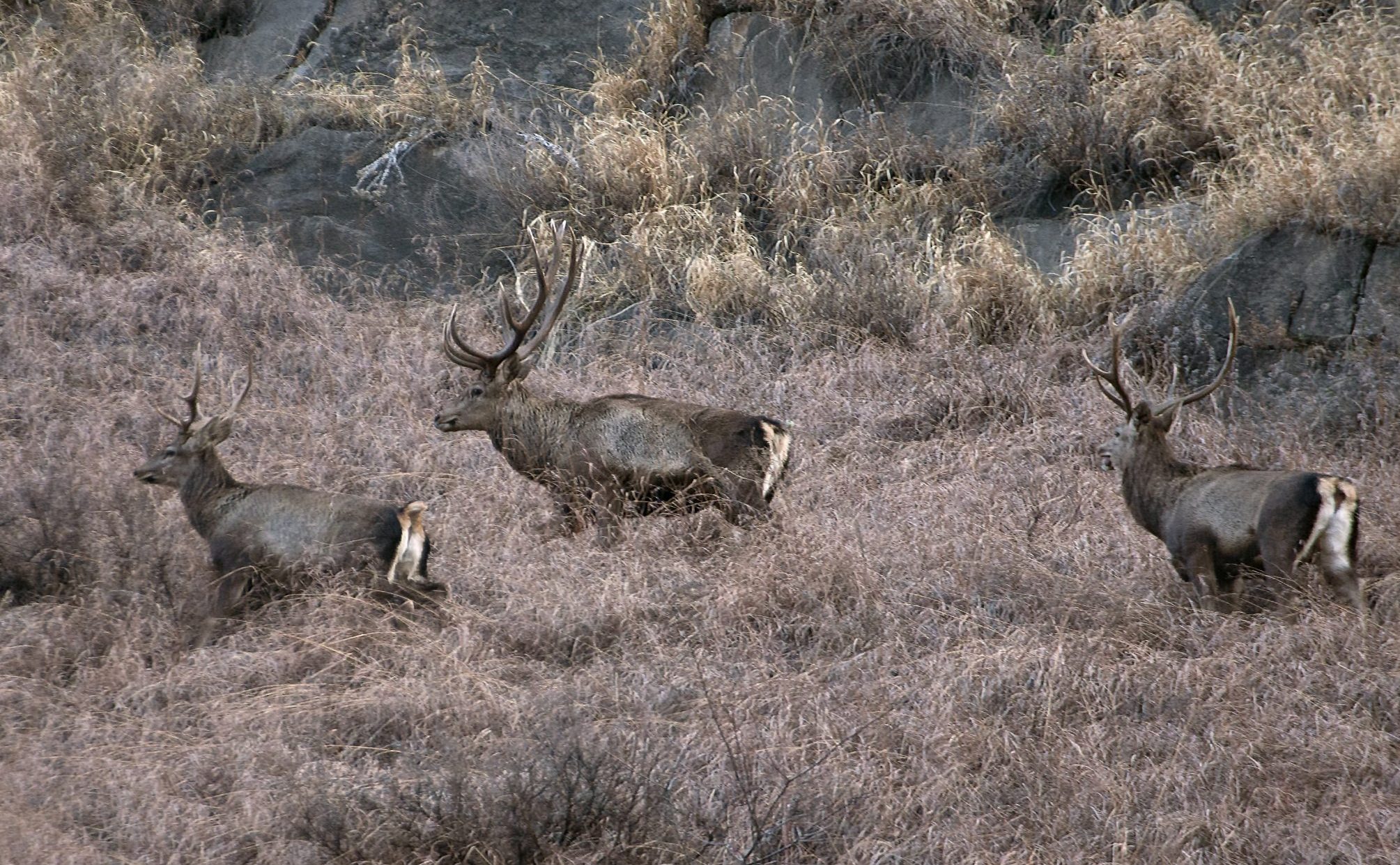
Hangul | Photo © Dr. Tanushree Srivastava/WTI
The Hangul (Cervus hanglu hanglu) is the only subspecies of the red deer found in the Indian subcontinent, and is endemic to the Union Territory of Jammu and Kashmir. The species is listed in Schedule I of the Wild Life (Protection) Act, 1972 and categorised as ‘Critically Endangered’ under the IUCN Red List of Threatened Species.
Ranging in numbers from 3000 to 5000 at the beginning of this century, the population has faced a drastic decline in the last four to five decades. Poaching, competition with livestock, and loss of connectivity between the populations due to habitat degradation and fragmentation have been the major reasons for the decline. The current population has been put as 263 adult individuals, based on the last census carried out in 2021 by the Department of Wildlife Protection, J&K. Once continuous, the only viable population of hangul in Dachigam National Park seems to be mostly disconnected from other smaller populations occurring in Shikargah, Tral Wildlife Sanctuary, and Overa Wildlife Sanctuary. A few other smaller populations exist in its historical distribution range.
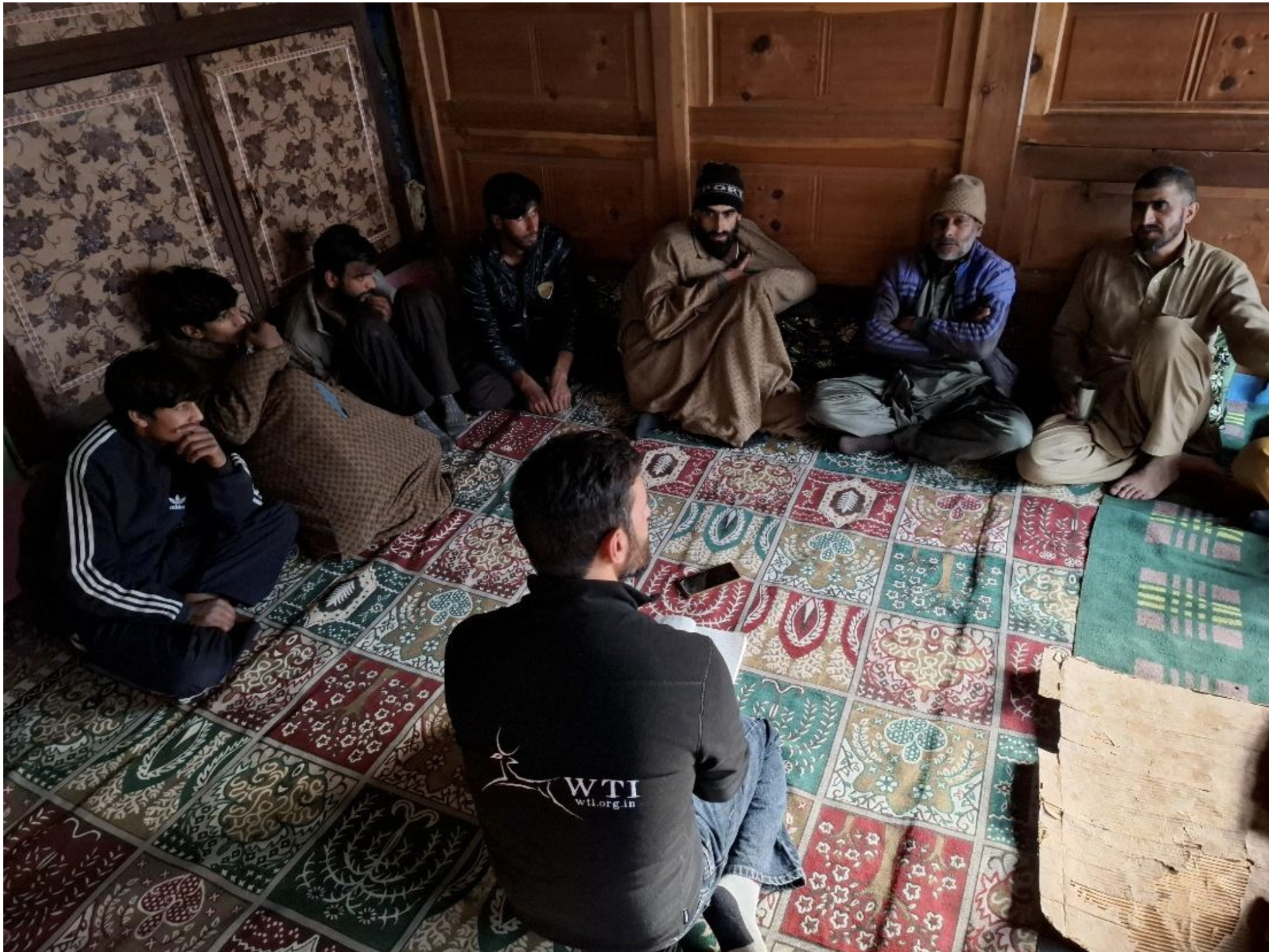
Focused Group Discussion with local communities in the Wangath–Naranag Complex as part of community-based Hangul conservation efforts | Photo © Aamir Rasool/WTI
In recent years, WTI has conducted extensive surveys in potential sites outside Protected Areas (PAs) to assess the presence of hangul. These surveys have identified several locations across North, Central, and South Kashmir—specifically in the districts of Kupwara, Bandipora, Ganderbal, Pulwama, and Anantnag—where hangul presence is considered plausible. The team has also mapped key corridors used by Hangul to move in and out of Dachigam National Park. These corridors require long-term restoration to maintain connectivity between the Dachigam population and the remaining smaller populations. Additionally, the team has identified several meta-population habitats outside PAs that serve as important wintering grounds for the species.
Overall, the surveys revealed that a few corridors are fragmented, and the species does use non-PAs during winter. Given the presence of multiple landowners in these corridor regions, it is crucial to engage all stakeholders and build a shared consensus to ensure safe passage for hangul across their summer and winter habitats.
Based on these results, WTI is aiming to protect the species and its corridors through long-term measures to allow safe passage through these corridors and reduce direct threats like poaching during their movements.
The 2025 Hangul census conducted by the Department of Wildlife Protection, Jammu and Kashmir, recorded a population of 323 individuals, the highest in decades, reflecting a significant conservation success and a substantial increase from the 127 individuals recorded in 2008. WTI is working in close collaboration with the Department of Wildlife Protection, Jammu and Kashmir, and other local stakeholders to develop a comprehensive Corridor Securement Plan in the near future.
PARTNERS: Serenity Trust, Department of Wildlife Protection, Jammu & Kashmir
PROJECT LEAD: Dr. Tanushree Srivastava