How birds found me in a small cat’s world
Mammals had always been my world. Even now, they remain the core of my work. But birds? Birds were frustrating. Chaotic. Unpredictable. They would vanish in the blink of an eye, leaving me with nothing but an empty frame and a sigh of defeat. I never imagined that I’d one day enjoy chasing birds.
When I joined WTI’s “Forgotten Cats of Seinthuk” project, I was thrilled to work on small cats in this unique landscape, alongside the community. My eyes were set on spotting small cats and studying the mammals of this region. Bird-watching wasn’t even on my radar, and I often wondered what made people go wild over birds. Funny enough, it was a bird that first sparked my interest in wildlife – the sarus crane. Strange, right? At that time, I was interning in the Etawah and Mainpuri districts of Uttar Pradesh. Witnessing the sarus crane’s graceful dancing behaviour during its breeding season stirred something in me. The experience marked a turning point, and I transitioned from studying ecotoxicology to exploring the world of mammals, or more specifically, small cats.
One winter morning, while staring at the lofty mountain behind the Wildlife Trust of India’s field station in Seinthuk, I saw a few tiny birds chirping and dancing on the twigs of a plum tree. Out of curiosity, I ran to grab my binoculars and camera and managed to click a picture. They were tiny birds with greenish backs and bright yellow bellies. Just as I was admiring their beauty, another bird appeared – this one orange with a blue head and back, and perched right in front of me. Hoping to capture a good shot, I clicked again.
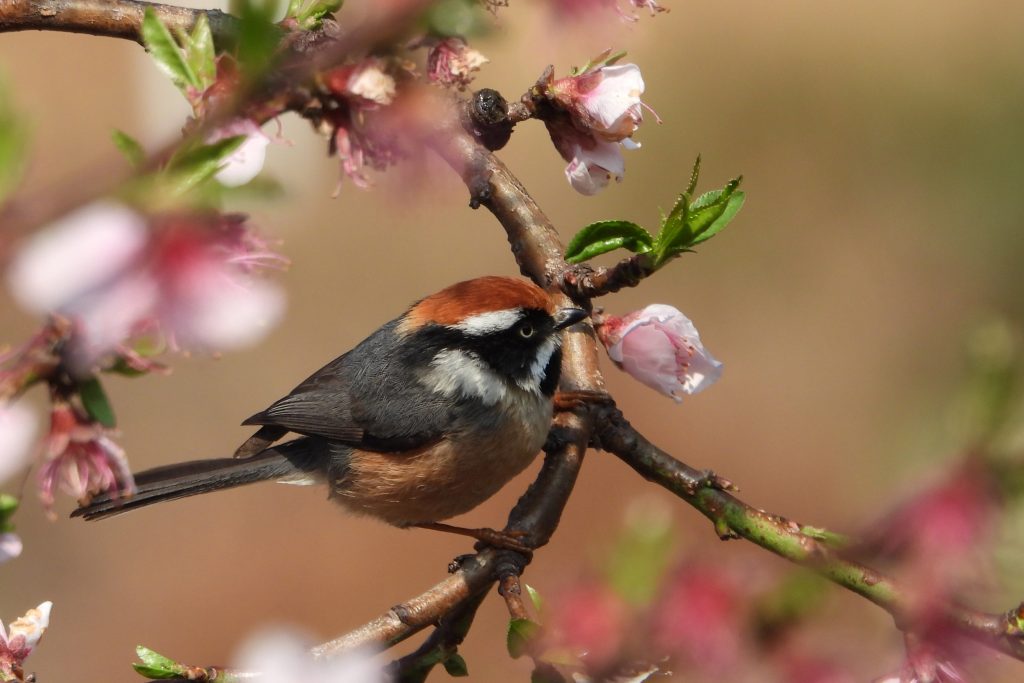
Black-throated tit (Aegithalos concinnus) | Photograph by Suranjta Roy/WTI
With no clue what these birds were and honestly, too lazy to look them up on the Merlin application, I turned to the easiest way to ID them – I sent the photos to a few experienced birders.
That’s when I realised, I didn’t need to be a “birder” to enjoy birding. I could find my own way. What had held me back all this time was the pressure to identify them immediately, like how seasoned birders do– spotting birds, naming them within seconds, making a checklist, scanning through binoculars, and chasing that perfect spot.
I simply wasn’t there yet. I need to start slow. Birding around. Note down what I could and build from there.
That moment of realisation opened up a whole new way of seeing this landscape beyond the small cats I had come here for.
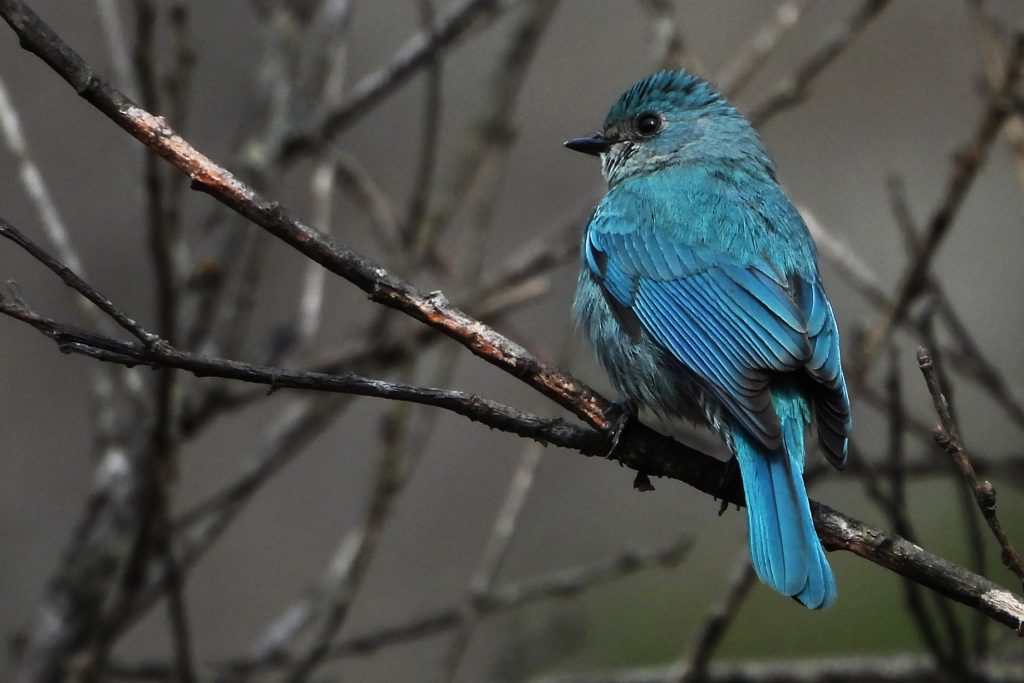
Verditer Flycatcher (Eumyias thalassinus) looks as though it has been dipped in blue paint. It belongs to the group of Old-World flycatchers | Photograph by Suranjita Roy/WTI
A trip to the bird paradise – Eaglenest Wildlife Sanctuary (EWS)
Ever since I first heard of EWS, which is known as a paradise for birdwatchers, one particular bird kept coming up in every conversation – the “Bugun liocichla”. And if you say you visited Eaglenest, the immediate question people ask is, “Did you see a bugun?
After some research, I learnt that the bird was named to honour the local Bugun community. This was a bird that not only brought recognition but also a source of livelihood in the form of tourism for the people. Found only in that specific stretch of forest, it felt more than just a bird; it was a symbol. “I want to see the bird at least once,” was the thought that crossed my mind.
Well, with that, I set off on my first birdwatching vacation – a four–day trip to the Eaglenest Wildlife Sanctuary. Just as we entered the sanctuary, there was a sudden rush of bird calls from every direction. As a beginner in birding, all I remember saying was, “Where?”, “Which bird?”, “Why am I not able to see it?”, “Oh, wow”.
Before I knew it, I had started behaving like a birder – chasing after shots, trying to keep a checklist, and constantly asking for IDs.
While the search for the Bugun liocichla (Liocichla bugunorum) continued, I found myself following the footsteps of senior birders, making sure I didn’t miss anything.
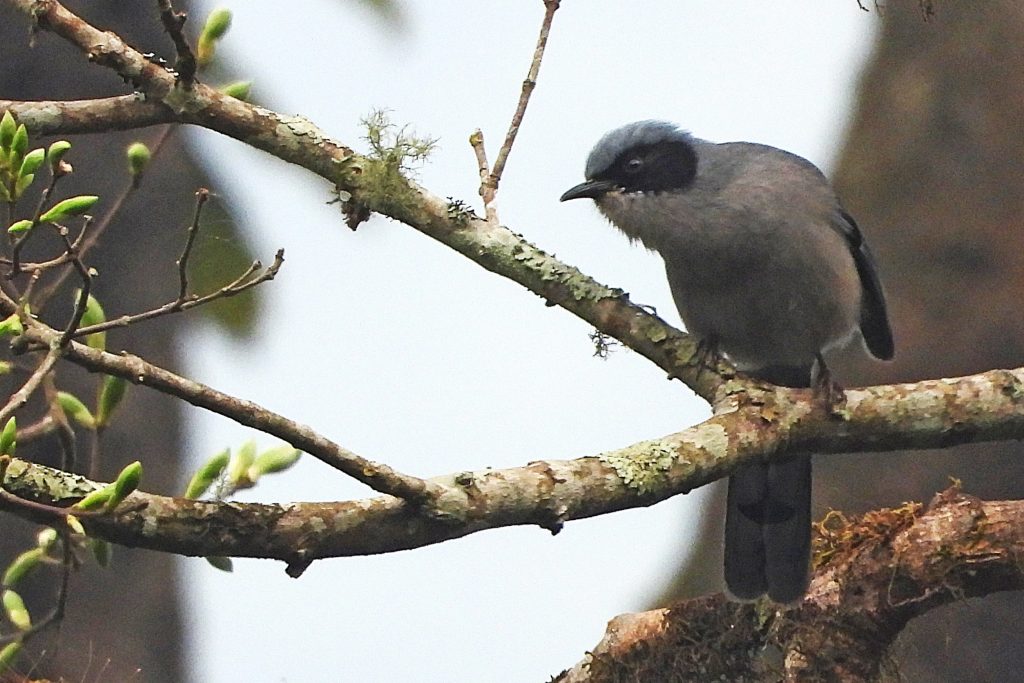
Beautiful Sibia (Heterophasia pulchella) | Photograph by Suranjita Roy/WTI
Seinthuk – A promising new bird-watching destination
Seinthuk (also known as Shergaon) in Arunachal’s West Kameng district is one of the most biodiverse areas in the Eastern Himalayas. Just adjacent to the Eaglenest Wildlife Sanctuary (EWS), the forests of Seinthuk are owned by the Sherdukpen community. The continuous forest patch connecting Seinthuk with Assam and Bhutan has contributed to its unique biodiversity. Being adjacent to EWS, it shares many similar species but also holds some surprises of its own.
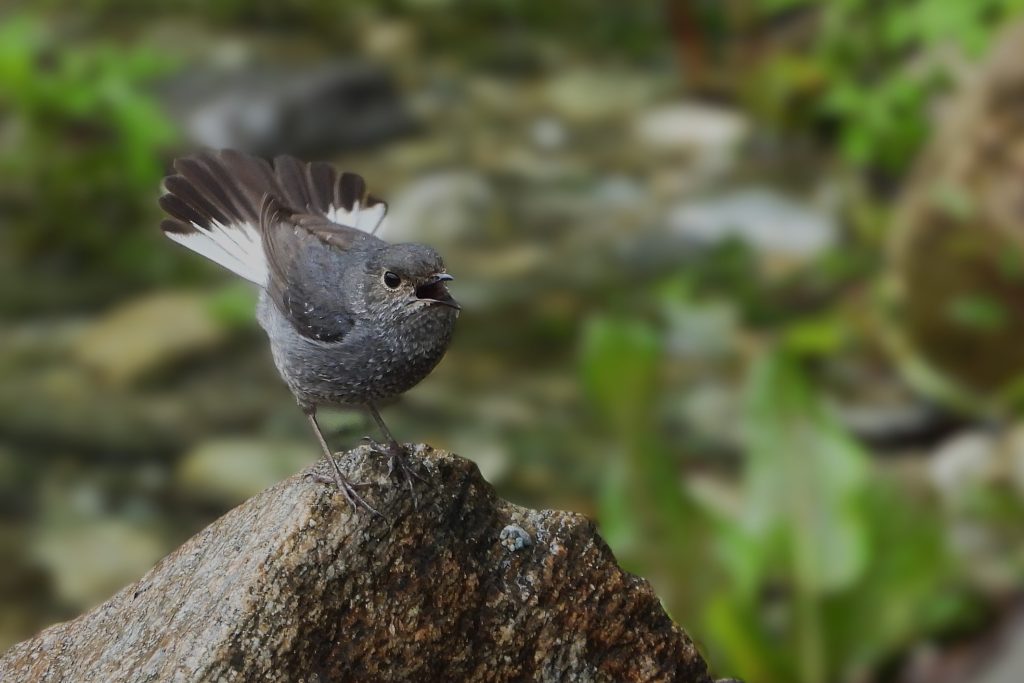
Plumbeous redstart (Rhyacornis fuliginosa) is a passerine bird from the Old-World flycatcher family Muscicapidae. In India, it is mostly found in the Himalayas and Northeast India. In the above picture, a female is displaying tail bobbing | Photograph by Suranjita Roy/WTI
Bird enthusiasts would often express their unfulfilled desire to work in the Himalayan landscape, and I’d smile politely, still unsure why they meant so much to them. That was until I went there myself and started birding.
Seinthuk seems to hold a rainbow in its canopy – bringing all the colours in the form of birds. The fiery red of the scarlet minivet (Pericrocotus speciosus), the vibrant orange of the ruddy shelduck (Tadorna ferruginea), the bright yellow of yellow-breasted greenfinch (Chloris spinoides), the rich green of the wedge-tailed green pigeon (Treron sphenurus), and the striking blue of the verditer flycatcher (Eumyias thalassinus).
Walking along the stream, you can come across species like the crested kingfisher (Megaceryle lugubris), common kingfisher (Alcedo atthis), gray–headed canary-flycatcher (Culicicapa ceylonensis), grey-hooded warbler (Phylloscopus xanthoschistos), brown dipper (Cinclus pallasii), white wagtail (Motacilla alba), white-capped redstart (Chaimarrornis leucocephalus) and the list goes on. The diversity shifts with changes in altitude and vegetation. A slight increase in altitude and you’ll find birds like the common rosefinch, white -throated fantail and more.

The Eurasian Hoopoe (Upupa epops) is widely spread across Europe and Asia, and has been the subject of various legends and myths. In some cultures, it is believed that the Hoopoe can bring rain or ward off evil spirits | Photograph by Suranjita Roy/WTI
Much of the forest here remains untouched, and the ban on hunting by the Seinthuk Village Council has played a vital role in preserving the rich diversity of birds. The landscape feels like a scene from a Studio Ghibli film – lush forests, clean water, birdsong filling the air, a slow pace of life, and far fewer tourists compared to other birding hotspots. The geographical location of the landscape has further enhanced its appeal to birds and birdwatchers alike.
Developing ecotourism centred around birdwatching and mammal watching will play a vital role in preserving biodiversity and protecting habitats. Birds are highly sensitive to habitat destruction and will not remain if the ecosystem deteriorates. Furthermore, ecotourism can provide sustainable livelihoods and greater recognition for the local community.

Bhutan laughingthrush (Trochalopteron imbricatum). True to its name, the bird is commonly found in Bhutan and some adjoining parts of NE India | Photograph by Suranjita Roy/WTI
Seinthuk will always hold a special place in my heart. Just as Etawah sparked my interest in mammals, Seinthuk has given me the courage to start and learn something new on my own. I’ve also come to realise that there are no such rules in birding. You simply do it in a way that works for you. For me, it’s about spotting the bird and clicking a decent picture to ID it later. I still don’t know half the birds out there, and I often turn to more experienced birders for help with identification. But that’s perfectly fine. Everyone moves at their own pace, and that’s part of the journey.
From tracking pugmarks to chasing birds, an unexpected chapter has been added to my journey as a researcher. I now find myself asking scientific questions about birds as much as I do about mammals.
But if you ask me – birds or small cats? I’d still choose my old love: small cats.
Until then, happy birding!
by Suranjita Roy, Biologist, Forgotten Cats of Seinthuk