Journey from rivalry to guardianship
At the crack of dawn, Marge moves into the forest with nothing but a torch and a eyok (machete) strapped across his body. Upon entering 200 mtrs inside the forest, he discovered a fresh elephant footprint, deep and round, pressed into the damp soil leading up to the riverbank. A small footprint could also be seen following and overlapping the bigger one. “They must have crossed the river last night. There must be a calf as well”, Marge murmurs to himself. He knelt down, clicked a photo of the print, geo-tagged it and immediately shared it in a WhatsApp group called “Plantation Watcher WTI” with a caption “Paglam restoration mein haathi ka nissan. Maa aur Bachcha hai” (Elephant footprints have been sighted in the Paglam restoration area— a mother and her calf).
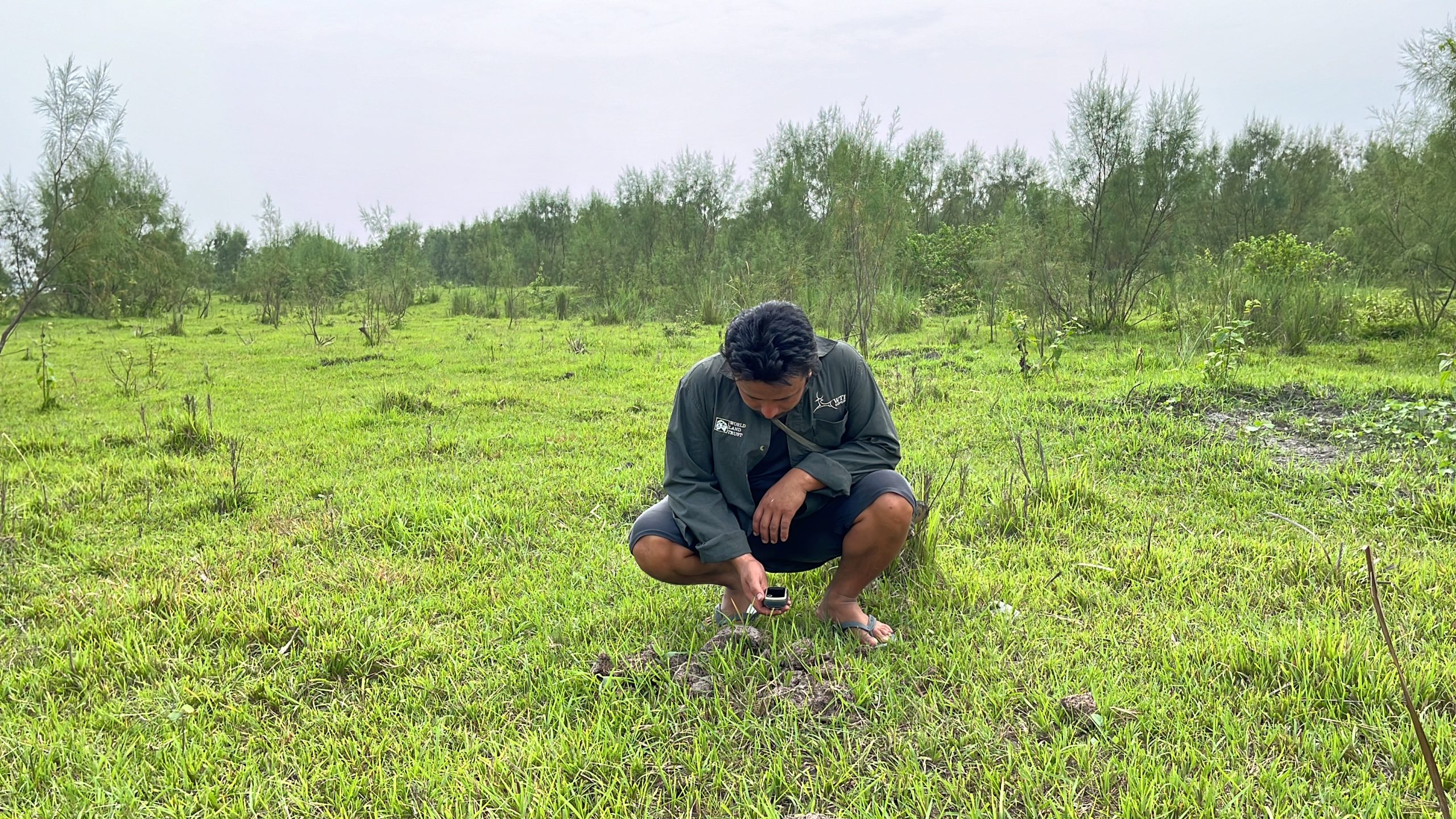
Documenting elephant dung with geo-tagging in the DDS corridor area. | Photo by Dindi Padi/WTI
Before becoming the guardian of the corridor
In his memory, Marge had always associated elephants with giant intruders in their village. He has grown up witnessing elephants bring the chaos into the calm of their quaint home. Every visit from one of the largest land mammals meant another tale of raided crops, damaged houses, or, in the worst cases, “a casualty” of both human and animal during such conflict situations.
Born and brought up in Paglam village in Arunachal Pradesh, which is situated at the fringe of the D’Ering- Dibru Saikhowa elephant corridor, Marge, who is now 35 years old claims he grew up perceiving elephants as a threat. He would be tasked to drive the elephants out of the village vicinity with fireballs made of coconut ropes and lit with kerosene. He recalls the time when a group of villagers, including himself, drove a herd of around 150 elephants from their village and back into the bordering Dibru Saikhowa National Park in Assam. Marge would remain vigilant, especially during the harvest season, patrolling at night, camping at machans (elevated resting camp) and night camps while quietly observing the movement of elephants through the sounds and motion coming from the silent forest. To him, their presence was always felt, even at a distance. Ridden by the terror of elephants threatening their livelihoods every season, for Marge, their conservation was never a cause Marge felt compelled to serve.
D’Ering- Dibru Saikhowa elephant corridor
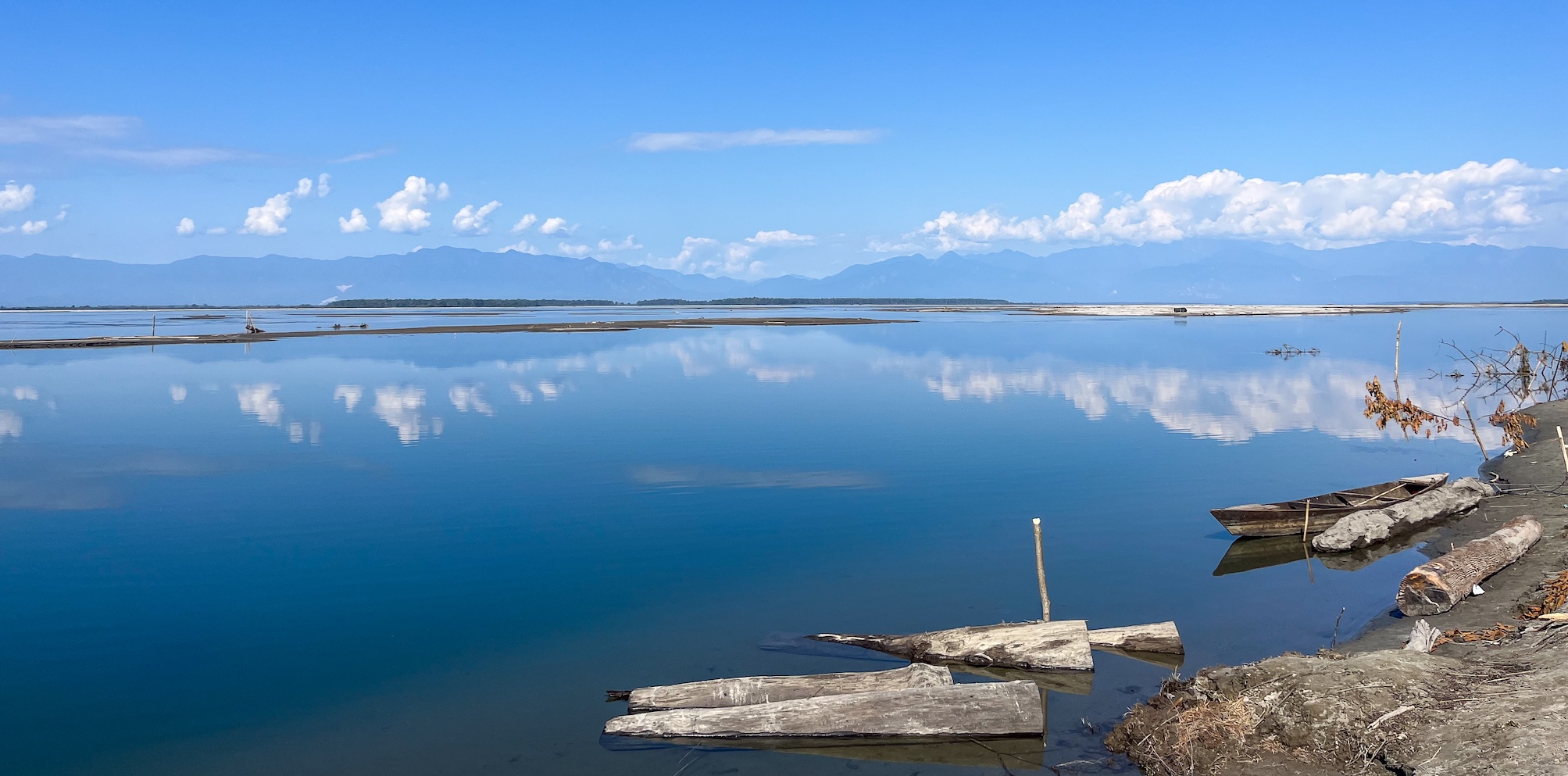
Located along the river basin and flood plains of the Siang River in Arunachal Pradesh and the Dibru River (tributary of the Brahmaputra) in Assam, the D’Ering- Dibru Saikhowa elephant corridor is a transboundary passage for elephants to move between the D’Ering Wildlife Sanctuary in Arunachal Pradesh and Dibru-Saikhowa National Park in Assam. This corridor supports the movement of approximately 150–200 Asian elephants (Elephas maximus) and other wildlife between the two Protected Areas (PAs). The riparian landscape makes this corridor a complex living passage for both humans and animals due to its ever-changing nature along the shifting river routes. Conserving a wildlife corridor is never simple, and conserving the kind that keeps on shifting is even more complicated. The shift in the flow of the river changes the natural landscape, thus affecting the wildlife movement in the landscape.
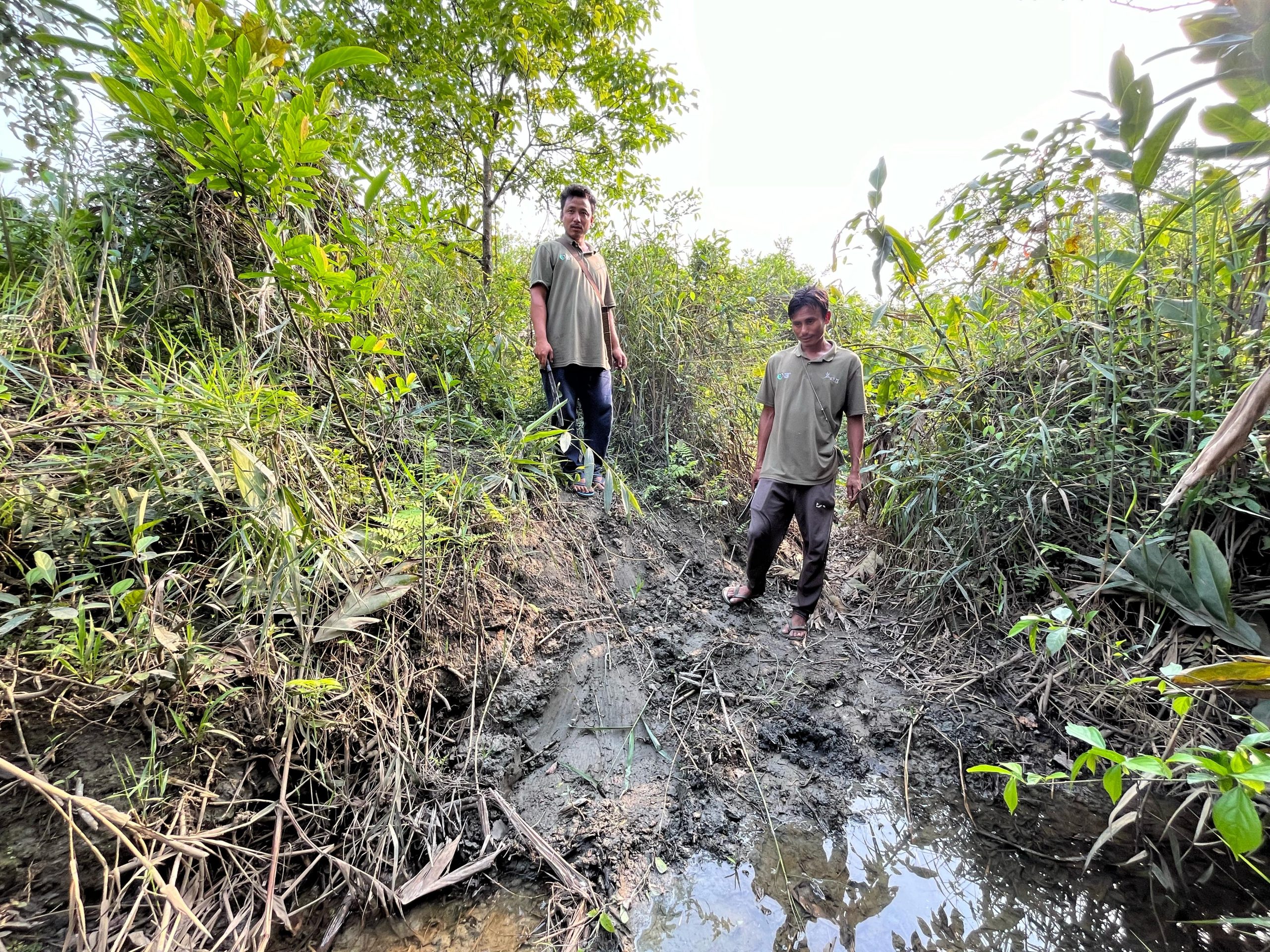
Elephant footprints observed along the stream at Paglam Restoration Area by Marge and Sanjib (Restoration Watcher) | Photo Credit: Dindi Padi/WTI
In 2019, with the support of the World Land Trust (WLT), Wildlife Trust of India (WTI) initiated the D’Ering- Dibru Saikhowa (DDS) elephant link project to secure and restore the said corridor through a community-based conservation approach. The project focused on securing at least 500 ha. of community-owned land in Mer, Namsing, and Paglam villages, which fall under the critical part of the DDS elephant corridor, to be notified as Community Reserves under Section 36C of the Wild Life (Protection) Act, 1972. Under this project, approx. 180 hectares have been restored through the plantation of 140,000 saplings, representing 34 native species. These restoration sites are maintained and monitored by the local guardians, also known as restoration watchers, to ensure biodiversity monitoring for the successful habitat restoration in the corridor area.
In becoming the guardian of the corridor
Once known for driving elephants away from the village, today, Marge’s priorities have shifted to reporting the elephant signs and sightings. One of his primary responsibilities is to document elephant movement and update it in the WhatsApp group. He is currently serving as a restoration watcher for WTI in this landscape. This role was entrusted to him by the villagers, who nominated his name because of his prior experience in interacting with elephants, especially during high human-elephant conflict situations. As an appointed guardian of the elephant corridor, Marge has learnt to understand the elephants’ language both inside and outside the forest area through signs and sounds. A walk into the forest with sightings of the tangible marks like elephant dung, broken branches, mud on tree girth, crushed grasses, and footprints helps Marge to identify the elephant trails and direction of movements. While the variation in elephant calls reflects the state of the herd, during the conflict season, identifying these signs enables Marge to alert the villagers about their presence in the area, helping to avert potential conflict risks at the earliest.
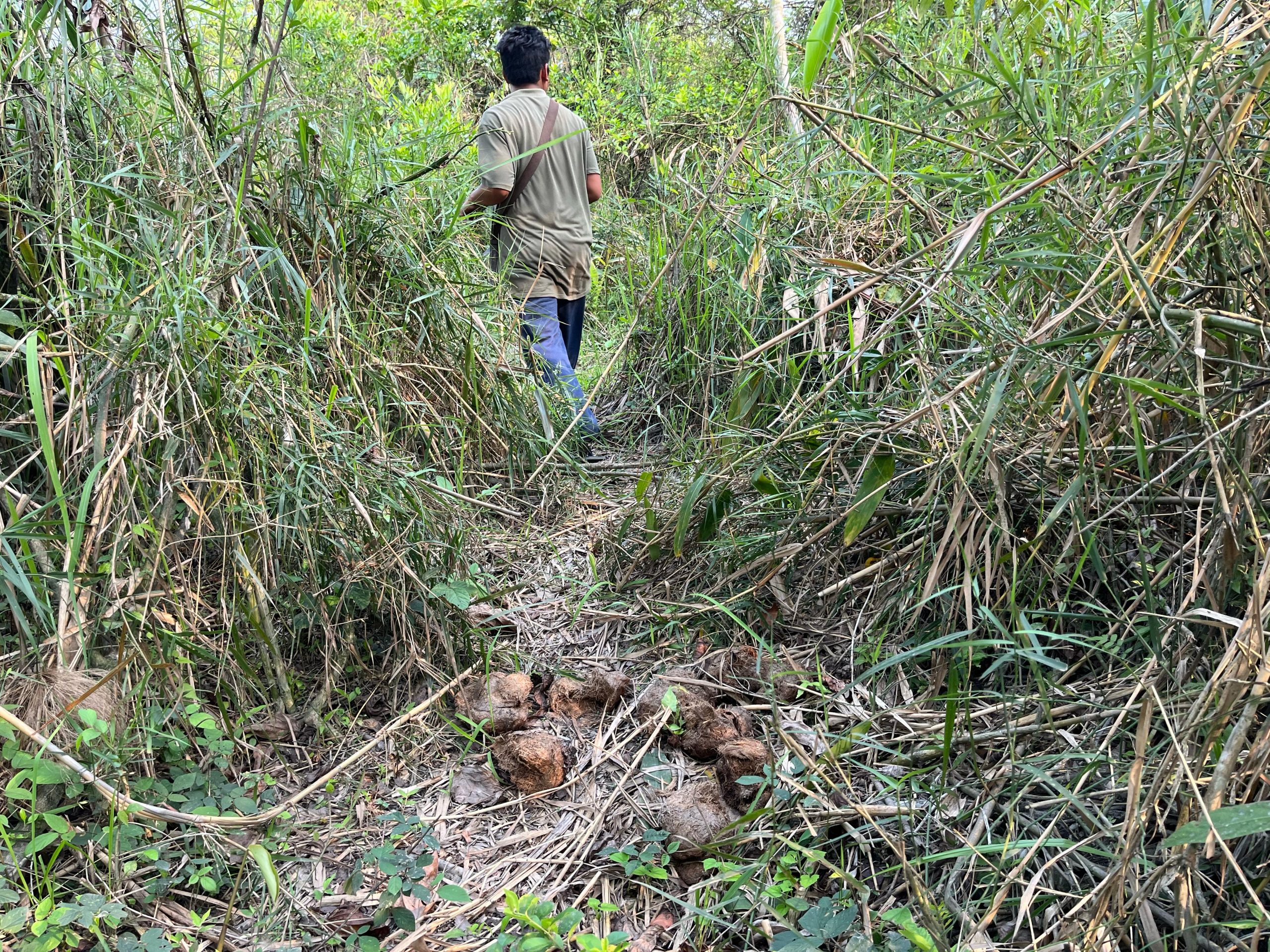
Elephant dung observed in the Paglam Restoration Area, indicating recent activity. | Photo by Dindi Padi/WTI
As a restoration watcher, Marge’s encounters with elephants have shifted from reactive fear to empathetic responsibility towards the elephants. In his journey from a lay villager to the guardian of the elephant corridor, he reflects on the lessons learned through active engagement in elephant conservation action. The shouts and waving of fire torches at the sight of elephants have turned into silent observation and careful tracking of their trail marks. Even using a soft beam of light, just enough to signal their presence before retreating, proved effective in initiating coexistence. Guardians like Marge play a crucial role in strengthening community stewardship for sustaining wildlife conservation.
“To be honest, there’s always a sense of fear when you hear elephants breaking barks inside the forest. However, witnessing a footprint stamped into the water-clogged clay the next morning brings a sense of relief, ”Marge said with a smile before moving ahead.
Story by Dindi Padi, Field Officer, D’Ering- Dibru Saikhowa (DDS) elephant link project, Wildlife Trust of India