Out in the field – mangrove restoration in Muzhappilangad
It was a bright, sunny day when we set out for our mangrove restoration site in Muzhappilangad last week. Rajan, our boat driver, had already tied his two boats together and was waiting at the banks of the Anjarakandi River, ready to ferry us across. Joining us were six locals, both men and women, who would be helping us plant the mangrove saplings we had brought along. These villagers, employed under the MGNREGA scheme,were regular contributors in our restoration work.
Our restoration site lay in the middle of the Anjarakandi River, on a large mangrove island that split the river into two. There were eight of us divided between two boats that were secured together for the journey. Our intern, Gopika, looked a little nervous. She was not a swimmer, and the thought of the boat toppling over was understandably scary. I teased her, saying “We might have to swim a little to reach the restoration site as the boat might not make it all the way to the banks”. Her eyes widened in fear. “Ehhh!” she exclaimed, while everyone burst out laughing. The chechis (meaning sisters in Malayalam) comforted her, assuring her that I was only joking and that she would be brought back safely.
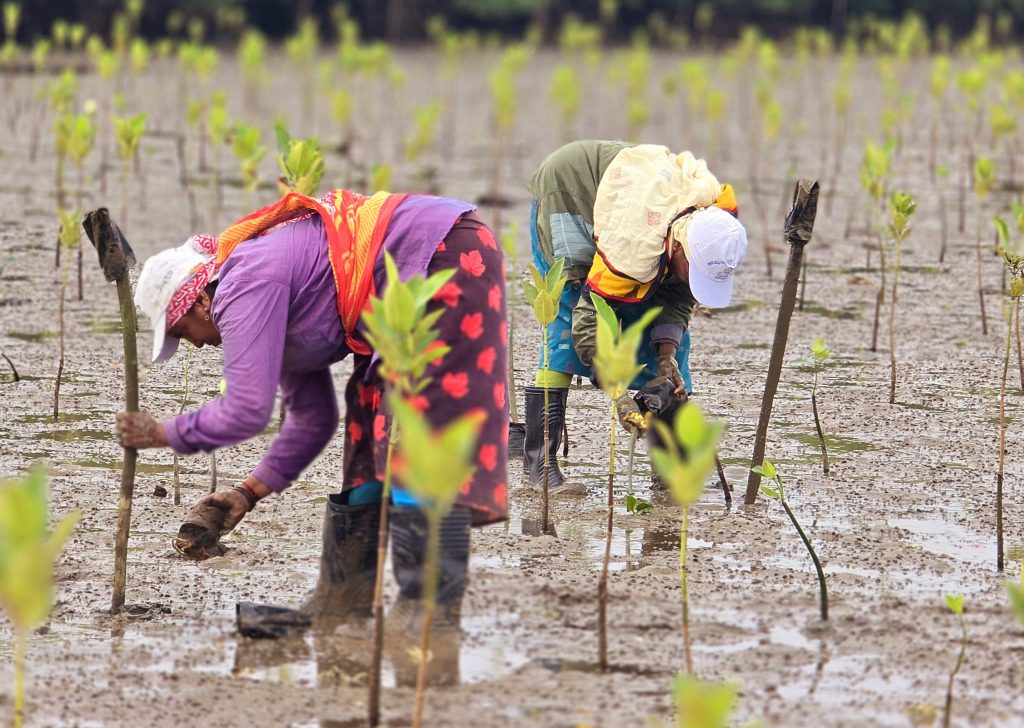
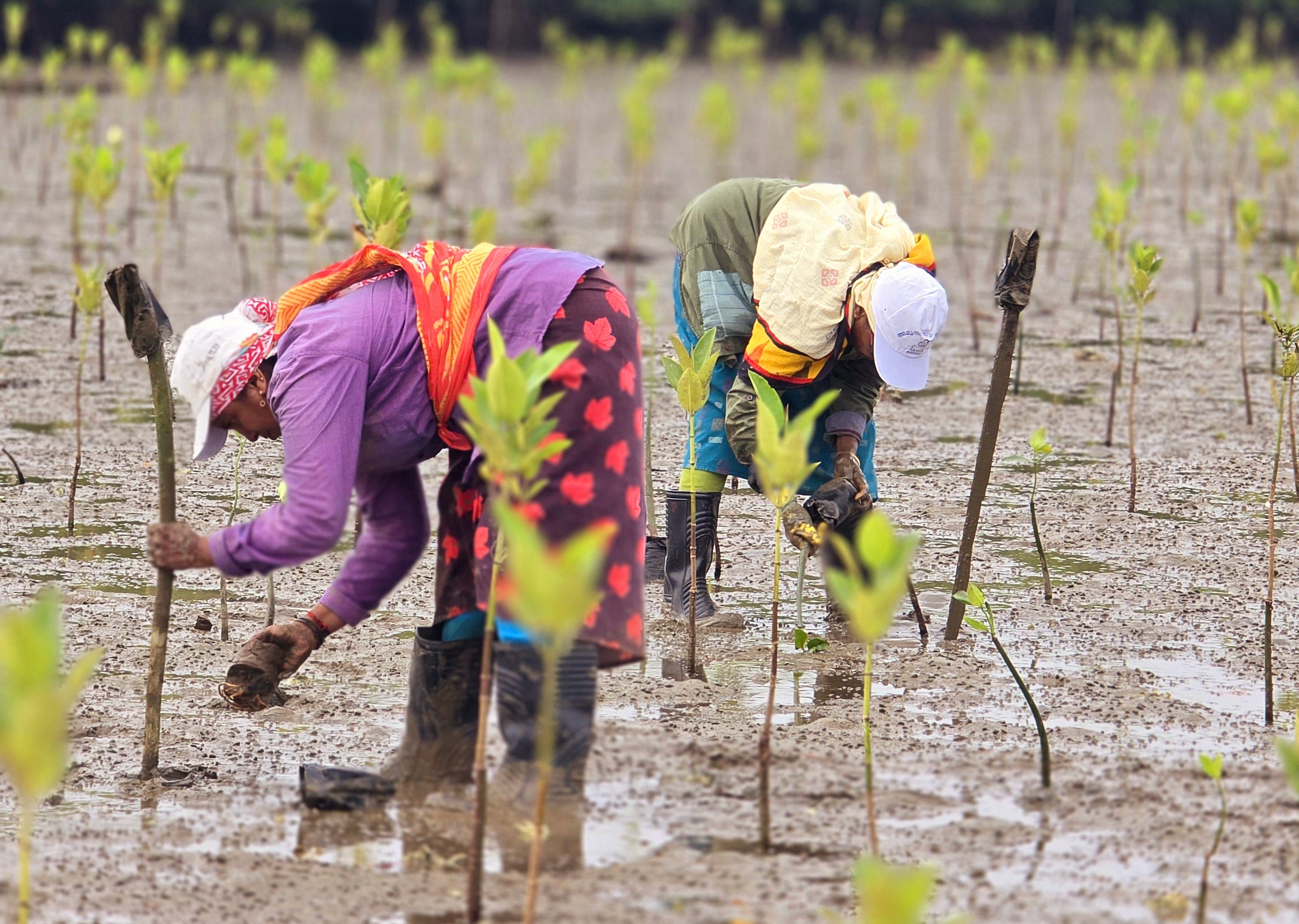
Chechis planting new mangrove saplings in in Muzhappilangad Island
Under the elements
We had covered our hands with arm sleeves and donned caps in preparation for the journey. The sun was usually harsh at this time of day, and the wind hot and salty. It felt like a sauna under our clothes. After about a ten-minute ride, we reached the location. It was low tide, and the water had drained completely from the banks, exposing a considerable swath of it. I noticed that the saplings from last year had now grown up to my waist – their shiny leaves swaying gently in the cool breeze drifting in from as far as the Arabian Sea.
The moment I stepped off the boat, my gumboots filled with water and mud. I loved how it made funny squelching sounds as I walked ahead. We unloaded the saplings, and meanwhile, Rajan untied one of the boats and rowed ahead to a different part of the mangroves.
Planting mangroves – one sapling at a time
Soon, we bagan planting. The chechis carried long sticks, twirling them into the mud to make pits, deep enough to plant the new saplings. At one of the pits, I noticed the water slowly filling in, and within seconds, a crab emerged and scuttled away. I waited for a while before placing the sampling I was holding into the cleared spot.
There were tiny crabs everywhere, inspecting our new plants like little watchmen! Small Bittium snails dotted the area as well. I picked one up to take a closer look. When I asked a chechi what they were called locally, she smiled and said, “Konkaran!”.
A few of the saplings were already covered with barnacles – highlighting one of the biggest challenges here. The barnacle shells are razor sharp and can easily cut your feet if you’re not careful. I have had the unfortunate experience more than once.
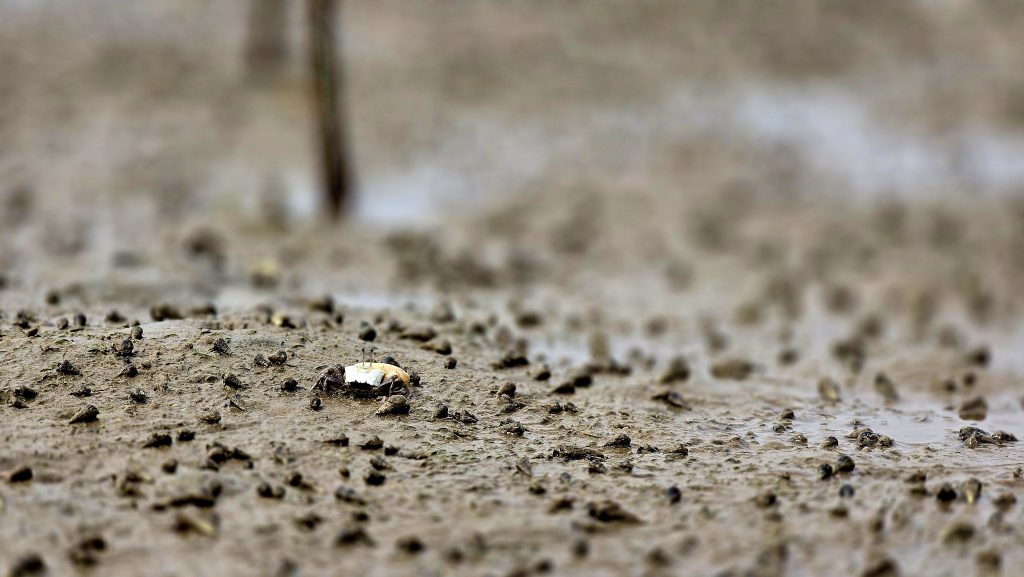
Fiddler crabs in the mangrove restoration site in Muzhappilangad
Of Life and Livelihood
As I walked farther from the group, checking the mangrove forest beside the site, I noticed a bat hanging upside-down from a branch, watching me intently. Mangroves have always put a smile on my face. Home to several other species, these forests are crucial for the survival of both the local biodiversity and the community that depends on them.
Suddenly, I heard Gopika shouting, “Chetta! (Brother in Malayalam) I fell down—please help!” I turned around to see everyone gathered around her. Her legs had sunk deep into the mud, and she couldn’t pull herself out. She had fallen into a muddy stream. We immediately helped her out, and gently reminded her to tread more carefully.
Not far from where we stood, a few locals were collecting clams. Their tiny boats were parked by the bank, and they chatted loudly while sorting their catch.
One with the elements
A deep and peaceful silence had settled over the area, broken only by the distant hum of vehicles. NH 66 was close by, and the passing traffic was a reminder that even in this quiet world of mangroves, life outside still had a lot of catching up to do.
As evening approached, a single drop of rain fell over my left eye and rolled down my cheek like a tiny river. The air had begun to cooler as well. The chechis had almost completed their quota for the day, and just in time, Rajan reappeared from the other side of the river, slowly making his way towards us. We collected the polythene covers that were removed from the saplings, washed them in the river, and packed them into a big sack to be taken back with us. We noticed the tide had receded so much that the other boat was now stranded on land. We had to push it back into the water, secured it again to the companion boat, and climbed aboard.
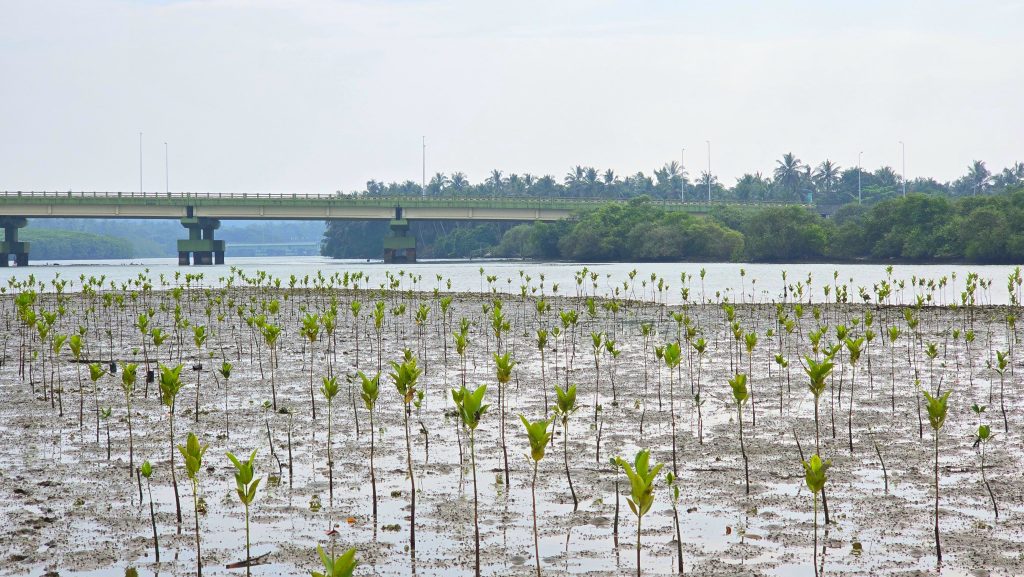
Mangrove restoration site in Muzhappilangad with the highway in the background
I looked back once more before boarding. The crabs had already started drawing their delicate patterns across the mud – tiny artworks that would be erased by the next high tide. I knew the same scene would unfoldtomorrow, and the next day, and the day after that. The snails were out again, fully active in their muddy kingdom. With our hearts full, we rode back to land – with a smile on our faces and quiet satisfaction of a good day’s labour behind our tired eyes.
Story and photographs by Vimal Lakshmanan, Field Officer, Kannur Kandal Recovery Project, Wildlife Trust of India