Rapid conservation actions to protect migratory birds in India
Migration– characterised by long-distance and repeated movements often linked to seasonal changes in temperatures or precipitation is among the most striking natural phenomena in the animal kingdom. While this behaviour is exhibited by a range of animals and in different forms, some of the most familiar and extreme journeys are undertaken by birds. Typically, birds migrate twice a year between their breeding and wintering grounds, sometimes travelling across thousands of kilometres and crossing multiple countries and continents. Being energy-intensive, this behaviour inherently puts the birds at risk of increased mortality and predation. The risk is further compounded as they traverse different geographical and political boundaries, encountering a range of anthropogenic threats, including overexploitation, loss of breeding and wintering habitats, and climate change. These challenges call for concerted, transboundary conservation approaches. However, it is equally important to translate these broader trans-boundary approaches to on-ground, local conservation actions.
Wildlife Trust of India’s (WTI) Rapid Action Project (RAP) is one such programme, which enables swift, site-wise responses to urgent threats and challenges, in partnership with grassroots conservationists or local partners, who are best positioned to bring effective changes on ground. In the year 2024-2025, we supported 63 RAPs spanning 18 states and union territories of India. Six of these focused on mitigating threats to migratory birds, many of whom travel in large numbers through the three distinct flyways encompassing the Indian subcontinent. In lieu of the recently celebrated International Migratory Bird Day on 10th May, here are some stories and updates on the unique approaches adopted through these RAPs.
Two of the RAPs focused on the black-necked crane, a Near Threatened species that winters in small numbers in the Sangti and Chug valleys in Arunachal Pradesh. However, each year the number of birds visiting these valleys has been declining, possibly driven by a changing cropping pattern coupled with the impacts of climate change.

A pair of black-necked cranes in Chug village | Photo by Tripti Shukla
These valleys are also home to the Monpa community, whose women make indigenous handmade paper known as ‘Mon Sugu’, derived from a local tree. Tripti Shukla, a conservationist working with communities in Arunachal Pradesh, employed an innovative approach where she linked the conservation of black-necked cranes with the revival of Monpa women’s traditional papermaking practice and enhanced their livelihood opportunities. She conducted workshops for the local self-help group, training the women in different skills such as screen painting, notebook making, and also supported them in marketing their goods at fairs.

A Monpa woman proudly displaying the handmade Mon-Shugu paper with black-necked crane prints| Photo by Tripti Shukla
Not long after this RAP concluded, we received reports on 6th March of an injured male black necked-crane in Chug valley, possibly a victim of a dog attack. The bird was found with a wing injury along the riverbank by Anurag Vishwakarma, a researcher who contacted the local authorities and sought help from different stakeholders. Upon receiving the information, WTI facilitated emergency aid through engagement of a veterinarian at the site, ensuring the bird received essential urgent medical care. Since there was a likelihood of another dog attack, a temporary enclosure was created at the riverbank, and the bird was placed under close monitoring with the help of the villagers.

The injured black-necked crane during its rescue by the veterinarian in Chug valley on 7th March | Photo by Anurag Vishwakarma
Unfortunately, the bird’s injuries were severe, requiring advanced medical support and surgery. As a result, it was shifted to a rescue centre in Dirang. Currently, the bird has been placed in an enclosure in Morshing, where it continues to recover. Although such advanced support typically falls beyond the scope of RAPs, the initial emergency funding support facilitated by Tripti through a RAP ensured that the injured crane received timely first aid and survived its ordeal.
While in this instance, creating a closer connection with the community’s traditions helped Tripti in fostering a positive relationship between the people and the migratory cranes, Ramhiamang Gonmei and his team from the Manipur-based Rainforest Club have been spearheading efforts to conserve a small but tenacious migratory falcon species- the Amur Falcon, which were once mass hunted in Tamenglong, Manipur. In 2023 alone, Ramhiamang spotted over 400 hunters in a single roosting site, each killing up to 100 birds. This rang alarm bells and triggered immediate efforts by him and others to protect these visiting birds of prey. Working closely with the Manipur Forest Department, local police, and village councils, last year the team facilitated the formation of several patrolling teams and flying squads comprising 20 volunteers from 5 villages.
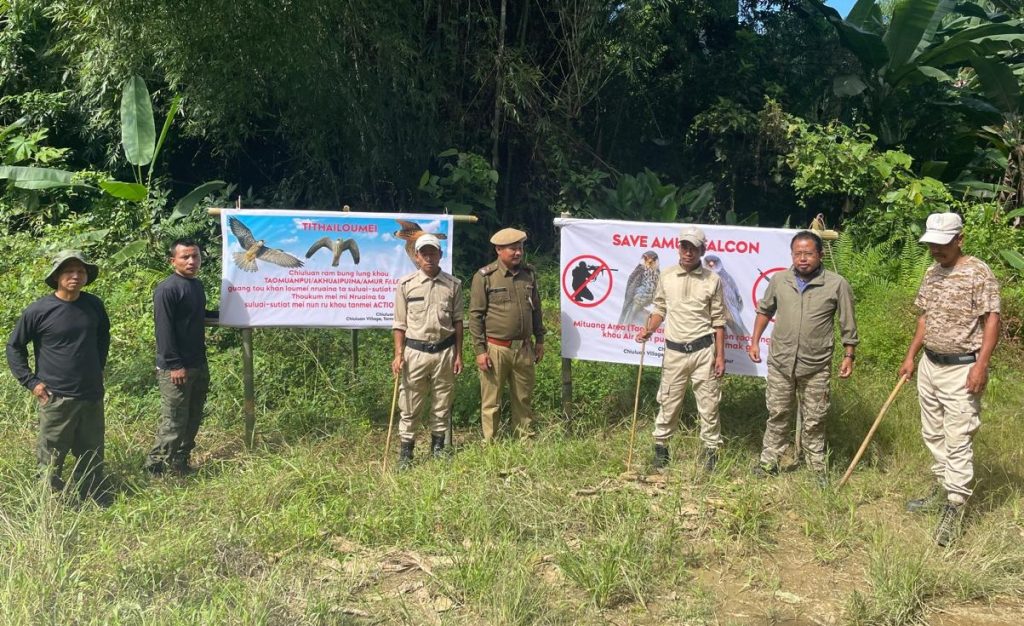
Patrol team members with the staff of Manipur Forest Department in Tamenglong, Manipur | Photo by Ramhiamang Gonmei
They also engaged over 1500 local students through different outreach activities such as painting sessions, football competition, guided treks to roosting sites, educational camps, and birdwatching sessions. One such birdwatching session turned memorable for the kids when they encountered four injured Amur falcons, leading to their timely rescue and handover to the forest department authorities for care. This experience was not only an important lesson for them on proper handling and rescue of birds, but it also allowed them to forge a profound connection with these extraordinary birds, possibly igniting a lifelong appreciation for their conservation.
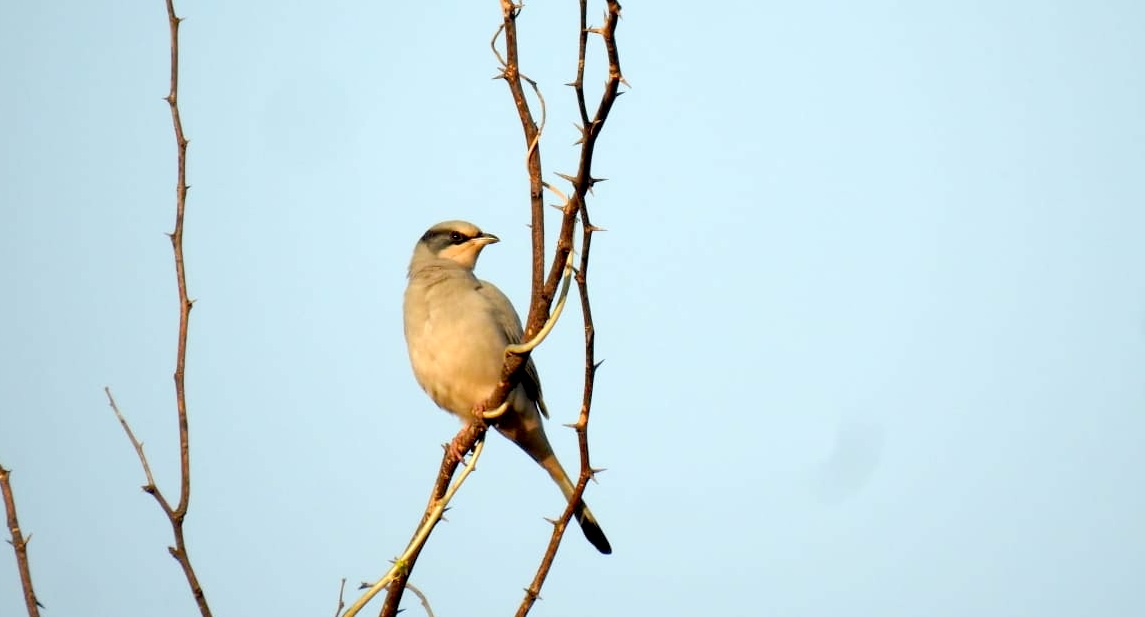
Another unique but lesser-known migratory species that winters in India is the grey hypocolius. This small passerine bird annually visits the arid and semi-arid landscapes of western India, especially the Banni grasslands in the Kutch district of Gujarat. Our conservation partner, Dr. Ekta Joshi, initiated efforts through a RAP to restore the species’ habitats in the Fulay and Tal villages through the plantation of Salvadora persica, whose ripe berries are eaten by these birds.

Saplings of Salvadora persica planted in one of the restoration sites in Tal village, Kachch District, Gujarat | Photo by Ekta Joshi
Despite an initial hiccup in the project, when the region was hit by a rare event of heavy rainfall leading to flooding of the plantation sites, Dr. Joshi managed to successfully plant and grow Salvadora sp. saplings. She and her team also organised multiple outreach activities, including awareness sessions for local school students, as well as creating wall signage in the villages to generate awareness among the local communities on the conservation of this unique migratory bird and its habitat in the landscape.
Migratory birds are particularly vulnerable to hunting during stopovers for feeding or resting. In West Bengal, the widespread use of mist nets and fishing nets to capture birds poses a significant threat. To address this issue, WTI supported two RAPs in 2024 to prevent hunting during the migratory season in winter in North 24 Parganas. Soumitra Roy played a key role in rescuing 35 shorebirds. Meanwhile, a team led by Suvrajyoti Chatterjee in central West Bengal successfully removed 55 km-long mist nets and facilitated the arrest of 9 commercial hunters.

A snipe entangled in a mist net in North 24 Parganas District, West Bengal | Photo by Soumitra Roy
The latter also assisted in the rescue and release of over 600 greater short-toed larks and pipits. While sustained efforts are essential for setting long-term deterrence against commercial hunting, these RAPs, being rapid in nature, demonstrated the potential to significantly reduce migratory bird mortality from hunting in the short term.
Through RAPs, WTI provides urgent aid to grassroots conservationists, individuals, and frontline forest staff to address wildlife emergencies. This allows us to nip emerging threats in the bud and prevent them from transforming into larger issues that may require greater efforts and resources to tackle. Our donors, such as Fondation Segre and multiple individual donors, have allowed us to continue supporting such crucial efforts across the country for nearly 26 years now.
If you know of a deserving individual or come across a wildlife emergency anywhere in India requiring urgent support, get in touch with us at rap@wti.org.in.