The legend of Mama-Bhasha Devsthan, NNTR, Maharastra
In the heart of Central India, particularly within the Vidarbha’s Gondia District, forests are intrinsically woven into the fabric of local life and livelihoods. The area is home to the Nawegaon-Nagzira Tiger Reserve (NNTR), established in 2012. The NNTR comprises two distinct sections, Nawegaon and Nagzira, linked by a vital yet relatively narrow forest corridor. Within a fragmented portion of this corridor lies the village of Girola-Heti, nestled amidst dense greenery. For generations, this indigenous community has upheld a tradition of sustainable forest conservation, a practice significantly influenced by the widely revered local legend of ‘Mama-Bhasha‘.
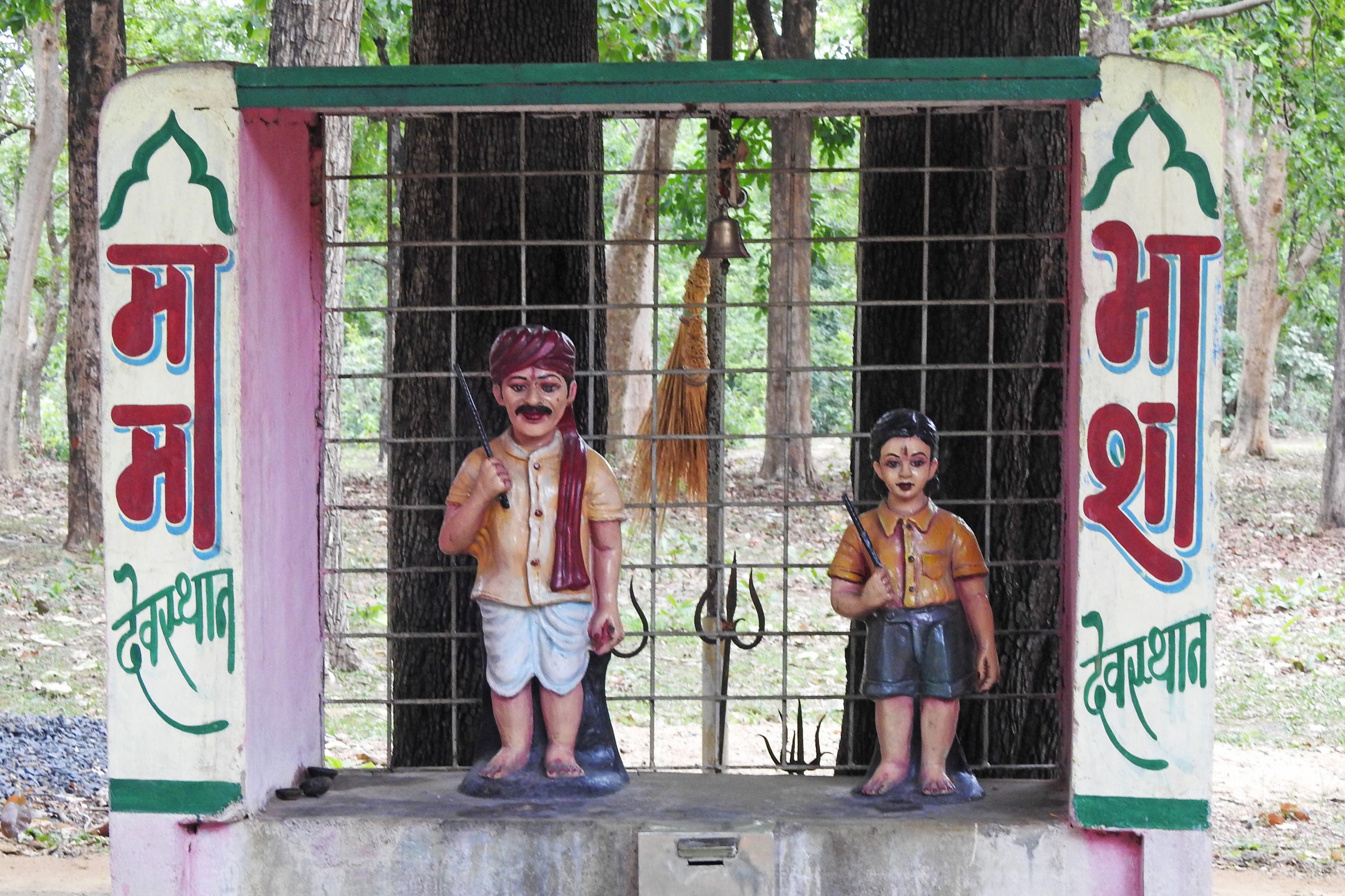
The Mama-Bhasha temple, a focal point of this cultural heritage, is situated within a forest patch along the Kosamtondi – Sakoli road. This sacred site is marked by two Tendu trees (Diospyros melanoxylon), which symbolically represent ‘Mama‘ (maternal uncle) and ‘Bhasha‘ (nephew) and is revered as a ‘Devsthan‘ (a dwelling place for deities) for the Mama-Bhasha deities embodied by the trees themselves. This deep-rooted cultural admiration for the forest, backed by the Mama-Bhasha legend, highlights a brilliant example of how traditional beliefs can effectively drive conservation efforts in crucial ecological landscapes.

Mama-Bhasha Temple in Girola-Heti Village, NNTR, Maharashtra | Photograph by Vedang Saikhedkar / WTI
The Mama-Bhasha is a century-old folklore and tells a touching story highlighting the deep connection between the community and the forest. According to local accounts, a maternal uncle (Mama) and his nephew (Bhasha) ventured into the dense forest to cut wood. At that time, this forest patch would have harboured a good wildlife population, including a significant number of tigers, because of which the villagers would have to keep extreme caution in the forest. As they sought out a suitable tree, they encountered a tiger that attacked and fatally mauled them.
The tragic incident occurred at a spot where two Tendu trees grew closely, side-by-side. Days later, another woodcutter, gathering timber in the same area, struck his axe into one of these Tendu trees. To his horror, blood appeared to ooze from the trunk, as if from human flesh. A chill ran down his spine, and he fled to his village where he shared his dreadful experience. The legend further suggests that the spirits of the uncle and nephew, visited the woodcutter in his dreams, pleading with him not to fell trees in that particular forest. The local community began worshipping the two trees and over time, the site came to be known as the‘Mama-Bhasha Devsthan.’ Since then, the villagers have refrained from cutting trees in the area surrounding the temple. This practice marks a powerful example of the influence of cultural folklore on local conservation practices.

The Mama-Bhasha Devsthan alongside the tendu trees in Girola-Heti Village, NNTR, Maharashtra | Photograph by Vedang Saikhedkar / WTI
The deep respect and love for this forested area extends beyond mere prohibition of cutting trees. On January 1st, every year, the temple becomes a focal point for a small scale two-day fair. Villagers, mostly from the indigenous community, from both the Gondia and Bhandara Districts visit in large numbers, not just to celebrate, but to express profound gratitude towards the forest. Even in modern times, the unwavering commitment of these communities ensures that no tree within the temple’s forest patch is harmed. On New Year’s Day, visitors partake in communal gatherings and sing praises of the deities and the sacred forest.
The Girola-Heti Village has a direct ecological connectivity with the Nagzira block of NNTR and is a vital corridor to facilitate movement of wildlife through the landscape. While it’s true that various factors beyond deforestation can degrade the connectivity of such vital wildlife corridors, the local community’s dedication, driven by their deeply held religious traditions, demonstrates their strong commitment to nature conservation. Though the historical veracity of the Mama-Bhasha folklore may remain unconfirmed, the ecological implications have certainly been crucial.Had it not been for the legend of the Mama-Bhasha, it is highly possible that this small yet critical forest fragment within the broader Nawegaon-Nagzira corridor might have already succumbed to human encroachment. The spirits of Mama-Bhasha truly continue to protect these forests. On a broader scale, it proves the fact that humanity is always intertwined with nature, through these powerful oral traditions. Such folklores possess profound potential to serve as a vital medium for future generations to cultivate their connection with nature, and thereby be a part of its conservation.
Vedang Saikhedkar is a Field Officer under WTI’s Central India Tiger Corridor Project.