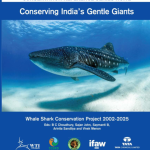

Over 1,000 whale sharks freed: WTI, forest departments & fishers lead lifesaving efforts along India’s Coastline
Delhi, 15th January 2024: In a monumental achievement for marine conservation, the Wildlife Trust of India’s (WTI) “Pan India Whale Shark Project” has facilitated the rescue and release of 1,001 whale sharks accidentally entangled in fishing nets along the coasts of Gujarat and Kerala. This incredible milestone underscores the compassion of India’s fishing communities and the dedicated conservation efforts of WTI since 2004.
The latest rescue took place on the auspicious day of ‘Pongal’ or ‘Makar Sankranti’ in Anchuthengu, Thiruvananthapuram, where fishers freed a whale shark caught in a fishing net, and guided it back into the sea. This marked the 34th rescue since the initiation of the project in Kerala in 2017, a collaboration with the Kerala Forest Department, the Fisheries Department, and supported by VST Industries Limited.
Saymanti B, OIC, Natural Heritage Campaigns, WTI highlighted that over the past seven years, the project in Kerala has thrived due to the unwavering support of the community. She emphasised that the 34th rescue from their project site is a testament to the success of private partnerships, noting that these achievements would not have been possible without the exceptional collaboration of the fishing community, as well as the contributions of supportive partners and donors.

Fishers sending an entangled Whale Shark back into the sea in Poonthura, Trivandrum Coast | Photo by Team WTI
These incredible efforts trace their origins back to 2004 with the initial launch of this project in Gujarat with support from the International Fund for Animal Welfare (IFAW), Tata Chemicals Ltd. and the Gujarat Forest Department, to combat the alarming mass hunting of these gentle giants. Highlighted in Mike Pandey’s Green Oscar-winning documentary Shores of Silence, their plight gained global attention. Additionally, a TRAFFIC India report in 2001 documented 600 landings during 1999 and 2000. As a result, the Ministry of Environment, Forest and Climate Change (MoEFCC) listed the whale shark in Schedule I of the Indian Wildlife (Protection) Act, 1972, thus becoming the first fish to get the highest level of protection nationwide in 2001.

Boat with ‘Save the Whale Shark’ messaging in Veraval, Gujarat | Photo by Madhumay Mallik/WTI
To date, the project in Gujarat has facilitated the return of 967 whale sharks to their natural ocean habitat, as a result of the unwavering dedication of various stakeholders including fisherfolk, along with the State Fisheries and Forest Departments who have joined this noble cause. Since 2011, the project has also successfully tagged 11 whale sharks, contributing to a certain understanding of their migration patterns.
Accodring to Farukhkha Bloch, Head of PAN India Whale Shark Project, WTI, the Saurashtra coast of Gujarat is a preferred aggregation site for whale sharks to meet their biological needs, especially females to give birth to young ones and feed planktons. He highlighted that WTI, in collaboration with Gujarat Forest Department have partnered to study the biological preferences and study the movement patterns of whale sharks in these waters.

A member of the project team deploys a satellite tag before releasing a whale shark caught in fishing nets | Photo by Team WTI
We are grateful to Tata Chemicals Ltd., TCSRD/C-SCAPES, VST Industries Limited and the Gujarat and Kerala forest departments for supporting our “Pan India Whale Shark Project.”