Workshop on Wildlife Protection Laws hosted by WTI and J&K Judicial Academy, Srinagar
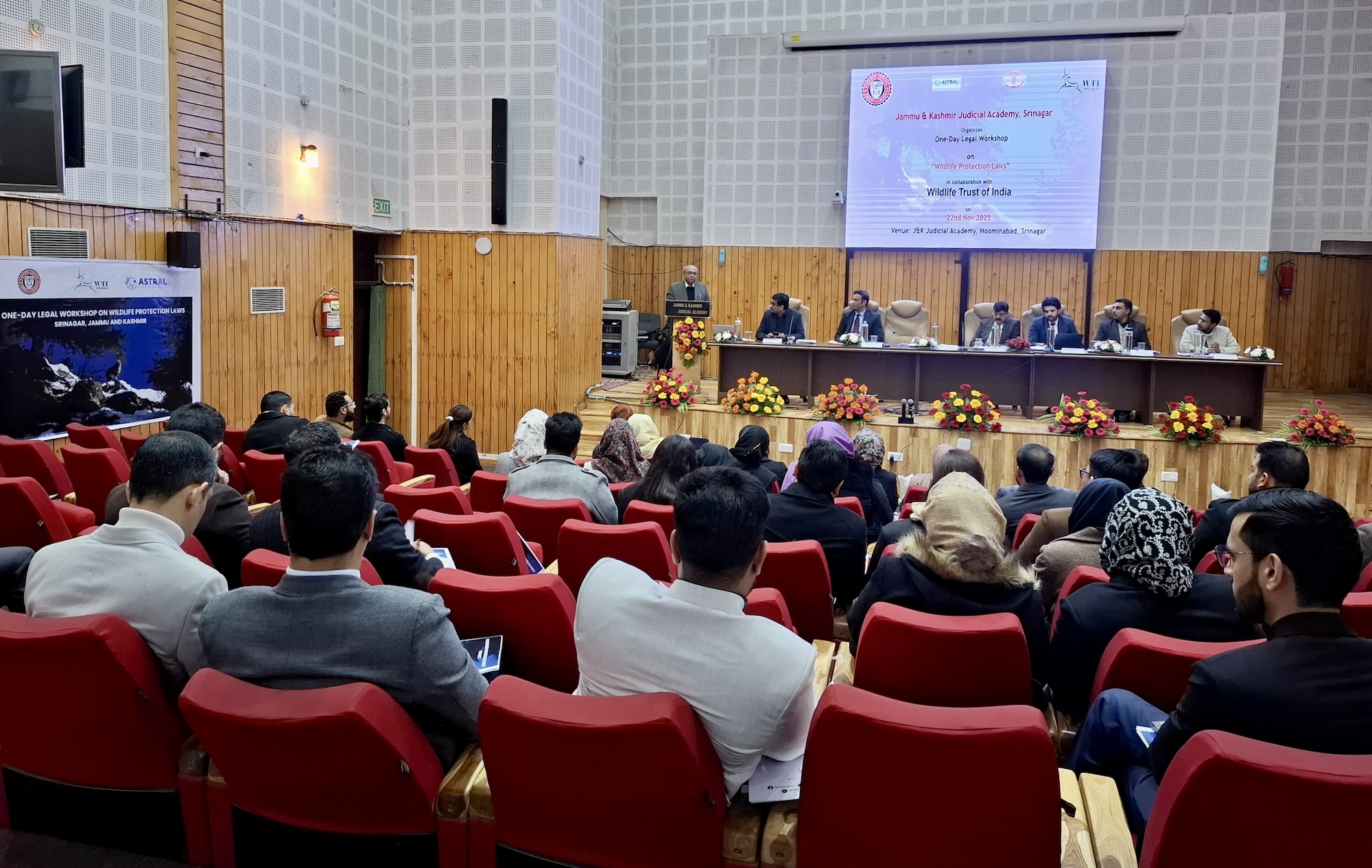
Srinagar, 22 November 2025: As part of ongoing efforts to strengthen wildlife conservation in the Union Territory of Jammu and Kashmir, the Wildlife Trust of India (WTI), in partnership with the Jammu & Kashmir Judicial Academy, Srinagar, and with the support of Astral Foundation, organised a one-day workshop on Wildlife Protection Laws on 22 November 2025 in Mominabad, Srinagar.
The workshop, was held under the patronage of Hon’ble Mr. Justice Arun Palli, Chief Justice, High Court of Jammu & Kashmir and Ladakh (Patron-in-Chief, J&K Judicial Academy), and under the guidance of the Hon’ble Chairperson and Hon’ble Members of the Governing Committee of the Academy, was attended by Judicial Officers from both the Kashmir Province and the Union Territory of Ladakh.
The programme commenced with the Welcome Address by Mr. Naseer Ahmad Dar, Director, J&K Judicial Academy, who highlighted the constitutional mandates enshrined in Article 48A and Article 51A(g), underscoring the duty of the State and every citizen to protect and improve the natural environment and safeguard wildlife. He reflected on the unique ecological sensitivity of Jammu & Kashmir and the growing challenges related to illegal wildlife trade and habitat threats, stressing the urgent need for stronger enforcement and judicial awareness.

Jose Louies, CEO, WTI, led a session on the illegal wildlife trade | Photo (c) Team WTI
This was followed by introductory remarks by Dr. Tanushree Srivastava, Senior Manager and Head, J&K, WTI, who outlined the scope and objectives of the workshop and emphasised the importance of enhancing institutional capacities to address wildlife crimes effectively.
Delivering the Keynote Address, Hon’ble Mr. Justice Rajesh Sekhri, Judge, High Court of J&K and Ladakh, emphasised that Jammu & Kashmir is not immune to the threats posed by wildlife crimes. He stressed the need for the judiciary to remain proactive and sensitive in enforcing wildlife protection laws and called for consistency and rigour in adjudicating such offences to preserve the region’s fragile ecological balance.
The guest lecture was delivered by Hon’ble Mr. Justice Sunil B. Shukre, Former Judge, Bombay High Court & Chairman, Maharashtra State Commission for Backward Classes. Justice Shukre provided an in-depth exposition of the Wild Life (Protection) Act, 1972, explaining its conservation-centric objectives and the strict standard of scrutiny adopted by the judiciary. Referencing Supreme Court judgments, he discussed the “broader probabilities” approach applied in wildlife cases, especially in light of evidentiary challenges arising from offences committed in remote wilderness areas.
Mr. Lovish Sharma, Advocate, High Court of Delhi & Legal Advisor, WTI, in his session explained the structure and schedules of the Wild Life (Protection) Act, 1972, elaborating on key sections and significant case law. He also reviewed key provisions and significant case law shaping contemporary wildlife jurisprudence.

A few commonly traded illegal wildlife articles | Photo (c) Team WTI
Mr. Darak Ullah, Former District & Sessions Judge, Assam Judicial Service, conducted a session on the judicial approach necessary for securing convictions under wildlife laws. He emphasised effective evidence evaluation, the use of statutory presumptions, and awarding compensation where appropriate. Drawing on his judicial experience, Mr. Ullah offered practical insights into how courts can address the challenges inherent in prosecuting wildlife crimes.
The workshop was marked by rich discussions, practical demonstrations, and reflective exchanges, reinforcing the Judicial Academy’s ongoing commitment to equipping the district judiciary with the knowledge and sensitivity required to address wildlife crimes with clarity, competence, and ecological consciousness.