Satellite-tagged whale shark returns to Gujarat waters after 100 days
Veraval, 5th April 2025: A whale shark that was satellite-tagged on the 22nd December 2024, returns to the waters offshore Gujarat, after 100 days of tracking and travelling more than 4000 kilometres across the Arabian Sea.
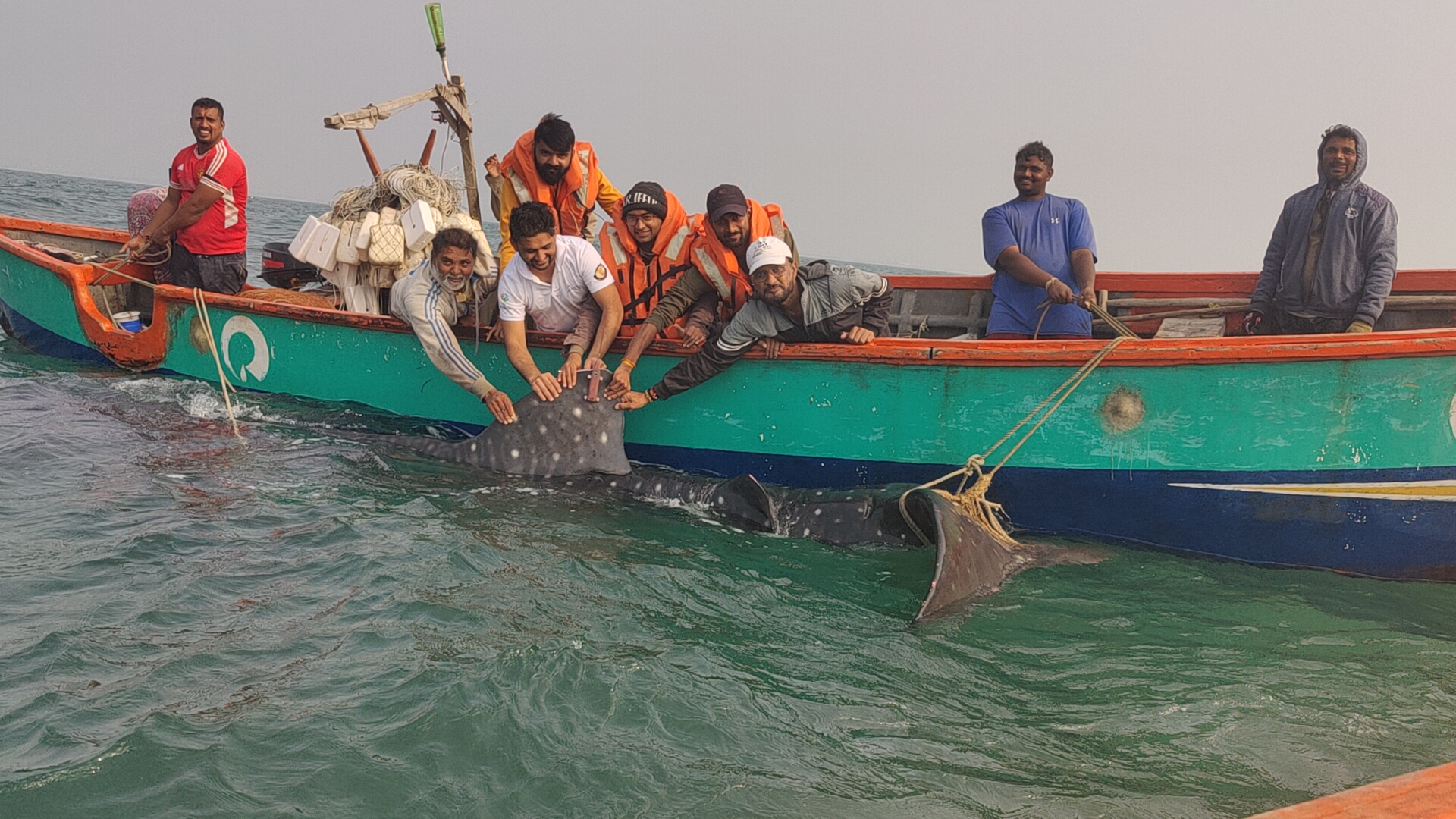
The 28-feet-long individual was tagged during its rescue and release from accidental entanglement in a fishing net. The animal was found to be in good health and actively returned to the deeper waters after being freed from the nets. The tagging exercise was undertaken by the Wildlife Trust of India’s (WTI) field team, in adherence to all necessary protocols, in the presence of the Mr. Y.S. Kalsaria (Range Forest Officer, Veraval), Dr. Vishal Chawla (veterinary officer, Junagarh Forest Division and Mr. Mohanbhai Bharavala (head of Veraval OBM boat association). Fishers on-board the trawling vessel had already undergone training on whale shark rescues in such situations, under WTI’s Pan-India Whale Shark Conservation Project.
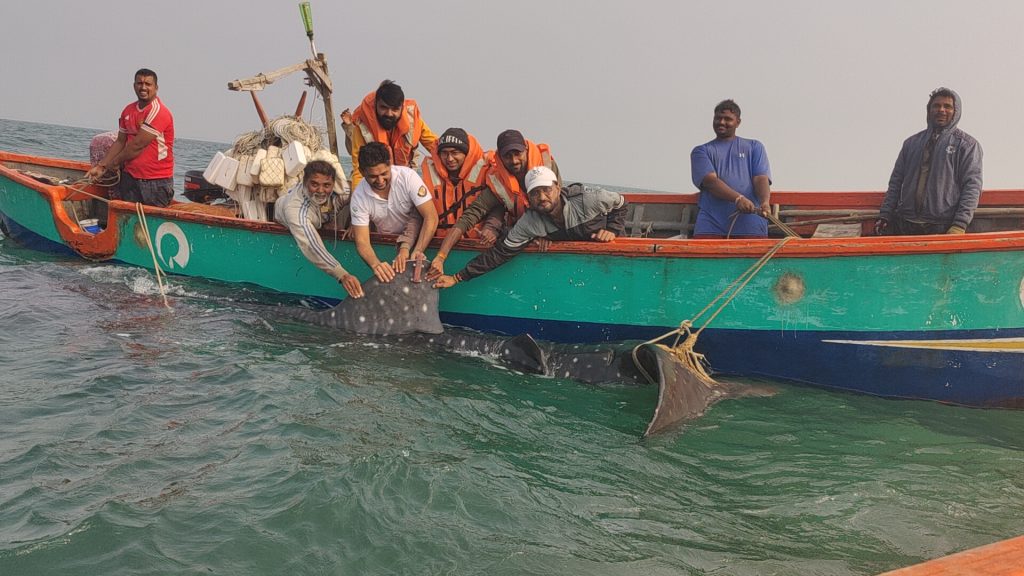
WTI and Gujarat Forest Department team tagging the 11th whale shark offshore Veraval, Gujarat | Photograph by Ganesh Devjibhai Varidum
Upon successful deployment of the tag, the team has been continually monitoring the signals and tracking its movement. The whale shark had travelled along India’s western coastline, covering the states of Goa, Maharashtra and Kerala, before entering the waters of the Lakshadweep Islands, where it stayed for a week before turning back and heading towards the Gulf of Oman. The farthest that the individual went off the Indian coastline was 700 kilometres from Maharashtra. The individual had then travelled north towards Karachi, before turning back to the coast of Gujarat. On 4th April, transmission was received off the coast of Veraval, where it was originally tagged.
“Such migration route hints towards the whale shark spending a considerable amount of time in Indian waters. The geo-spatial migration in correlation to the Sea Surface Temperature (SST) suggests that the animal prefers warmer waters in the range of 250-300 C. Further, correlation with the global distribution of phytoplankton suggests the route through areas with high distribution of planktons, the main food for whale sharks,” explains Sajan John, the head of Marine Projects for WTI.
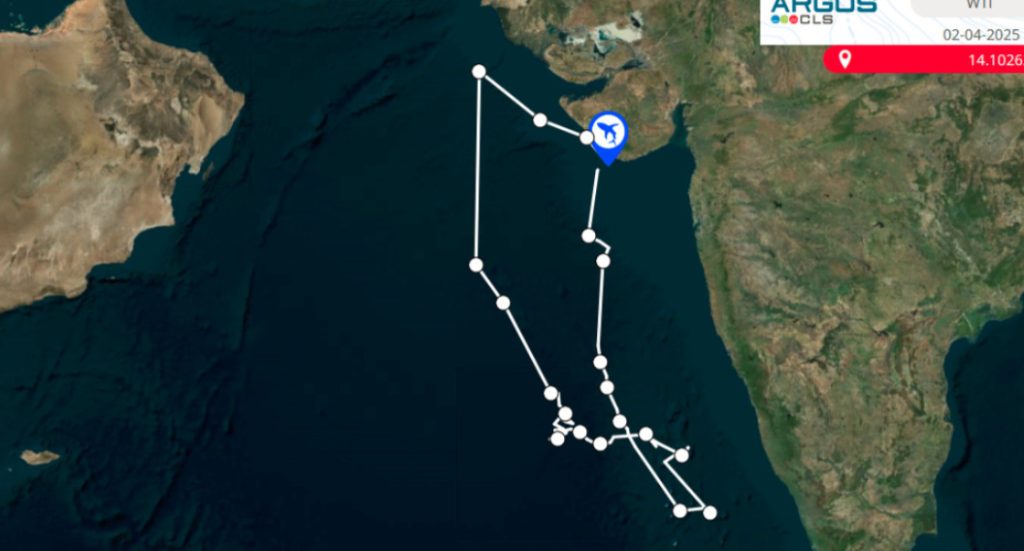
Satellite data tracking 104 days of whale shark movement | Map by ARGOS
Since 2011, the WTI team has tagged 11 whale sharks to understand more about the species’ behaviour and migration route. Since the success of the project in Gujarat, where more than 970 whale sharks have been rescued by fishers, the project has since expanded to Kerala and the Lakshadweep Islands. In Kerala, fishers have rescued more than 40 whale sharks since the project took off. While there have been no reports of whale shark entanglement from the Lakshadweep Islands, it is known to be an aggregation site for the species. The team is continually engaging with the fishers and spreading awareness about the world’s largest fish.
Whale sharks are listed under Schedule I of India’s Wild Life (Protection) Act, 1972. While hunting has been banned, accidental entanglement of the shark has become the greatest threat to the population of the species. Tagging exercises such as these will help the team to converge the rescue and awareness efforts to locations where the species is the most vulnerable.
The Pan-India Whale Shark Conservation Project was formally launched in Gujarat in 2008 in partnership with the Gujarat Forest Department and is supported by the Tata Chemicals Ltd.