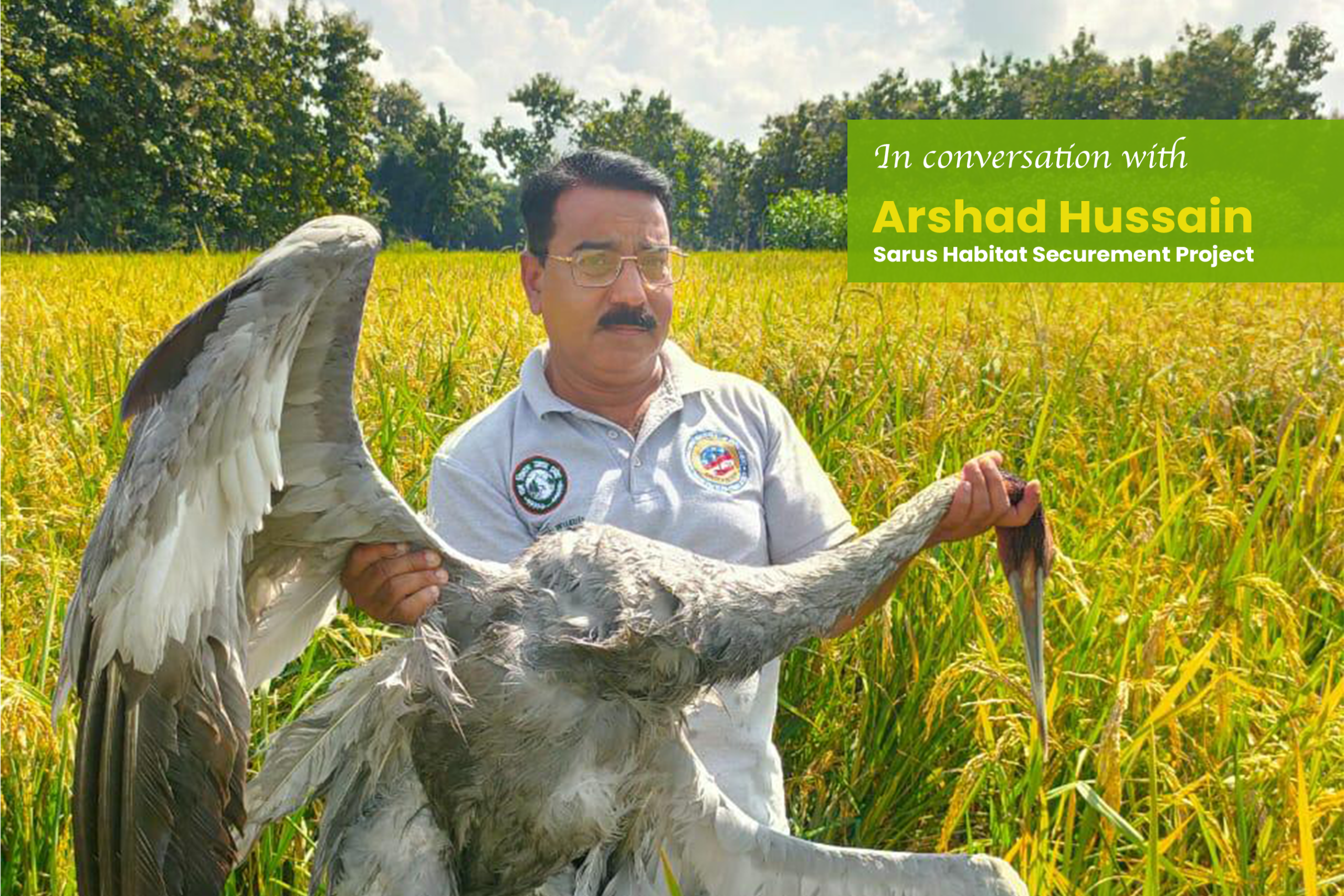
Watching Over the Wetlands : In Conversation with Arshad Hussain
A phone call from a farmer can change the course of a day for Arshad Hussain. Sometimes, it is a report of rising water levels threatening a sarus crane nesting site or it could be the news of a newly built nest, hidden among the paddy fields. In some cases, it could as well be about an injured bird or a wildlife emergency that requires immediate attention. For Arshad, the project lead of Wildlife Trust of India’s (WTI) Sarus Habitat Securement Project in eastern Uttar Pradesh, these calls are more than field updates – they are reminders of just how far conservation efforts in the region have progressed.
The communities that once questioned the value of protecting the sarus crane, actively monitor their nests today. Called the Sarus Mitras, they report crane sightings and assist in conservation efforts. This transformation however represents years of patient engagement, trust-building, and countless conversations across villages and wetlands.
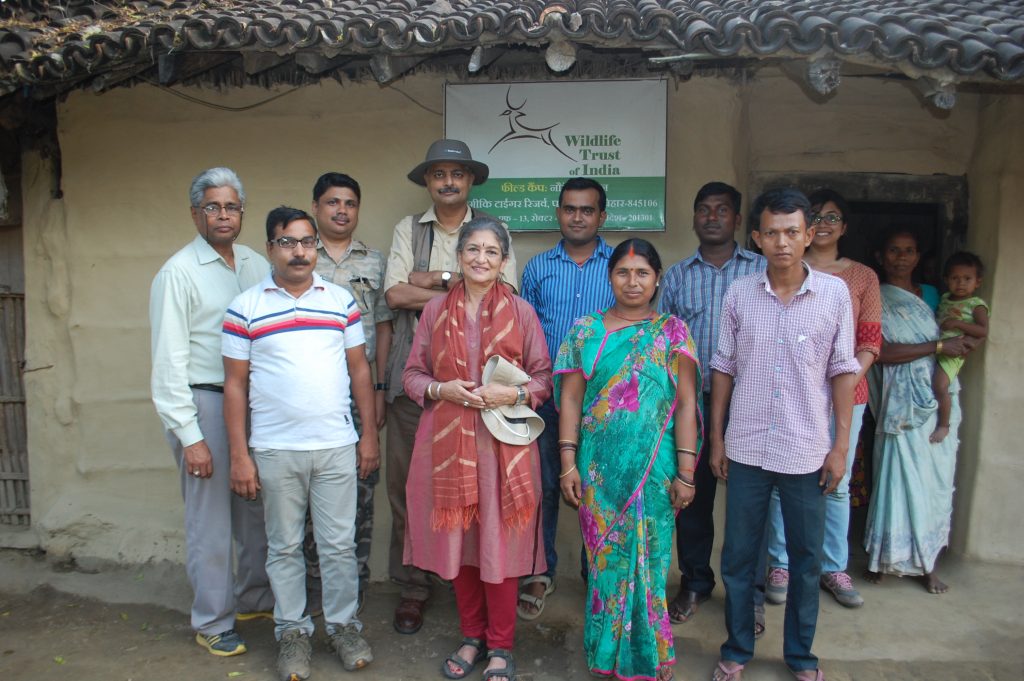
Team WTI (Top LtoR: Prof. BC Choudhury, Dr. Samir K Sinha, Mr. Vivek Menon, Mr. Kaushik Deb, Rajkumar and Ms. Upasana Ganguly and Bottom L2R: Mr. Arshad Hussain, Ms. Tara Gandhi, Indu kumari and Ashwin. At the back is Indu Kumari’s mother) in front of WTI’s Field Camp in Done Valley, Bihar (2016-17).
A Journey into Conservation
Arshad’s conservation journey began more than fifteen years ago. Growing up with a keen interest in wildlife, he always imagined himself working in a field that combined conservation and community. He was drawn to stories and documentaries, nurturing a dream of contributing to conservation if the opportunity ever arose.
“This is my favourite kind of fieldwork. Ever since my college days, I had thought that if I ever got the chance to work for wildlife welfare or conservation with communities, I would certainly do it.” That opportunity came in 2013, when he joined WTI’s Eradication of Street Dancing Bear (Kalandar) Project in Bihar as a sociologist.
Over the years, grew his experience and expertise of working closely with communities and understanding the social dimensions of conservation. Today, he leads the Sarus Habitat Securement Project in eastern Uttar Pradesh, where his work revolves around protecting wetlands in collaboration with the local community.
Working for the Sarus
The project spans across ten districts – Bahraich, Balrampur, Barabanki, Ayodhya, Kushinagar, Maharajganj, Santkabir Nagar, Sharawasti, Shahjhanpur and Siddhartha Nagar – and focuses on securing important wetland habitats, supporting Sarus populations, promoting community stewardship, and encouraging the protection of nests and breeding sites. For Arshad, however, conservation extends far beyond project targets and field surveys. Much of his work is centred around people.
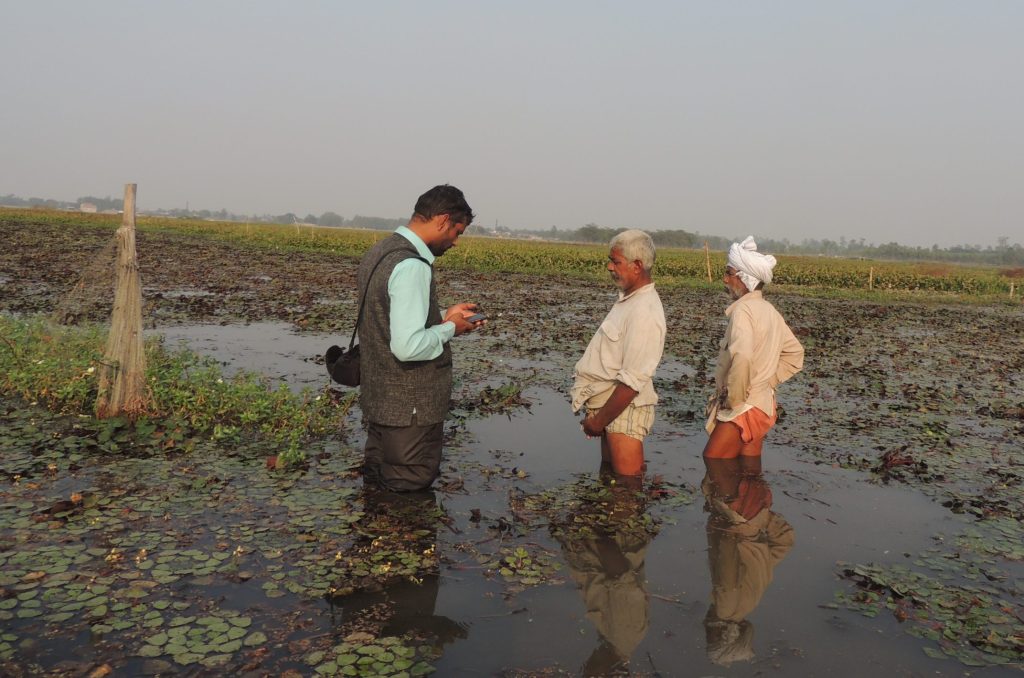
R.K. Tripathi, field attendant, noting the GPS points and weed infested areas at Hariharpur wetlands in Maharajganj_Sarus Project | Photograph by Arshad Hussain/WTI
“Whether the work is desk-based or in the field, every day brings in unique challenges,” he exclaims.
A typical day for him involves travelling between villages, meeting farmers, interacting with community volunteers, coordinating with the Forest Department, and responding to reports from the field. Working in landscapes where people and wildlife share space means constantly balancing conservation goals with local concerns and livelihood priorities.
“The fact remains that attempting wildlife conservation in unprotected areas without the community’s cooperation seems impossible.” Building that support has not always been easy.
Winning Trust, One Conversation at a Time
One of the biggest challenges he faced during the early years of the project was convincing people that sarus cranes and wetlands were worth protecting. Several community members treated the sarus as any other bird. Many considered it a nuisance that damaged crops. Others questioned why they should contribute to their conservation when it was them who were negatively affected.
“Whenever the topic of wildlife conservation arises within the community, the very first question asked is, ‘Why should I save them?’” Rather than approaching these concerns as obstacles, Arshad treated them as opportunities to listen and learn. He realised that successful conservation could not rely on a one-size-fits-all method. Different communities had different experiences, concerns, and perceptions of the wildlife around them. Understanding those perspectives became an essential part of his strategy.
Over time, conversations that began with scepticism gradually evolved into discussions about coexistence and stewardship. By helping people understand the connection between healthy wetlands, biodiversity, and their own lives, he was able to build stronger support for conservation efforts across the project landscape.
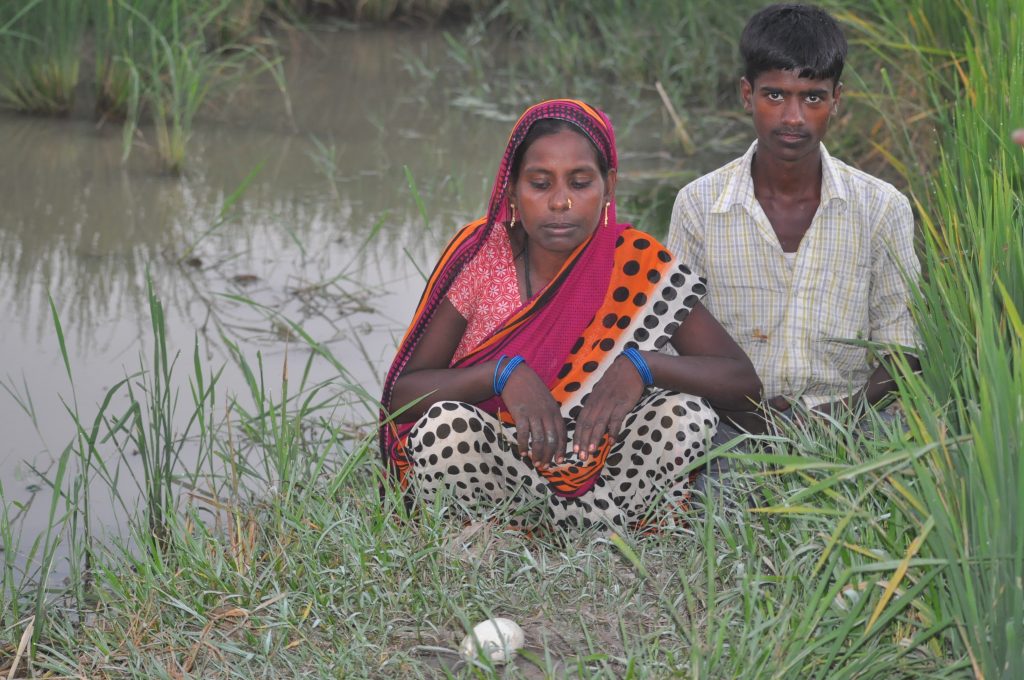
Local villagers in Valmiki showing a sarus egg | Photograph by Arshad Hussain/WTI
When Communities Become Conservationists
Some of Arshad’s most memorable experiences illustrate just how powerful community participation can be.
One such incident took place in Baidauli village, where a sarus chick was trapped in dense water hyacinths and was close to death. A Sarus Mitra named Chhote Lal, a retired soldier, noticed the struggling chick and immediately stepped in to help. After carefully freeing the bird and helping it recover, he successfully reunited it with its mother. For Arshad, the incident demonstrated the remarkable commitment that local communities can show when they feel invested in conservation.
Another memorable moment occurred in Madanpura village. A Sarus nest located in a waterlogged area became vulnerable when rising water levels threatened the eggs. After alerting WTI, Sarus Mitra Chedi Kewat worked alongside WTI field assistant Ravindra Kumar Tripathi to secure the nest using bamboo poles. Their efforts paid off. Thirty-one days later, the eggs hatched successfully.
For Arshad, these stories are not simply examples of successful interventions. They are evidence of a larger change taking place across the landscape. Perhaps the most rewarding aspect of his work has been to witness the shift in community attitudes towards wildlife conservation. When the project began, discussions often centred on the costs and inconveniences associated with wildlife. Today, communities are actively involved in conservation efforts and frequently reach out to WTI when wildlife-related incidents occur.
“The joy is even greater when a farmer or a Sarus Mitra calls to say, ‘Sir, the Sarus is building a nest,’ or ‘A chick has hatched.’”
People now report Sarus nesting activity, alert teams about injured wildlife, share information on poaching incidents, and seek assistance when animals enter human settlements. What began as an effort to protect a single species has gradually expanded into a broader culture of wildlife stewardship. The community’s concern extends beyond Sarus Cranes to other birds, turtles, snakes, monitor lizards, deer, crocodiles, and even leopards.

Govind, a member of the village wetland and management committee from sabiya monitoring the Sarus nest at the Chiraiyakot wetland | Photo by Arshad Hussain/WTI
Looking Ahead
This transformation gives Arshad hope for the future. He believes that community participation will remain the cornerstone of successful habitat protection. At the same time, he emphasises the importance of continued engagement by government agencies and other stakeholders. Conservation awareness, according to him, must be nurtured continuously so that the trust and cooperation built over the years, is not lost.
For young people aspiring to enter the conservation field, his advice is simple: develop a genuine connection with nature. According to him, effective conservation begins with empathy – not only for charismatic species, but for every living creature, no matter how small.
“If someone truly wants to be a conservationist, they must feel a connection to everything around them and possess the desire to do something for even the smallest of creatures.”
After more than a decade with WTI, Arshad Hussain continues to work across the wetlands of eastern Uttar Pradesh, helping secure a future for the sarus crane and the habitats it depends on. Yet, perhaps his most enduring contribution lies elsewhere – in the network of farmers, volunteers, and community members who now see themselves as custodians of the wetlands around them.
Story by Pallavi Ghosh, Intern, Wildlife Trust of India.