Amidst the Mist: Protecting frogs in Munnar’s plantations
The light from my head torch made the fine drizzle shimmer. My wet hands were nearly frozen from the motorcycle ride through torrential rain, which, fortunately, seemed to have taken a break. My colleague Abhijith led the way down the slippery path through the cardamom plantation. I looked up at the canopy, but the light revealed nothing but white fog. All around me were the shrill ‘trik trik…’ calls, numerous bush frogs calling to their mates.
I am not a fast walker in the forest and always have been the last to reach the destination during many school and college treks. As I ambled along the rocky path, my torchlight landed on a little black frog sitting on a stack of firewood. A young common toad, I thought to myself, but still decided to get a closer look. My jaw dropped as I leaned in. Tiny blue specks glinted across its glossy black skin. It couldn’t be! It was my first night out in the field after arriving in Munnar to work with Wildlife Trust of India’s (WTI) Amphibian Recovery Project. How could it possibly be the rare and elusive galaxy frog (Melanobatrachus indicus), sitting on a pile of firewood in a plantation, when people spend days, even weeks, searching primary rainforest hoping for just a glimpse of one? What else could be hiding in these plantations?

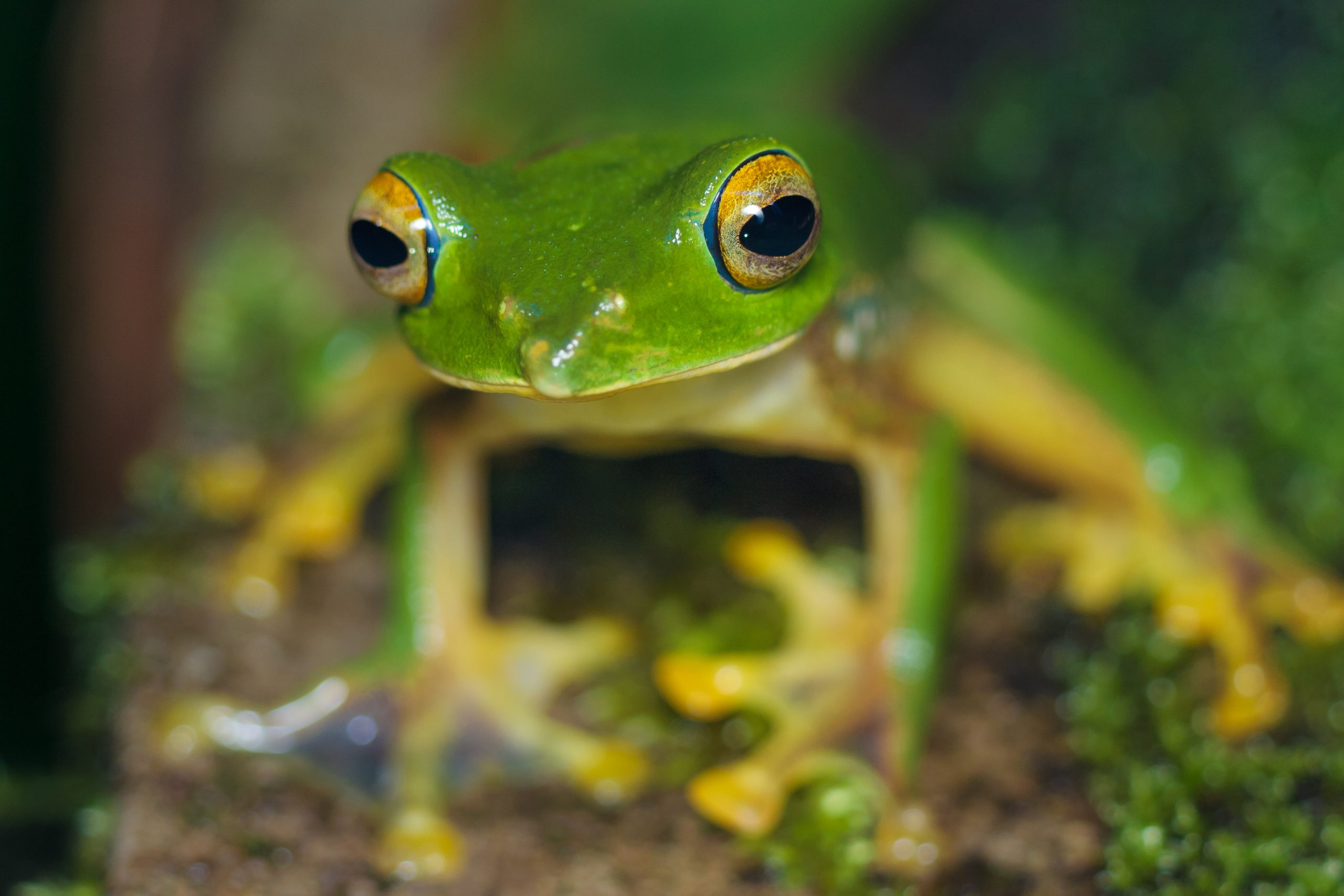
Anaimalai gliding frog in Munnar’s cardamom plantations | Photograph by Dr. Harikrishnan S
This unexpected encounter marked the beginning of my work in Munnar, a small town nestled in the southern reaches of the stunning Western Ghats mountains of India. This mountainous landscape used to be covered in forests until British planters arrived and established the first commercial plantations. Today, this landscape is a mosaic of plantations, primarily of tea, cardamom, eucalyptus, and a variety of other spices. Spread across the plantation landscape are many patches of remnant forests, memories of old times. There are also several protected areas, the most renowned being the picturesque Eravikulam National Park, with its unique cloud forests (locally called ‘Shola forests’) and grasslands. Like every other tropical biodiversity hotspot, here too, amphibians are on the decline, the reasons for which are many. The power to change this lies in the hands of the people who call this land home.
The livelihoods of most people in the Munnar landscape depend on the tea and cardamom plantations, either directly or indirectly through tourism. Hadlee Renjith, a local photographer and tour guide, with support from WTI, created the first artificial breeding pond for the Anaimalai gliding frog (Rhacophorus pseudomalabaricus) inside Windermere Estate’s cardamom plantation back in 2020. Eventually, this small step sparked something bigger. Inspired by the success of this pond, WTI began paying close attention to the region’s threatened amphibians, and one pond turned into many, across several estates. The Amphibian Recovery Project, supported by Synchronicity Earth, was initiated in 2021. Another significant milestone for amphibian conservation in the region came when one of the largest plantation companies in the area, the Kanan Devan Hills Plantation Company Pvt. Ltd. (KDHP), agreed to support the project. Their involvement gave us access to vast expanse of plantations and forest fragments outside the protected areas.
But first, we needed to know where the frogs were.
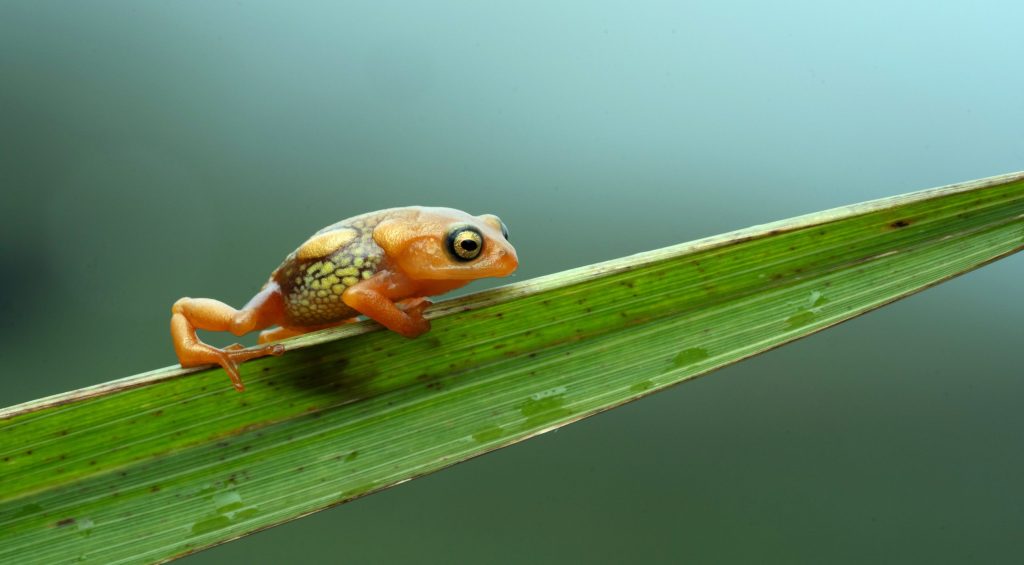
Resplendent Grass Frog (Raorchestes resplendens) in Munnar | Photograph by Sreenanth K/WTI
And so, began our surveys across these plantations during the monsoon of 2023. Our aim was to document species presence, particularly that of threatened species, across the many remnant habitat patches. The Munnar landscape is dotted with numerous streams, patches of forests, and swamps, many of which have never been surveyed for amphibians. We plodded through these habitats in torrential rains, searching and listening for frogs at night. The tiny leeches loved our presence but the same didn’t apply to the huge gaurs (Bos gaurus). Nevertheless, we continued spotting frogs, recording their calls, and observing their behaviour. We also needed to understand what actions needed to be taken to improve the status of these fragmented populations, which meant identifying local threats. For example, we noticed a particular stretch of road where many Anaimalai gliding frogs were getting run over by vehicles, a problem that is hard to solve considering the arboreal nature of the species. We also monitored the prevalence of the notorious Chytrid fungus, which impacts amphibian populations worldwide. Additionally, there seem to be invasive species of plants that were altering the habitats of some threatened species. The solutions were yet to be reached. The good news is that the government agency that manages the forests in the region, the Kerala Forests and Wildlife Department, and the plantation companies like KDHP and Windermere Estates, are highly supportive of our initiatives. We remain hopeful that more stakeholders in this landscape will to join us in our conservation efforts.
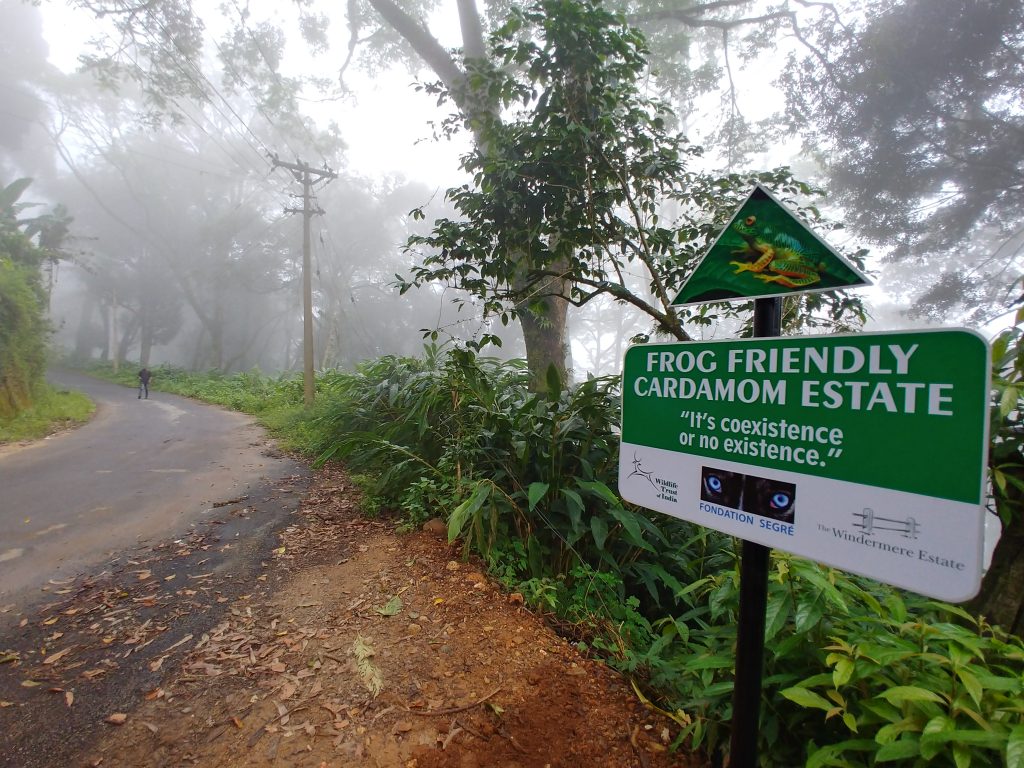
Windermere Estate in Munnar | Photograph by Hadlee Renjith
We began our surveys with approximately 25 species of frogs known from the Munnar region. After almost two years, we now know of at least 47 species, and we have not even covered half the landscape yet. Sadly, at least 26 of these species fall under the Threatened categories of the IUCN Red List. These include the montane grassland specialists such as the resplendent grass frog (Raorchestes resplendens), the stream-dwelling, beautiful dancing frog (Micrixalus adonis), and of course, the one that blessed me on my first night in the field, the galaxy frog (M. indicus). The future of these species hinges on the actions taken by all involved, but particularly the local communities of this treasure trove of biodiversity.
Dr. Harikrishnan S is the project head and manager of WTI’s Amphibian Recovery Project in Munnar.