The Madaparampu model – A blueprint for sustainable agroforestry in Wayanad
In the Wayanad district, where a quiet crisis of agricultural abandonment is unfolding, a particular three-acre property offers a different vision. To pass through it is to feel a “coolness and relaxation suddenly wrap you,” as a dense canopy of reed bamboo softens the light. This is the Madaparampu Plantation, established by Bhaskaran, a local farmer. Amidst the regional trend of farmers relinquishing their land due to crop raids by wild animals, this venture stands as a powerful counter-narrative. It is more than a farm; it is the subject of this case study—a successful, replicable model for generating economic value while fostering ecological resilience.
The pressures on traditional agriculture in Wayanad
To grasp the significance of the Madaparampu model, it is crucial to understand the initial problem it solves. Bhaskaran, like his father and neighbours, inherited a traditional agricultural landscape based on crops such as paddy, coconut, areca nut, and tubers. This long-standing way of life, however, came under immense pressure from the surrounding environment. According to Bhaskaran, it was a new development at the time, with crop raids increasing to a level that was no longer tolerable.
The primary challenge was the escalating frequency of crop raids by wild animals, which particularly devastated paddy and areca nut cultivations. The economic and personal toll became unsustainable for many. Consequently, a significant shift occurred in the community: one by one, neighbouring families gave up farming altogether, handing over their land to the forest department under official resettlement schemes.
Bhaskaran’s personal response to this pressure was pivotal. He ceased paddy cultivation, the crop most vulnerable to raids, while continuing to maintain a few areca nut and coconut trees around his home. Most importantly, he chose not to abandon his family’s land. This decision to remain, despite the partial failure of traditional methods, set the stage for his search for a viable alternative. This intersection of environmental pressure and personal resolve was the catalyst that transformed a challenge into a new beginning.
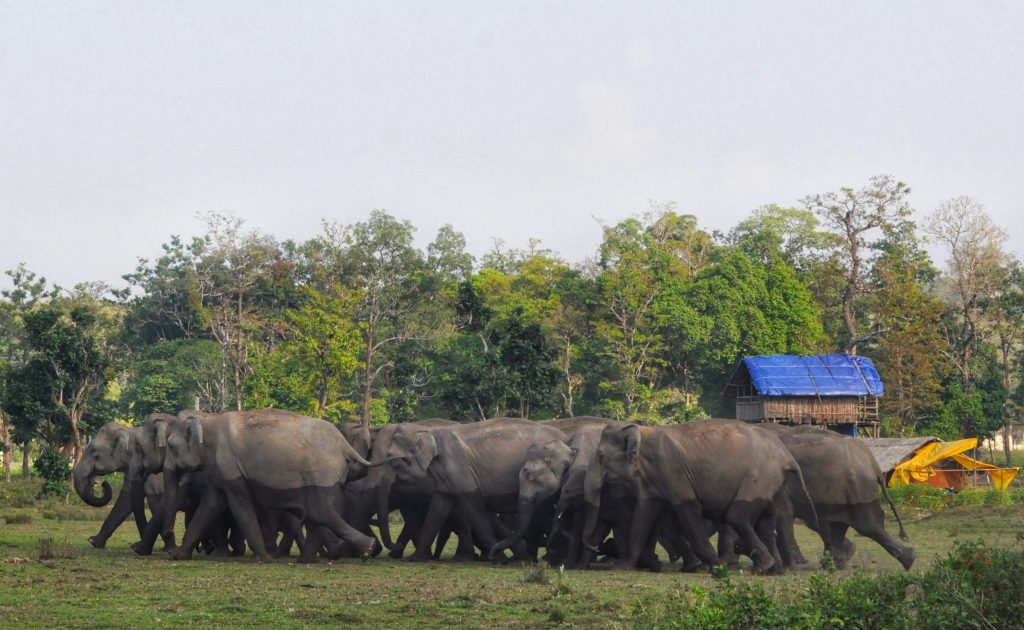
Herd of wild elephants in a village in Wayanad | Photograph by Prashant
Expansion of the Bhaskaran’s bamboo venture
The success of the Madaparampu model is rooted in its humble origins, demonstrating how a small, opportunistic event can serve as the catalyst for a large-scale sustainable enterprise. The project did not begin with a grand design or significant investment but with a simple, practical step.
Bhaskaran’s venture started when he received ten saplings of reed bamboo (Ochlandra travancorica) from the local Pulppally Grama Panchayat. He planted them along the path to his house without a specific commercial plan. The rapid and beautiful growth of these saplings, which formed a green archway, soon attracted the attention of passers-by. This organic interest was quickly followed by practical demand, as local people began visiting to cut reed sticks for their household needs.
Observing this unsolicited interest, Bhaskaran recognized a clear opportunity and made the strategic decision to expand. The scaling-up strategy was methodical and resourceful. He expanded the plantation to over three acres by purchasing more saplings and propagating new plants from rhizomes. To source high-quality specimens for this expansion, he travelled to Mankulam in Idukki, a village noted for how beautifully Ochlandra travancorica grows, and collected additional seeds and saplings. Through these efforts, a small planting along a path was transformed into a thriving three-acre bamboo forest, laying the groundwork for a successful business model.
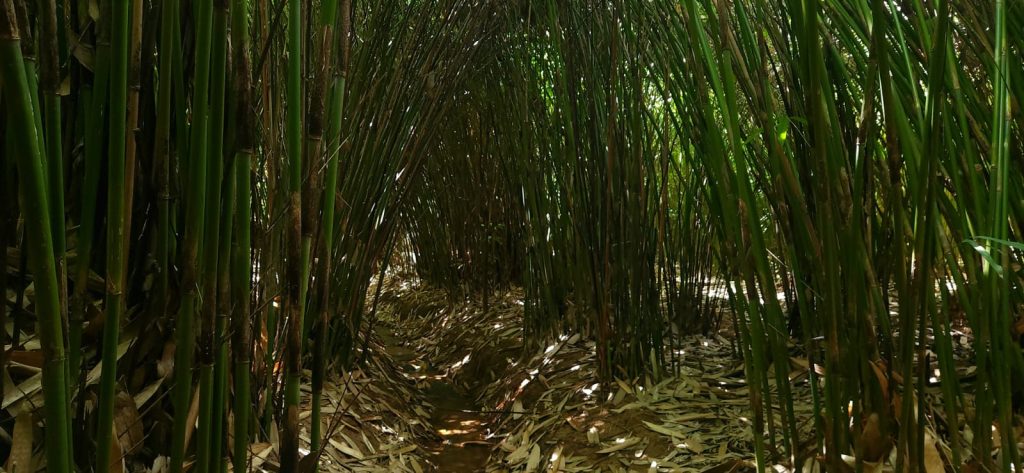
Bhaskaran’s bamboo farm | Photograph by Karthika Sulochana / WTI
A zero-maintenance, high-value business model
The long-term success and replicability of any agricultural model depend critically on its economic viability. Bhaskaran’s bamboo venture excels in this regard, built upon a remarkably simple, de-risked, and profitable financial structure. His revenue model was straightforward and directly integrated with a resilient local market. Its stability is further reinforced by a key market driver: many customers purchase from him because collecting reeds directly from the forest has become increasingly difficult, creating a supply gap that his plantation strategically fills.
A single bamboo stick sells for a consistent price of Rs 35. Bhaskaran’s customer base is diverse and local, including the Kottiyoor temple, which uses the bamboo for its annual festival, as well as local artisans and architects who depend on the material. His plantation currently supplies nearly one lakh sticks annually to the Kottiyoor temple alone, demonstrating its capacity to meet large institutional orders.
The single most significant operational advantage of this business model is its cost structure. The maintenance cost is, as Bhaskaran notes, “absolutely zero.” This feature represents a critical de-risking strategy for smallholder farmers. Unlike traditional crops requiring constant labour, fertilizer, and pest control, the bamboo forest is self-sustaining, ensuring a steady annual income and making it a starkly attractive alternative. This proven economic viability provides the foundation for the model’s wider ecological and social impacts.
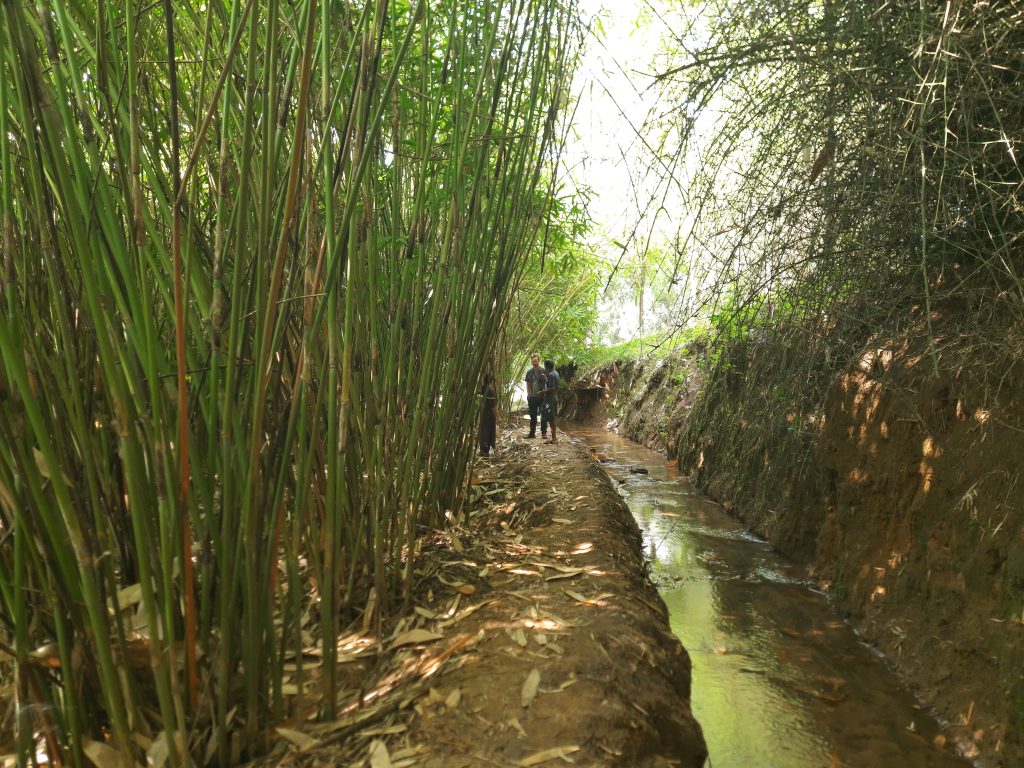
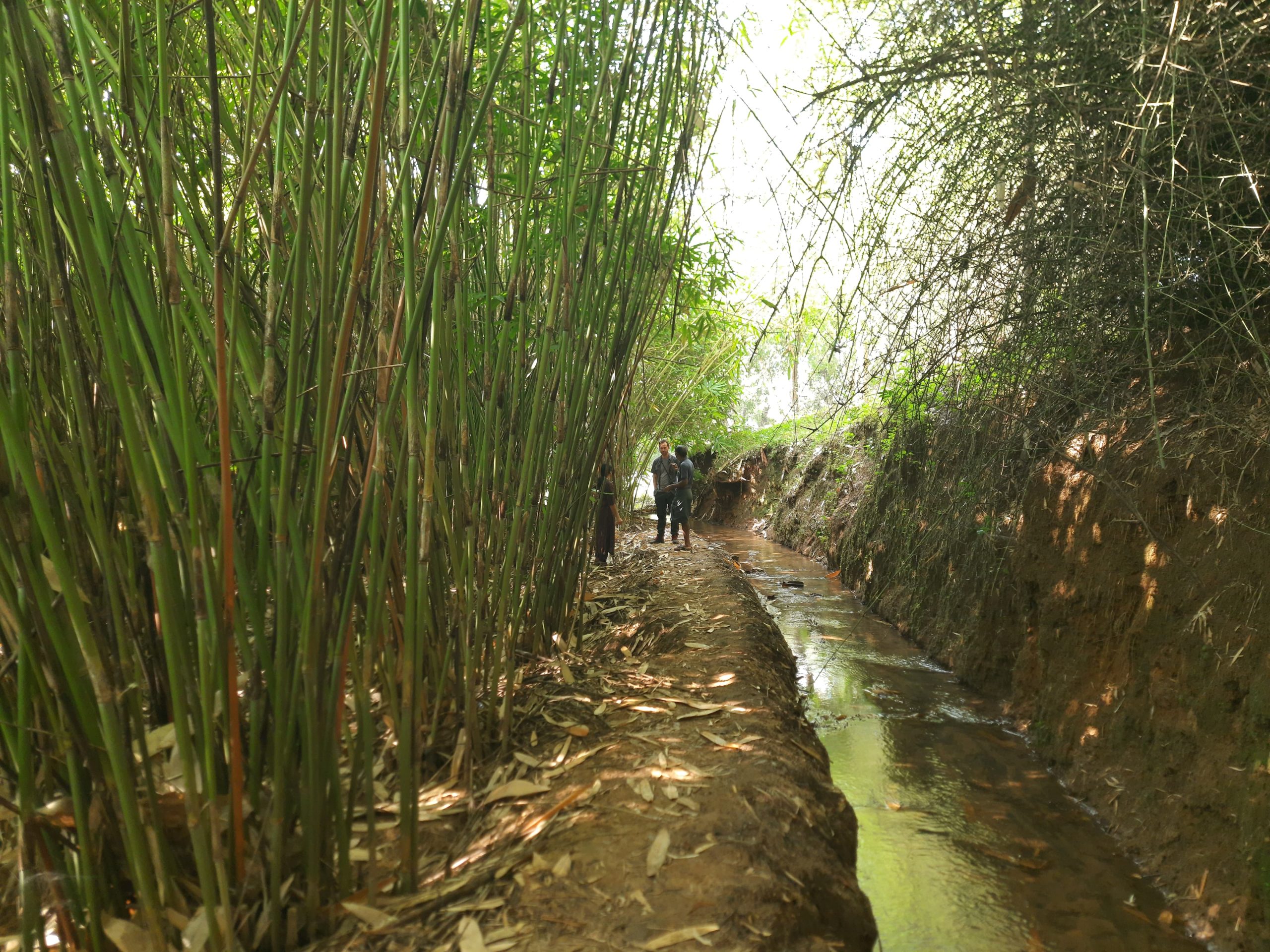
A small stream running through Bhaskaran’s Bamboo Farm | Photograph by Shajan M A / WTI
A framework for coexistence
The value of the Madaparampu model extends far beyond its economic returns. It offers a paradigm shift from a conventional conflict mitigation model to an integrated ecosystem management approach, demonstrating what the source describes as “quiet, practical coexistence.”
The three-acre bamboo forest has created tangible ecological benefits that serve both humans and wildlife.
- Microclimate creation: The plantation functions as what Bhaskaran aptly calls a “quiet therapy room made of bamboo.” The dense canopy generates a palpable coolness, softens the light, and provides a unique, tranquil environment, demonstrating a direct psychological and aesthetic benefit.
- Water security: Small streams running through the property remain active even during the peak of summer. This provides a critical, year-round water source and offers relief to local wild animals.
This ecological harmony is underpinned by Bhaskaran’s profound conservation philosophy. A casual conversation might suggest anger towards wildlife, but if you carefully listen, he is “never truly blaming the wildlife.” When an elephant occasionally enters his land, his response is one of acceptance: “Let it be. There is enough for all of us.” This is not a passive sentiment; it is an active management strategy. He has deliberately set aside space for an elephant to drink from the stream, a practical demonstration of his commitment to a shared habitat. Bhaskaran’s approach proves his role as a practical conservationist and sets a powerful example for the region.
The unpraised ecologist as a replicable model
This case study reveals that Bhaskaran’s venture at Madaparampu is a powerful counter-narrative to the perception of Wayanad as a region defined by agricultural decline and human-wildlife conflict. It is a working blueprint for sustainable agriculture that is at once economically profitable, ecologically restorative, and socially harmonious. The success of this model is not accidental but is built on a set of core principles that make it highly replicable for other small-scale farmers facing similar pressures.
The future of ecologically sensitive regions like Wayanad may not lie in large-scale, top-down interventions, but in the hands of “unpraised ecologists” like Bhaskaran. His work demonstrates a tangible, proven path for communities to live with the forest, not against it, securing both their livelihoods and the rich biodiversity of their home.
Story by Karthika Sulochana and Saneesh CS, Wayanad Conflict Mitigation Project, Wildlife Trust of India