When the wild came calling: A story of coexistence
On the evening of July 21st, the sky over Aiswaryakkavala in Seetha Mount (a village near Pulpally in Wayanad district of Kerala state) was thick with clouds, and the rain poured gently. A few men sipped tea and chatted outside a small roadside shop – the regular gathering. It was meant to be another idyllic evening in Aiswaryakkavala but the calmness was short-lived.
“It must have been around 4:30 p.m., when a tiger had emerged from the forested side of the Nagarhole Tiger Reserve”, recounted the locals. The animal had crossed the invisible state boundary marked by the Kannarampuzha Stream, and stepped into the farmlands, dotted with rubber, coffee, and pepper plants.
Just beside the tea shop, Ammini’s 2.5-year-old cow stood tied to a rubber tree with a nylon rope, as was routine when letting it graze freely on the green patch nearby. Ammini, its 72-year-old caretaker, had secured it there, just as she had done many times before. But this evening was different. The tiger, likely hungry, saw an opportunity. “Following instinct, it had attacked the cow and dragged it into a nearby agricultural field” added eyewitnesses who raised an alarm promptly. Ammini, whose house was just a few metres away, had rushed out but overwhelmed by shock, she lost consciousness.
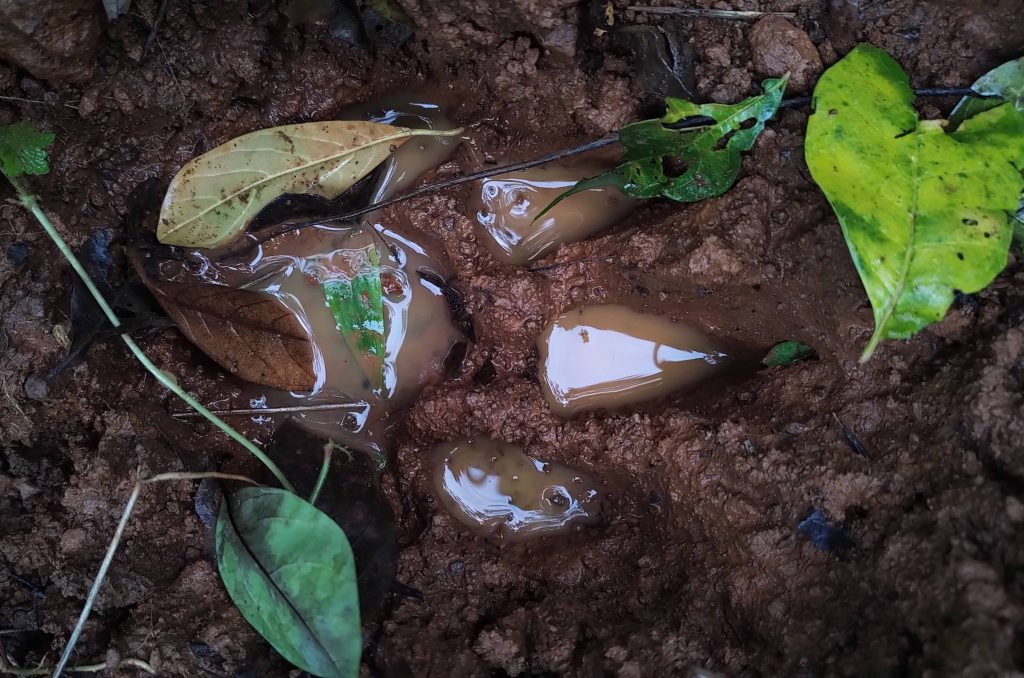
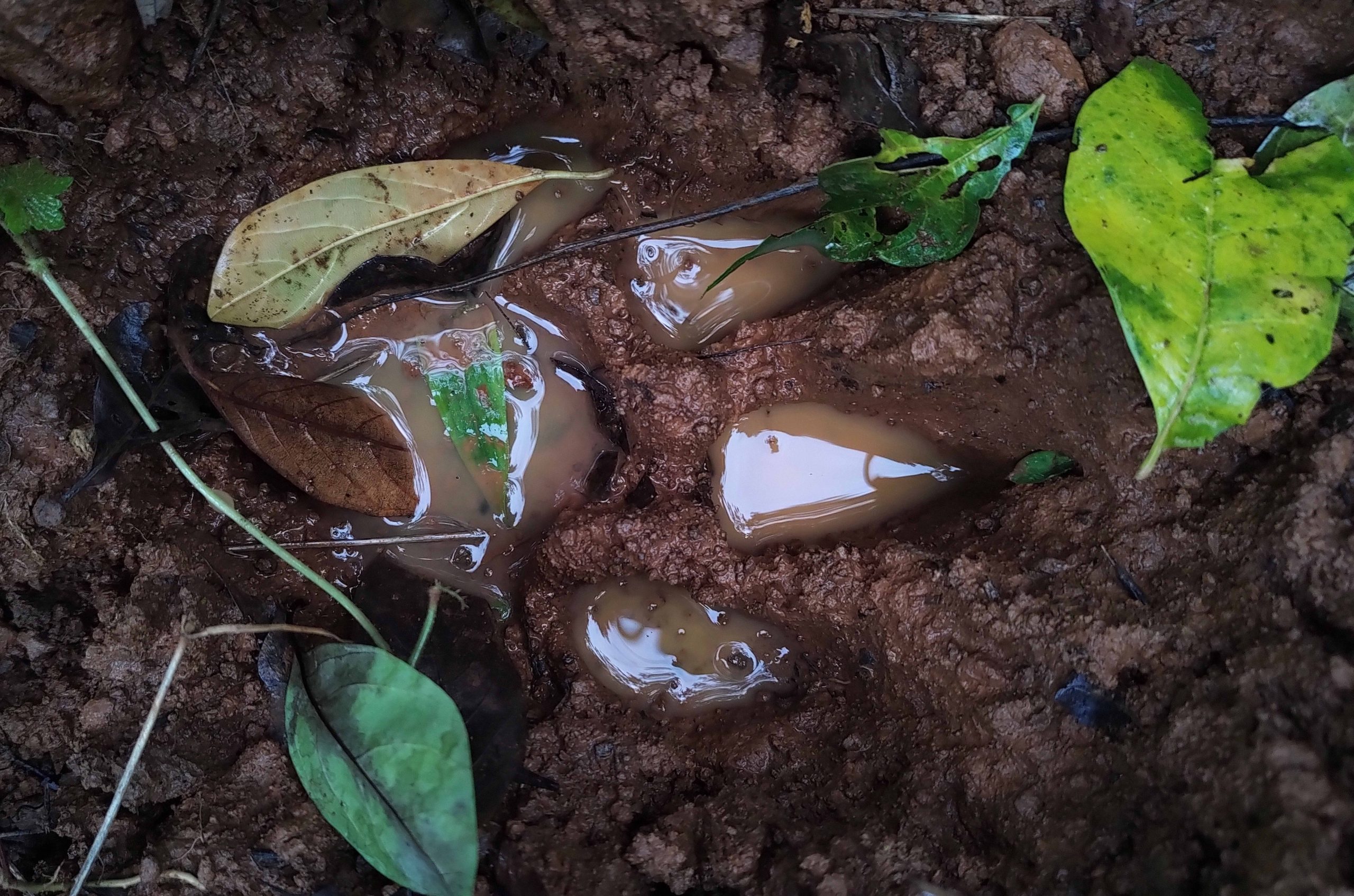
Tiger pug mark in Wayanad | Photograph by Sujnan MK / WTI
The startled cat disappeared into the plantations, leaving behind only silence and a deep sense of unease that usually follows such encounters.
“The tiger must have been hungry”
By the time forest department officials, accompanied by a veterinary team, arrived from Chedaleth Forest Office, the sun had set. They documented the incident, reassured the villagers, and promised Ammini her compensation for the loss. It was a necessary gesture.
Around 3:00 a.m., the next morning, the tiger came back. It tracked the cow’s carcass and quietly carried it back across the boundary into the Nagarhole Tiger Reserve. A few of us from the Wildlife Trust of India visited Ammini four days after the incident. We expected grief, maybe frustration or even anger. We certainly didn’t expect what was to follow.
Ammini did look tired, and her eyes carried a deep sadness. She had lost more than a cow – this was an animal she had raised, cared for and even spoken to. It was as if she had lost a child, yet she didn’t blame anyone. Not the tiger. Not the forest. Not the forest department.
“What can we do?” she said softly. “The tiger must have been hungry. It saw my young cow and took it. Now I have to take care of the others that are still with me.” In those few words, Ammini told a story of quiet strength, of empathy in the face of loss, and of understanding that the forest lives by rules beyond our control. It was a perspective rarely captured in headlines – a story deeper and more layered than what usually appeared in local media.
This wasn’t a tale of a victim but among the strongest examples of coexistence. In this stretch of northern Kerala, bordering Karnataka’s Nagarhole Tiger Reserve, boundaries are not just lines on a map. They are living frontiers where agriculture and wilderness, livestock and predator, human and tiger, meet – often uncomfortably, but sometimes with extraordinary grace.
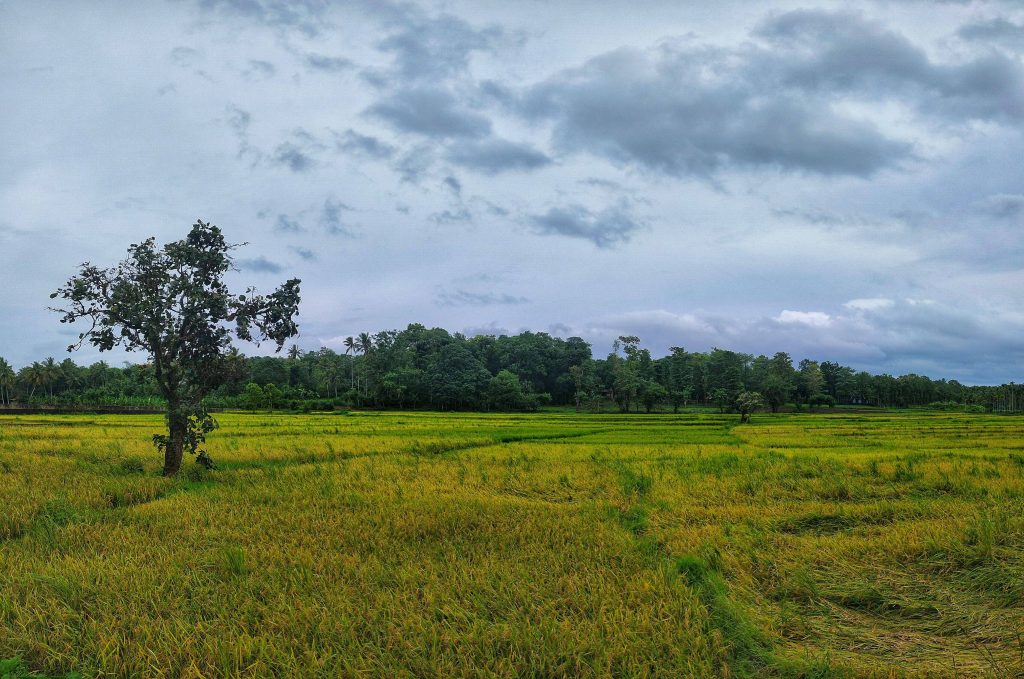
Forests fringes and agricultural fields in Aiswaryakkavala, Wayanad, Kerala | Photograph by Sujnan MK / WTI
The Edge of the Wild
The landscape around Aiswaryakkavala is both beautiful and delicate. On one side of the Kannarampuzha lie small houses, tea shops, small-scale agriculture fields and cattle sheds. On the other, dense deciduous forests echoing with the quiet trails of tigers, elephants and gaurs.
The forest fringes here are always shifting, shaped by seasons, crop cycles and the movements of wild animals. In places like Seethamount, people adapt constantly: they adjust where and when they graze livestock, how they build shelters, and what crops they plant. But even the most careful decisions can sometimes be no match for a hungry predator.
That day, Ammini’s cow became part of that larger, often invisible web of life. And Ammini, with a kind of humility only those close to nature seem to carry, accepted it.
“I don’t want to leave this place. I’ve lived here almost all my entire life,” she had added.
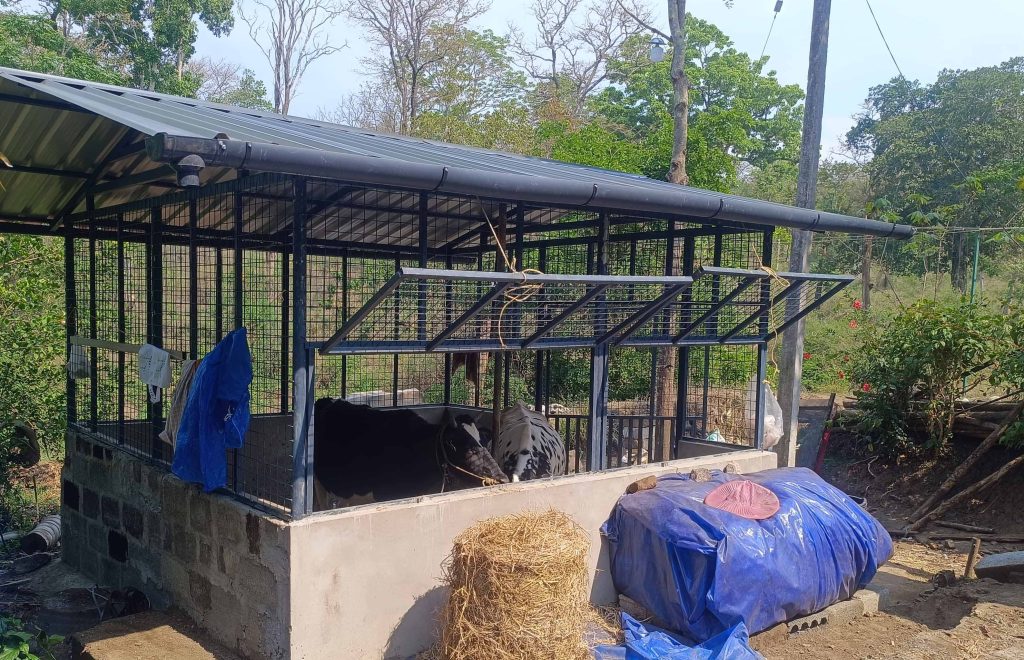
Predator proof shelter in Pulpally Village | Photograph by Sujnan MK / WTI
We also met Johny, who lived just a few meters further from Ammini’s house. He pointed to the pugmarks around his cattle shed. The tiger had come there too but couldn’t make a kill. “My shelter is predator-proof,” Johny had exclaimed. “We know these animals live just beyond the trees on the other side of Kannarampuzha, sometimes even resting in our fields. But no, we are not going anywhere. To be living in such a rich environment, this stress is the price we are happy to pay” added Johny.
More Than Just Compensation – headlines that matter
To the forest department’s credit, their response was swift. Officials and veterinarian had arrived within hours. They documented the event, explained the compensation process, and promised support. These steps matter. It helps build trust and prevents fear from turning into resentment and retaliation. However, it is equally important how we tell these stories. Too often, headlines focus on fear: “Tiger kills a cow in front of people.” or “Killer tiger on the prowl”. In doing so, we miss the real lesson.
For most villagers, it’s not about revenge. They want systems that work, officials who show up and the space to grieve not just for the loss of an animal, but for what it means to live with wildness. When institutions respond with care and efficiency, they reinforce trust in the delicate balance of coexistence – protecting both humans and wildlife.
Ammini’s story reminds us that coexistence isn’t just about animals. It’s about people – their wisdom, their grit, and their compassion, even for a tiger that took something dear. After the official inspection, Ammini, without hesitation, agreed to leave the carcass for the tiger to feed on. And the tiger did return. In doing so, Ammini didn’t just speak words of empathy — she lived them. “The tiger must have been hungry,” she had said. And her quiet decision to allow the animal to finish its meal showed that she truly meant it – offering not just tolerance, but understanding of a forest life that follows its own rhythms.
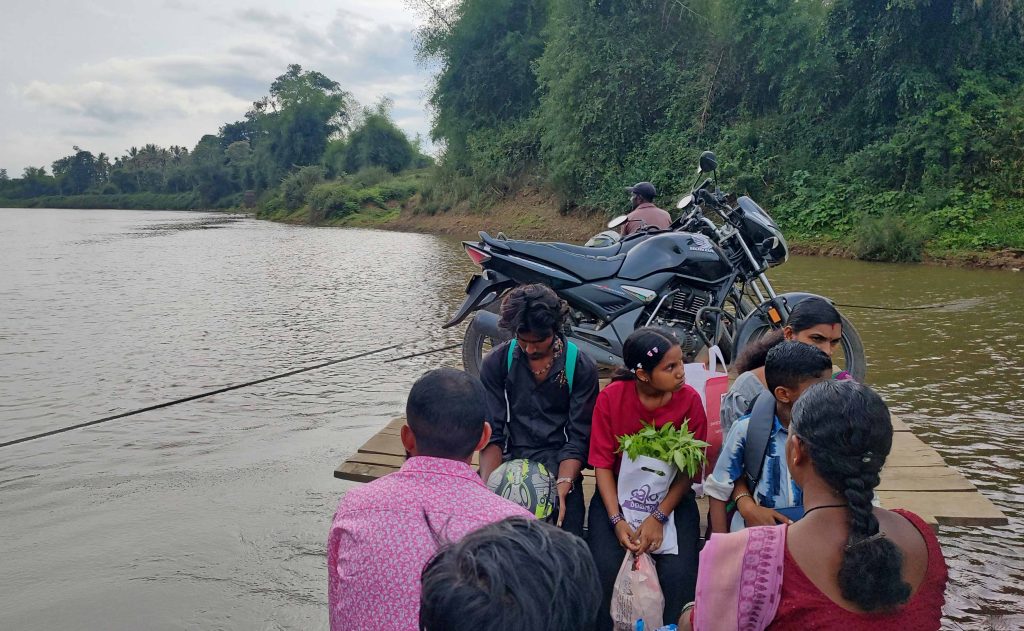
Villagers travelling along the forest fringes | Photograph by Sujnan MK / WTI
As conservationists, researchers, and policymakers, we often speak of corridors, compensation, and conflict mitigation. These are vital tools – but they are only part of the picture. Perhaps the most important, and often overlooked, thing we can do is listen. Really listen, to voices like Ammini’s and Johny’s. Not as victims, but as people with hard-earned knowledge of what it takes to share space with the wild.
The Future of Coexistence
The tiger will roam again. Perhaps it was the same one that visited Johny’s cow shed. Perhaps it will cross the Kannarampuzha once more. Perhaps another cow would be dragged into the wilderness of Nagarhole. We won’t be able to prevent every encounter but we must, as institutions, and as conservation experts, support the communities living on the edge of the wild.
To co-exist means seeing the tiger not as an enemy, but as part of a world we share.
As we left Ammini’s house, a breeze rippled through the rain-soaked fields. In the distance, a mother elephant and her calf grazed quietly beside domestic buffaloes. Life was returning to normal.
Saneesh CS is is an Assistant Manager & OiC with WTI’s Wayanad Conflict Mitigation Project.