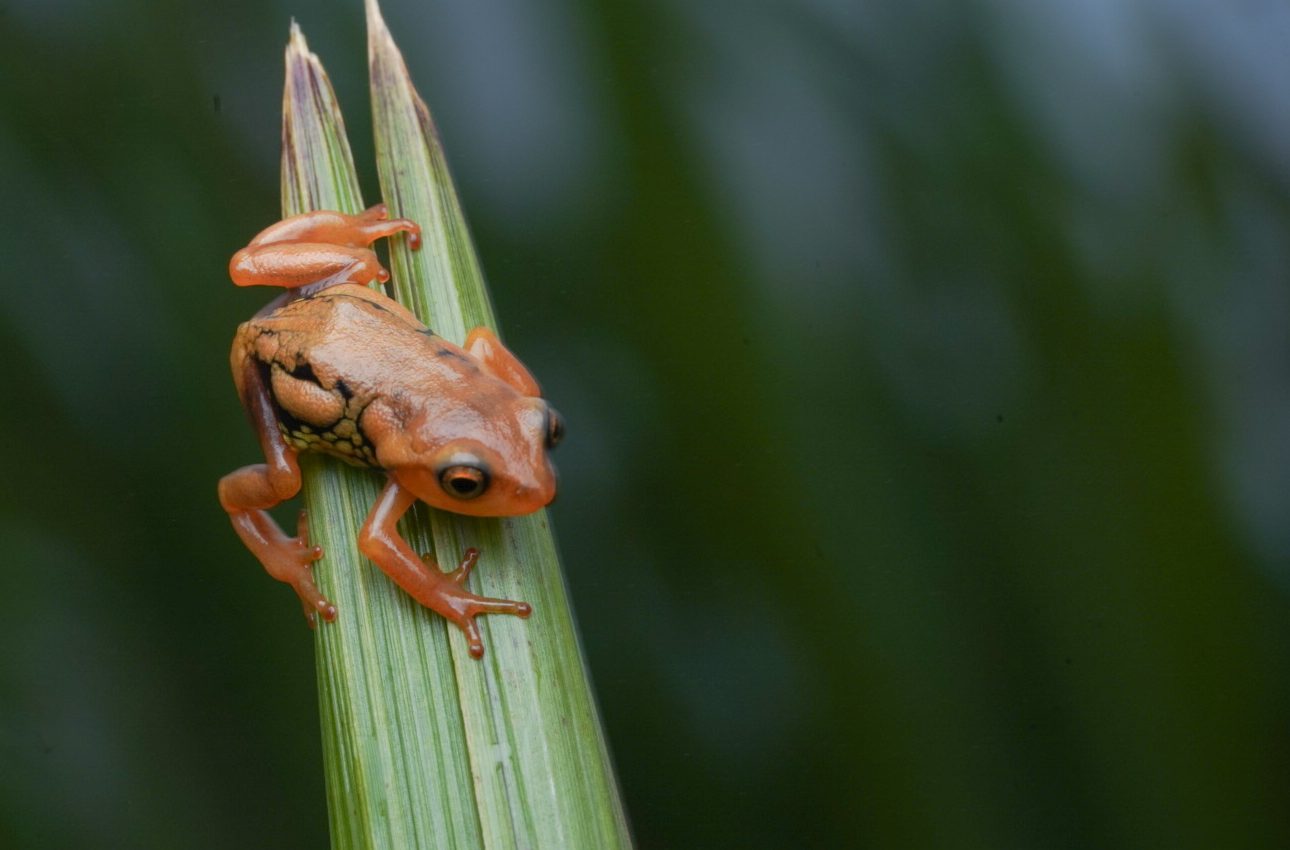
In Search of an Orange Sapphire in the Munnar’s Monsoon Hills
Nestled in Kerala’s Idukki district, along the Western Ghats, Munnar is beautiful year-round, but the monsoons adds a distinct charm to its landscape. It is also during this time that Munnar’s biodiversity, especially its amphibians, thrive.
I have known frogs to be used as bait to catch fish. This time however, my friend and colleague Abhijith used one to “bait” me into joining an amphibian survey! Raorchestes Resplendens, commonly known as the Resplendent grass frog, is critically endangered but is perhaps the most striking of frog species. I had only seen this species in photographs. Well, this was about to change.
Thrilled at the chance to see this beautiful species for the first time, I packed my gear and set off for our Munnar field station without a second thought. “We need to start the journey within two days and will be spending 4-5 days inside the Munnar’s high elevation grasslands, so please pack your essentials”, briefed Dr. Harikrishnan, the lead of WTI’s Amphibian Recovery Project. “There won’t be electricity and mobile network coverage, ” he warned. Heading into the isolated shola grasslands for four to five days never felt like a concern to me – after months of city life, I was longing for an escape like this.
“One more thing…” Dr. Hari added, “the vehicle won’t go all the way, so there will be a 13 km hike.” My brain immediately hit the panic button! “13km on foot? ! Through the hills?” I asked with a mix of excitement and dread in my voice.
“Yes, but don’t worry, it will be a great experience for you.” Abhijith said with a smile on his face. He was buzzing with excitement about the survey, while I was quietly worrying about my lack of physical prowess for this adventure. Forcing a smile, I accepted my fate and replied, “Yes, let’s go.”
Over the next two days, we prepared for the long journey ahead, stocking up on food, water, electronics and some medicines. Finally, the day arrived, and a team comprising of Dr. Hari, Abhijith, me and three forest guards from the department left Munnar in the wee hours of the morning. After an hour-long drive, the vehicle reached the drop point.

The team at the drop off and the beginning of the trek
We began our trek
The guards carried the food, water and other supplies we bought, while the three of us were left to manage our own luggage. My backpack was stuffed with some clothes, a rain coat, a laptop, two cameras, lenses, a mic and five-six power banks. One of the guards lifted my backpack, looked at it curiously, and smiled softly. I became curious, rather inquisitive about this untimely appreciation.
“Nothing… Nothing. Let’s move,” he replied, and started walking. After completing the first two kilometres, I understood the meaning behind his smile. Carrying so much weight while trekking was clearly not a good idea, but I didn’t have a choice, as all of it would come in handy for the shoot. Taking small breaks along the way, I continued the walk.
After covering the first hill, I felt like I was entering a dream world. There were droplets of mist on my eyelashes, and in no time, we were shrouded under a white foggy blanket. Though I was sweating, a chill crept through me. We reached the campsite around 12 in the afternoon. Four other guards who were preparing to head home after finishing their shifts, welcomed us each with a cup of black coffee.
“Let’s rest up so we can start the search by late evening,” exclaimed Dr Hari. After clearing the leeches and dirt from our shoes, Abhijith and I sat down with our cups of coffee, loking forward to the best part of the day that was yet to be.

Abhijith looking for frogs and other critters during the trek
As the sun began to set beyond the monsoon hills of Munnar, we stepped out of the camp in search of the frog. Dr. Hari and Abhijith led the search, while I eagerly followed with my camera. An hour passed by and we still haven’t found our first frog. As darkness set in, the guard insisted that we go back to the camp since it’s not safe to walk in the dark without proper light. A light drizzle accompanied us on the way back. We would have to try the next day.
On the way, we noticed a small movement in the grass, which Abhijith identified as a large-scaled pit viper. Keeping a safe distance, I took a glance at the snake. Snakes are something that I prefer to see in photos, while Abhijith, who is passionate about them, took time to explain the species and guided me in taking a photograph. After a few moments spent in learning more about the snake, we continued back to the camp.
New day with renewed hopes
The next morning, with one of the guards alongside, we headed to a nearby Shola forest patch. Entering Munnar’s Shola Forests during monsoon comes with its own set of challenges. The most concerning thing were the multitude of leeches. They were everywhere, often infiltrating through small gaps in one’s clothing. Nevertheless, we began our search. We hoped to find the Nyctibatrachus deccanensis, commonly known as the Shola night frog or Deccan night frog. Dark in colour, these frogs camouflage easily with the darkness of the forest. Luck however was on our side and we spotted two individuals near a stream.

Dr. Hari and Abhijith discussing the plans ahead
The frog calmly perched and stayed still for Dr. Hari and Abhijith. Sadly, it seemed far less accommodating towards me. Just as I was setting up my frame, it vanished. After searching for a few more hours, we headed back to the camp. The grass frog, however, still remained a mystery to my eyes. As evening set in, Dr. Hari pointed out to the “ear candy”—calls and responses echoing all around. The calls created a ventriloquist effect, making it hard to pinpoint their exact location before the rain returned. It was time to head back and rest.
Dr. Hari hoped that the frogs would emerge after the showers and before the scent of the rain faded. The resplendent is known to emerge from their hiding places. We switched on our headlamps and torches to continue the search. Suddenly, one lamp started strobing rapidly. The guard and I walked toward it, noticing another light moving in the same direction. I wondered quietly to myself who it could be and what might be happening.
As we approached, the light from our lamp revealed Dr. Hari’s smiling face– he had found the frog. Hidden within the thick grass was the Resplendent grass frog. This tiny, 2 centimetres frog had brought me on a 13-km trek through the hills. With a mix of emotions, I finally had my first sighting of this beautiful amphibian! While Dr. Hari and Abhijith recorded their observations, I was simply soaking in the glory of the frog.
Within a few minutes, we spotted two more individuals. I took a few photos for documentation purposes, but wasn’t satisfied. After close observation, both individuals were released at the same spot and we called it a day.
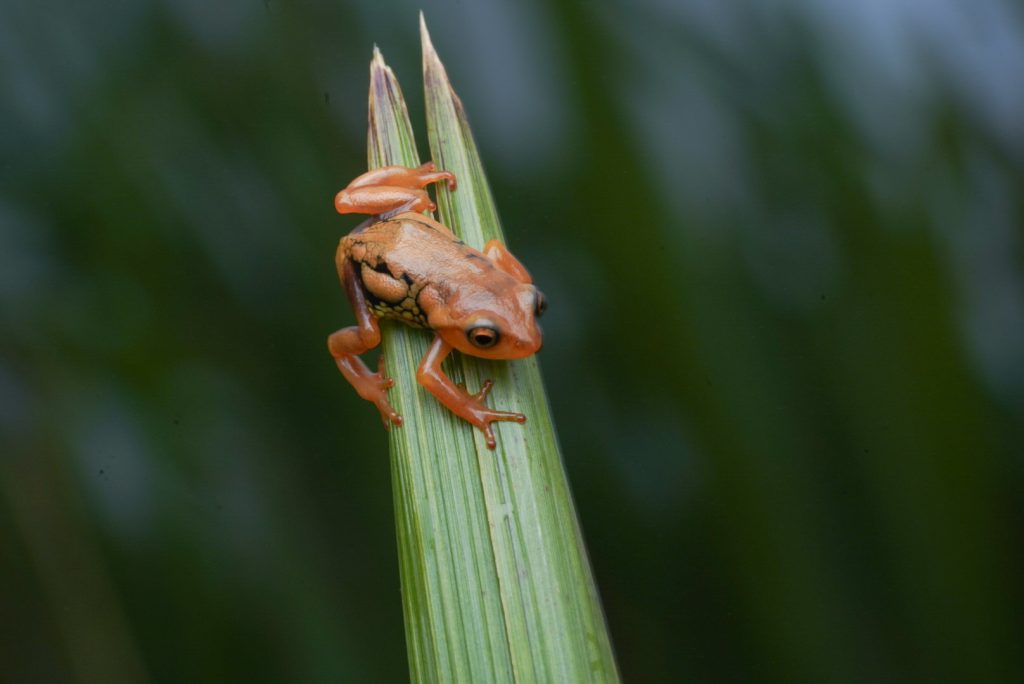
The resplendent grass frog perched on a blade of grass
Coffee, leeches and a photograph
As the first rays of light touched the grassland, we resumed our search next morning. To my surprise, this time around we managed to spot another grass frog with ease. In the misty foothills of Munnar’s hills, I once again encountered a resplendent grass frog—but this time without the cover of a dark sky. I lay down on the ground and moved as close as I could to the frog. It was perched on a blade of grass, tiny droplets of dew resting on its body, giving it the appearance of an orange sapphire.
Without further ado, I captured my first image of the resplendent grass frog beneath the soft blue sky. The tiny frog stayed long enough for several photos and videos, before finally leaping into the thick bushes.
As we wrapped up the visit, the three of us sat together and began talking about the varieties of frogs and amphibians we had encountered. I was mostly a listener; the sheer number of species and scientific names left me confused, but I was happy knowing that I had photographs one of the very frogs they were talking about.
We had an early dinner, as the guards had prepared a feast for us. While eating together, we decided to keep frogs and amphibians off the table for the time being and instead talked about movies, family, and even the stock market. Even then, frog calls drifted in from outside, as though they were engaged in their own lively conversation about the humans who had come to observe them.
The following morning, we woke up, got ready, and prepared ourselves for the journey back. As I sipped my final cup of black coffee in the hills, gazing out at the vast, mist-covered green grasslands, my thoughts drifted back to the cup of coffee I had on the very first day in this place. Between those two cups, lay days filled with constant leech bites, long treks across the hills, zero network, and moments when I was truly lost in nature’s beauty – alongside the unforgettable encounter with the resplendent grass frog.
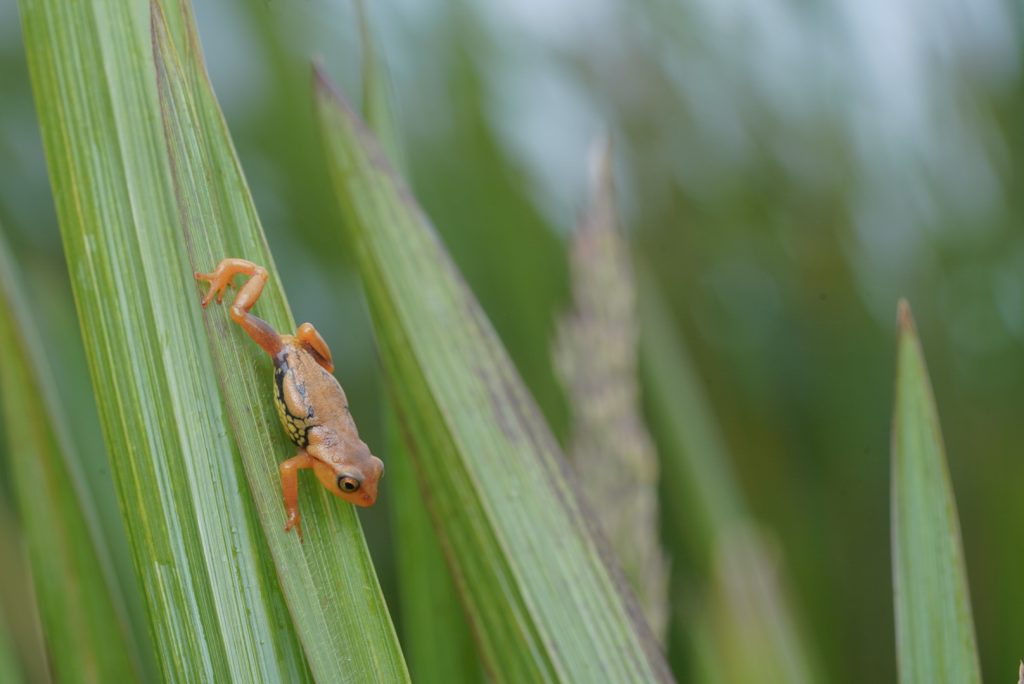
The jewel of Munnar’s monsoon hills – resplendent grass frog
“The jeep driver will pick us up around noon, at the same spot where he dropped us,” Dr. Hari said. “So let’s get moving.” His words gently pulled me back to reality—my own two feet still had 13 km to cover before I would see the four-wheeler again. I walked all this way, I reminded myself, I can walk back too.
With nothing extra to carry on our way back, the guards kindly offered to help with one of my bags. Even before he finished his sentence, I made sure the bag was already in his hands. As we walked out along the trail, surrounded by the calls of countless frogs, I couldn’t help but wonder—perhaps somewhere in the grass, a resplendent grass frog was watching its guests leave.
Story and photographs by Sreenanth K, Programme Officer, Communications