From Dialogue to Declaration: Tharu Community bans Ritualistic Hunting in West Champaran
Indigenous institutions are being increasingly recognised as influential contributors to biodiversity conservation. This is especially true for landscapes where protected areas intersect with human use. Research shows that traditional systems of governance, traditional ecological knowledge and community norms play a crucial role in regulating resource use and sustaining biodiversity. A striking example is the Tharu community of West Champaran, located in the Terai region along the Indo–Nepal border.
From hunters to protectors
Historically, hunting has been a key ritualistic practice among Tharu communities. The practice has, however, been driven by strong conservation-oriented norms. The Barna Festival, for instance, enforces a period of strict abstinence from entering forests or harming wildlife, reflecting an embedded ethic of ecological restraint and reverence for nature, highlighting the community’s indigenous conservation systems.
However, with wildlife spaces shrinking and wildlife being continuously lost to illegal trade, community enforcement against any form of hunting has been the need of the hour. Ritualistic hunting, though historically rooted in custom, has increasingly come into conflict with the need to conserve biodiversity and maintain ecological balance in the Terai Landscape—one of South Asia’s most important conservation regions. The Tharuhat Region lies in close proximity to ecologically sensitive forest areas and wildlife habitats associated with the larger Valmiki landscape, making community stewardship especially important. In August 2024, the Wildlife Trust of India and the Gumastas of Santpur Village initiated a discussion on ritualistic hunting and its implications for wildlife conservation. Gumastas are traditional village eldermen or aldermen within the Tharu social system and often play a central role in influencing customary practices and social norms. In the course of what was essentially a “chai pe charcha”- style exchange, some of them suggested initiating a dialogue with BTKM to explore the possibility of formally declaring a ban on ritualistic hunting, on the lines of a similar community-led conservation intervention supported by WTI in Manipur.
Through a sustained process of dialogue, advocacy, and community engagement, supported through grants from the Bureau of International Narcotics and Law Enforcement Affairs (INL) under the project “Strengthening India’s Wildlife Crime Prevention and Law Enforcement Measures along the India and Nepal Border”, WTI played the role of a facilitator and catalyst, helping create space for dialogue, trust-building, and local ownership around the issue.
The formal declaration was put in place on the 26th of March 2026. The Bharatiya Tharu Kalyan Mahasangh (BTKM), the apex representative body of the Tharu community, officially promulgated a ban on ritualistic hunting across the Tharuhat Region of West Champaran District. The declaration was made by the Secretary of BTKM in the presence of members of the Gumasta Sangh and Mukhiya Sangh, representing the traditional leadership institutions of the Tharu community. For a region where customary institutions continue to shape social conduct and community decision-making, this development marks a deeply important moment in the relationship between indigenous governance, social responsibility, and conservation.
A conservation milestone led by the community
The declaration needs to be credited to the persistent efforts of the WTI Santpur V3 (Village Vigilance volunteer) team, led by Mr. Aniruddh Sokhait, who remained engaged throughout the process through repeated field-level dialogue, community outreach, and follow-up with key stakeholders. Communicating the intent behind the proposal, dispelling apprehensions, and ensuring that the message was understood not as an erosion of culture but as a conscious act of ecological responsibility required patience and sustained dialogue. This process unfolded over nearly one and a half years before finally culminating in the official promulgation.
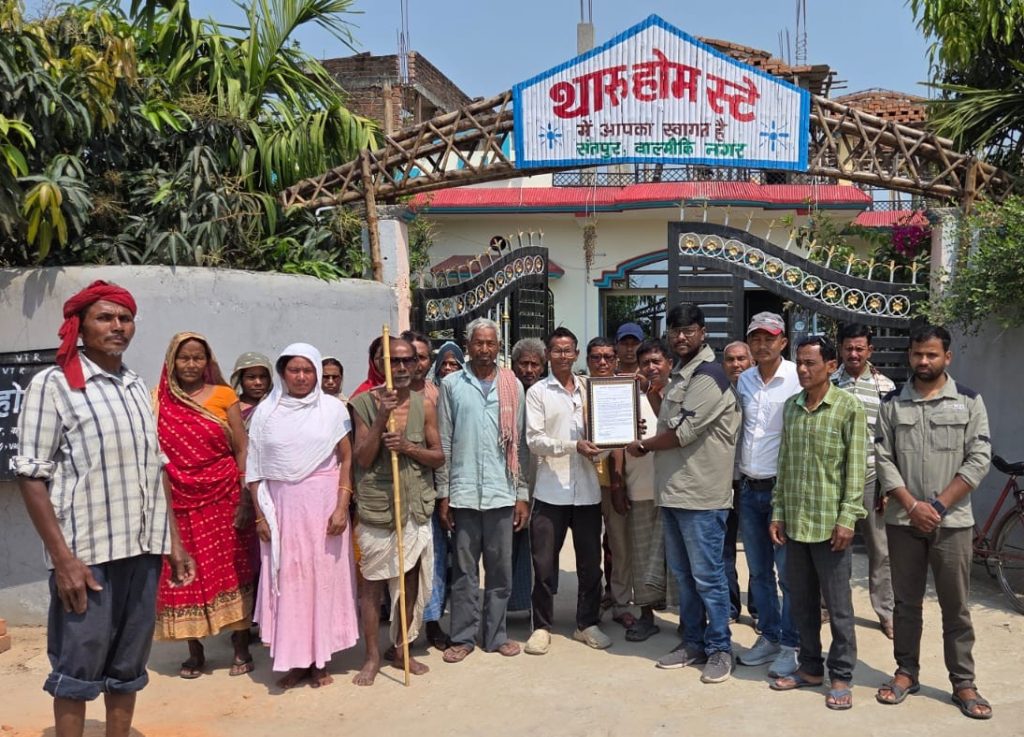
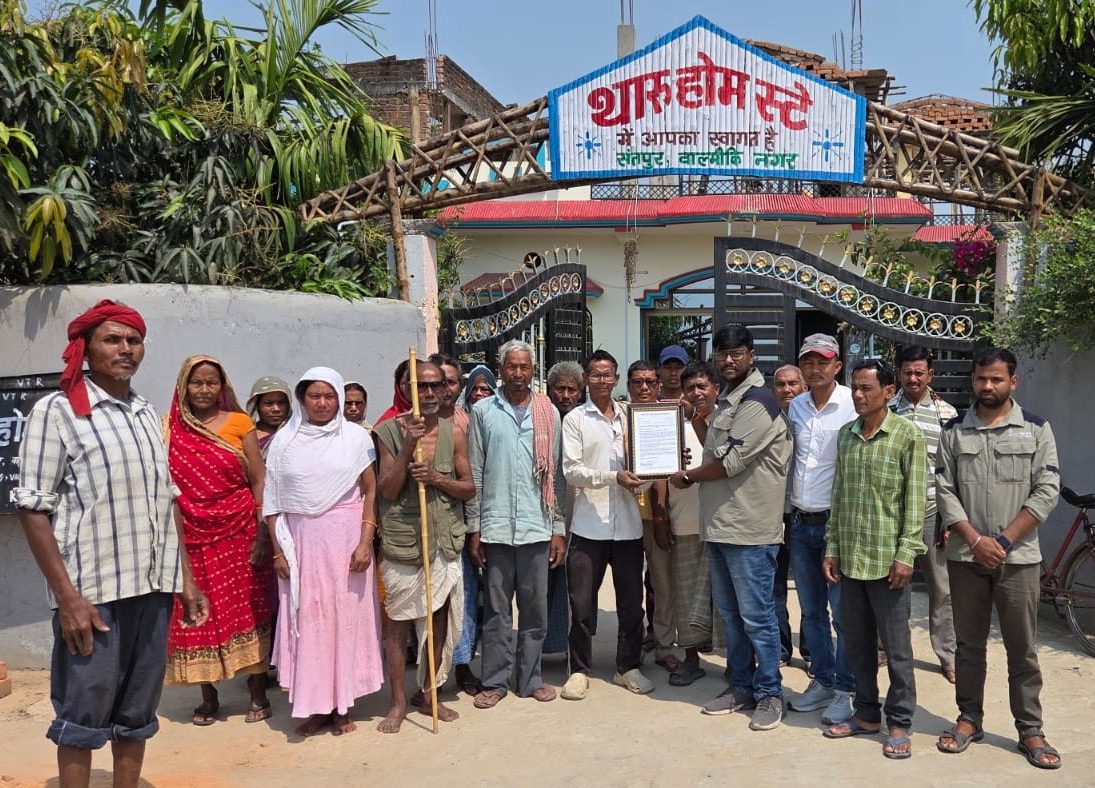
Handing over a copy of the ‘Declaration of Ban on Ritualistic Hunting’ in the Tharuhat region to the Gumasta of Santpur Village | Photograph by Harilal Kaji
An example of the landscape
The significance of this ‘ban’ becomes even clearer in the context of Tharuhat itself, referring to the native Tharu-inhabited belt of West Champaran District in Bihar, stretching across several villages and settlements where the Tharu community has historically lived, sustained its cultural identity, and maintained traditional forms of self-governance. Tharuhat is not merely a geographical region, but also a socio-cultural landscape where community institutions continue to hold deep legitimacy. This region is co-terminal with the fringes of Valmiki Tiger Reserve (VTR) and stretches roughly across five community development blocks of West Champaran District (Bagaha-II/Sidhaw, Ramnagar, Gaunaha, Mainatand and Sikta). For generations, social order and customary practices within Tharuhat have been shaped by institutions such as the Gumastas and Mukhiyas. In this setting, BTKM occupies a particularly influential position as the apex representative body of the Tharu community in Bihar. Decisions taken under its aegis are widely respected and often treated with a seriousness comparable to formal law within the community.
By officially promulgating this ban, BTKM has demonstrated the power of community institutions to act as agents of conservation and social change. The decision reflects not only a growing awareness of wildlife protection within the Tharu community, but also a willingness to reinterpret tradition in a way that is compatible with present-day conservation values. More importantly, this development stands as a powerful example of how meaningful conservation outcomes are often achieved not only through enforcement but through trust, dialogue, and social legitimacy from within communities themselves.
Pavel Ghosh is the senior field officer with WTI’s Strengthening Cross-Border Wildlife Crime Prevention and Law Enforcement between India and Nepal Project, currently posted in Valmiki Tiger Reserve.