The Emerald Bridge: From the Cannanore to the Coringa Mangroves
Our journey began at the break of dawn. From Kannur, the land of looms and lore, and through the rugged Malabar Coast, we had boarded the train for the sprawling deltas of the Godavari. As a conservation enthusiast, the cross-country journey wasn’t just for soaking in the scenery, but rather a mission to bridge two worlds of green. Our starting point was the Peruvamba River, the heart of the Kannur Kandal Project managed by the Wildlife Trust of India (WTI). For years, we had heard whispers about Kannur’s “distant relative” on the East Coast – the Coringa Wildlife Sanctuary in Andhra Pradesh. While Kannur’s mangroves are scattered like emerald jewels across private lands and tidal creeks, Coringa represents one of the largest continuous stretches of mangrove forests in India. With a notebook full of questions, I boarded the train.
Lessons on the run
The changing landscapes from the Western to the Eastern Ghats is a lesson in geography. As the train wound its way through the Palakkad Gap and into the plains of Tamil Nadu before heading north toward Andhra Pradesh, I reflected on the insights shared by the WTI team in Kannur – In Kerala, the major conservation challenge has been a fragmented mangrove habitat. Most mangroves patches here are privately owned, meaning the WTI team has to act as much as diplomats as they do as ecologists. We try convincing these local landowners to preserve mangroves rather than converting them into shrimp farms or coconut groves. I wanted to see if the sheer scale of Coringa changed the conservation dynamic, or brought in new challenges.
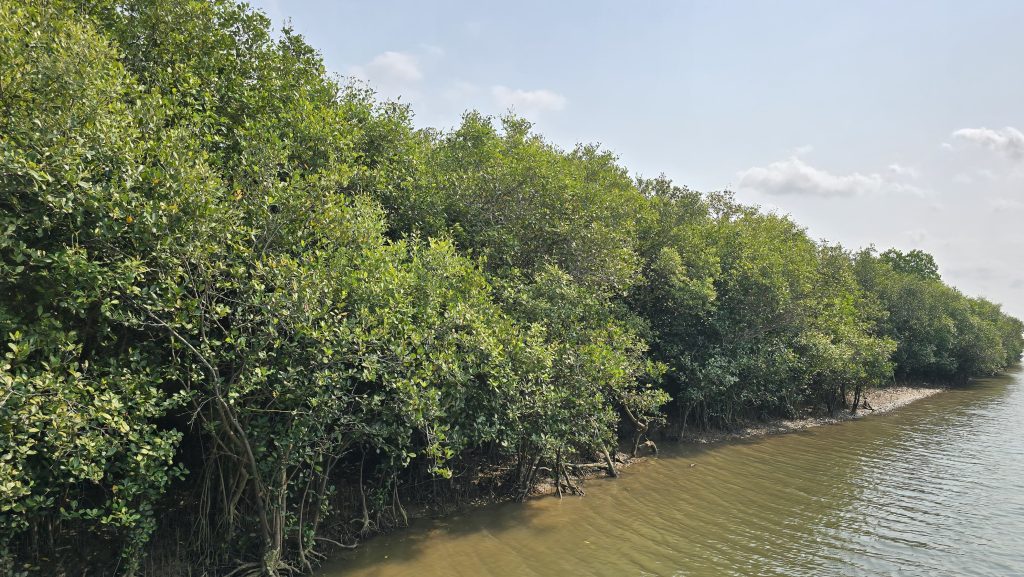
Coringa Wildlife Sanctuary | Photograph by Vimal Lakshamanan N V/WTI
Arrival in the land of the Godavari
Stepping off the train in Kakinada, the air felt different—thicker, saltier, and infused with the scent of the sea and the nearby industrial hum of the port. Kakinada is a city of contrasts, where massive shipping vessels share the horizon with ancient tidal forests. I met the section forest officer near the Kakinada anchorage. As we drove toward the sanctuary, the urban sprawl gave way to a shimmering landscape of mudflats and tangled roots.
It would be important to note that Coringa is situated in the estuary of the Godavari River. It is the second-largest stretch of mangrove forests in India, spanning over 235 square kilometers and serves as a vital barrier against cyclonic storms and tsunamis, much like the protective fringes the WTI is trying to restore in Kannur.
Deep into the Labyrinth of Coringa
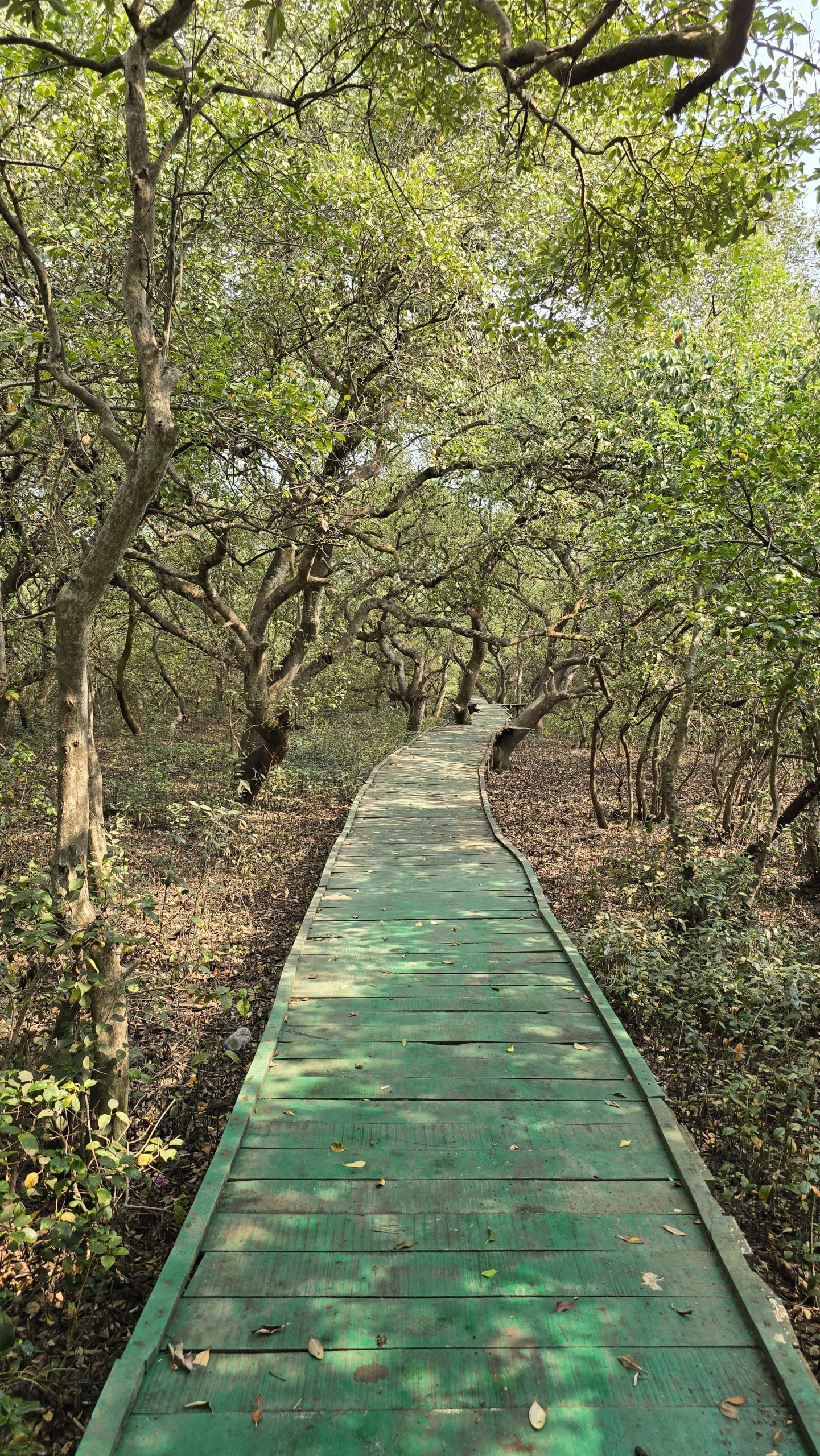
Entering Coringa is like stepping into a prehistoric world. We navigated the wooden boardwalks that snaked through the dense canopy of Avicennia marina, commonly known as the white mangroves. The scale was rather staggering. Unlike the pocket-sized groves in Kannur, Coringa is a vast, interconnected lungs-of-the-coast. However, the mission remained the same – survival.
The shifting tides of the Bay of Bengal carry more than just salt and silt; they carry the legacy of a resilient wilderness. We boarded a boat to the Hope Island, a verdant sentinel within the Coringa Wildlife Sanctuary. Nestled like a biological fortress between the churning Kakinada Bay and the open ocean, the shores of the Hope Island play host to an ancient ritual. Every year, under the silver glow of the moon, olive ridley sea turtles, guided by an internal compass as old as the currents themselves, emerge from the surf. They find in Hope Island a rare sanctuary – a patch of soft sand where their hatchlings can begin their precarious journey toward the horizon. While the western Malabar coast struggles to hold onto its botanical heritage, Hope Island tells a story of staggering abundance, true to its name. On the far western shores of the Indian Subcontinent, in Kannur, the Lumnitzera racemosais a rare treasure where researchers might count a mere 50 individuals across vast stretches of coastline. In contrast, on this eastern outcrop of the country, the narrative changes. In the West – It’s a fragile population fighting for a foothold. On Hope Island – A dominant force. Hundreds of Lumnitzera racemosa thrive on this single island, their roots weaving a dense, protective lace through the brackish water.
Hope Island is a masterclass in mangrove restoration. As the trees grow, they form a living shield that protects the mainland from the fury of the Bengal Bay. In this quiet corner of Coringa, nature isn’t just surviving—it is reclaiming its throne, one seedling at a time.
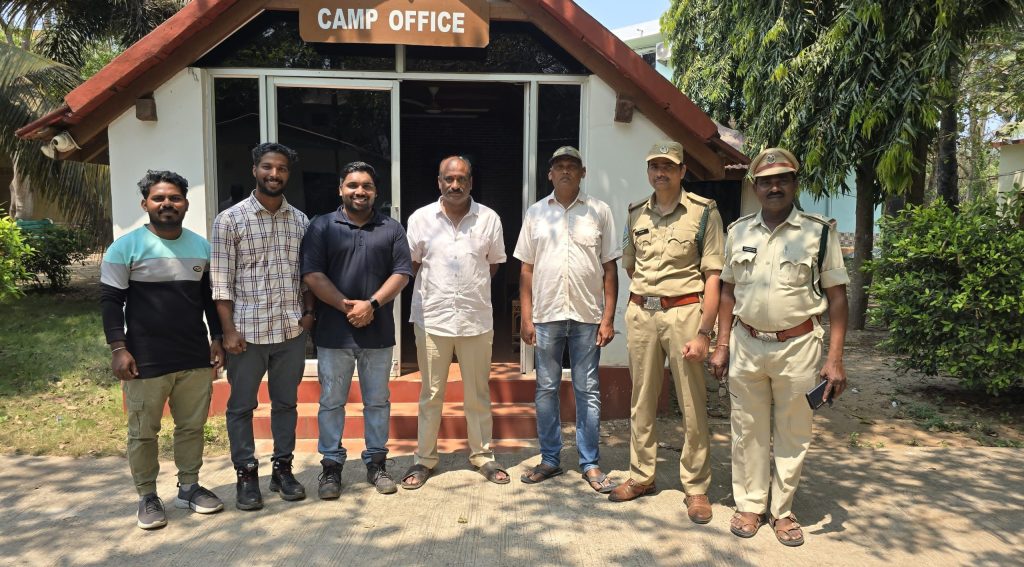
Team WTI and the staff of Coringa WLS
An Exchange of Ideas
I spent the rest of the afternoon speaking with the sanctuary guards and local researchers. We shared photos of our Kannur Kandal Project’s nursery—where thousands of saplings are raised in polybags, to be sentinels of the shores. The Coringa team was especially fascinated by the WTI’s “Mangrove Interpretation Centre” in Kunhimangalam, which focuses heavily on educating the youth. In Coringa, the focus has been on ecological restoration. Being a protected area under the Forest Department, they don’t face the same hurdles of ‘privately owned mangrove lands. Instead, they battle plastic influx from the river and the shifting salinity levels caused by upstream dams.
The Iconic Inhabitants of Coringa
Kannur’s mangroves are known for the unique species of dragonflies and migratory birds, but Coringa is the undisputed kingdom of the fishing cat (Prionailurus viverrinus). As we glided through the Gautami-Godavari river channel on a silent boat, I scanned the stilt roots. We didn’t see the elusive cat, but we saw its tracks in the soft silt. We did, however, spot dozens of Smooth-coated otters frolicking near the banks – a sight that immediately brought a smile to my face. Back in Kannur, our team often monitors similar otter populations in the Valapattanam River. As the sun began to set, casting an orange glow over the pneumatophores (breathable roots) sticking out of the mud, I began to synthesize what I had learned.
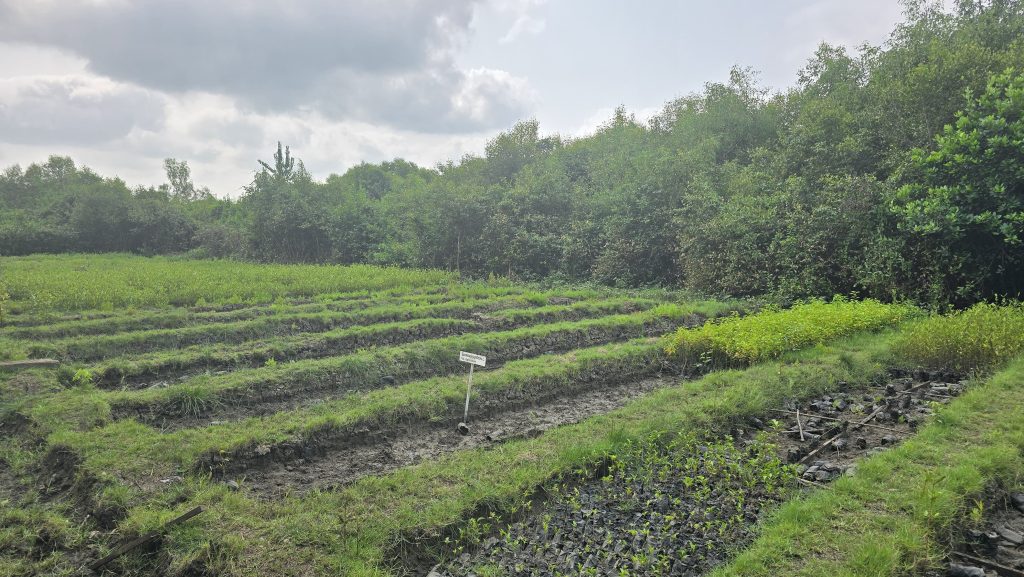
Nursery at Coringa WLS | Photograph by Vimal Lakshamanan N V/WTI
Taking back the lessons
The WTI staff in Kannur are essentially “Land Securers”. We use a model of purchase and protection. In Coringa, the staff are “Landscape Managers”, dealing with the hydrology of an entire river delta. On my final evening in Kakinada, sitting by the beach, I realized that the distance between Kannur and Kakinada isn’t just measured in kilometers. It’s measured in the shared passion of the people working to save these “blue carbon” sinks. The Kannur Kandal Project provides a micro-level blueprint for saving fragmented ecosystems– a model that could be used in the encroached outskirts of Kakinada. Conversely, Coringa offers a macro-level vision of what a fully recovered mangrove ecosystem looks like – a goal for the WTI team to strive towards as they connect the dots in Kerala. I left Andhra Pradesh with a bag of seeds (metaphorically speaking) and a notebook full of data to bring back to the WTI team. The journey confirmed one thing – whether it’s the Arabian Sea or the Bay of Bengal, the “Guardians of the Coast” speak the same language—the language of the tide, the mud, and the resilient mangrove tree.
Story by Dr. Sanal C Viswanath & Vimal Lakshmanan N V, Kannur Kandal Project, Wildlife Trust of India