
Tiger between the core and the edge
In the verdant sprawl of the Western Ghats, the boundary between the wild “core” and the human “edge” is rarely a hard line; it is a membrane, permeable and reactive. During the second week of October 2025, our field team witnessed a visceral demonstration of this connectivity. Two emergency calls, separated by mere hours, revealed how the administrative management of death in the forest can inadvertently script the survival strategies of the living.
Nature’s rule: The tiger needs to eat
The day began with a grim yet necessary task, part of our routine, attending a postmortem. This time, it was for a young elephant calf deep inside the forest near Valluvady in the Kurichiat Range.
Upon arrival, the cause of death was evident: natural predation. Field verification confirmed the calf had fallen to a tiger, the carcass partially consumed. Here, my fellow team member Shajan, a sociologist specialising in conflict mitigation, proposed an ecological intervention: non-intervention. He urged the staff to abandon the carcass to the tiger immediately. While the team insisted on proceeding, field verification confirmed that the death was indeed a tiger kill. The tiger had partially consumed its meal, but because the death of an elephant is a serious matter, it took a while to complete the official procedures.

Remains of an elephant calf killed by a tiger in Wayanad Wildlife Sanctuary | Photograph by Shajan M.A./WTI
The tiger needs to eat, and the herd must bear the loss. Recognising this, the operation team ultimately made the right decision to leave the remaining carcass right where it fell. However, we unwittingly erected a barrier of human scent and activity around the kill.
The tiger wasn’t waiting!
Before the postmortem was complete, we received a second call around 3:00 p.m., this time from Veetikutty, a village near the forest edge. The predator had followed its need for prey right into the human-dominated landscape.
Athul, a young grazier, was tending his family’s livestock along the sanctuary’s fringe when the tiger appeared, not more than 50 meters away. In a swift, terrifying motion, it seized a three-year-old Jamunapari goat and vanished back into the sanctuary.
When our team, including the Deputy Ranger, reached the scene, the family was understandably shaken. Shajan met with Athul and his family, providing necessary support and reassurance. The loss of livestock was, needless to say, a direct blow to a family’s livelihood and sense of security.
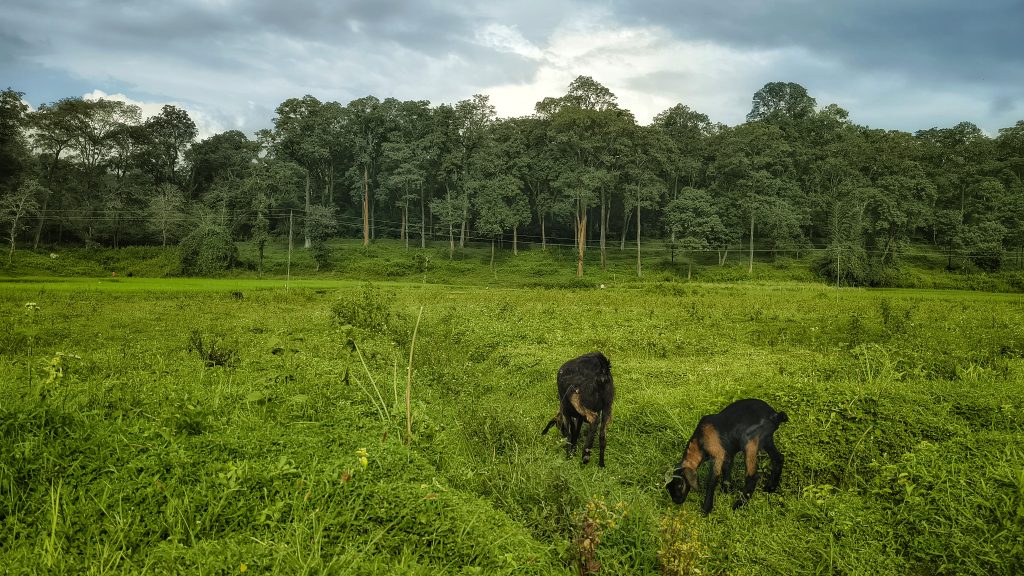
Livestock grazing in the forest fringes in Wayanad Wildlife Sanctuary | Photograph by Sujnan MK/WTI
Lesson woven in conflict
These two incidents, the elephant calf and the goat, were likely driven by the same hungry tiger.
As is standard behaviour for big cats (and many other predators), they often guard or hide a kill to feed on it over several days. This tiger probably returned for the leftover carcass, but it couldn’t afford to wait for us to finish our documentation of the dead, an official necessity for us.
When we respect the tiger’s right to hunt in the core (by leaving the calf), we see the natural order. But when that hunger pushes it to the edge, the tragic cost is borne by the forest-dependent communities.
The lesson is stark. At the core, we must respect the tiger’s agency. When we disrupt its natural feeding cycle, even for necessary officialdom, we risk exporting its hunger to the edge. Our presence that day was meant to document the dead; it had reshuffled the fate of the living, reminding us that in Wayanad, managing the forest means managing the delicate, high-stakes oscillation between the laws of man and the laws of the wild.
Story by Saneesh C S, Assistant Manager and OiC, Wayanad Conflict Mitigation Project, Wildlife Trust of India.