Golden Langur seizure points to worrying trend of wildlife trade and captive animal fetish
A recent seizure of golden langurs has been the cause of alarm for conservationists and animal protectionists in India. The bust took place late Friday night on June 19, 2026, along National Highway 27 at Kashikotra village, situated within the Sidli Police Station limits in Chirang. The Special Task Force (STF) of the Assam Police, with help from Wildlife Trust of India, dismantled an international smuggling ring by seizing eight endangered golden langurs in the Chirang district of Assam. Between June 19 and June 20, 2026, a joint team involving the STF, Chirang Police, and the Sashastra Seema Bal (SSB) acted on intelligence reports. They intercepted two vehicles on Bamungaon Road under the Sidli police station. Authorities found eight golden langurs stuffed into suffocating sacks and cramped cages. The primates were being poached from the Ultapani forest area in Kokrajhar. The animals had an enormous black-market value.
Law enforcement officials arrested nine individuals in this operation. This included a Bangladeshi national from Dhaka who entered India illegally, five syndicates from West Bengal, and three local facilitators from Assam. A follow-up raid also led to the seizure of an ambulance used by fleeing suspects to transport the animals.
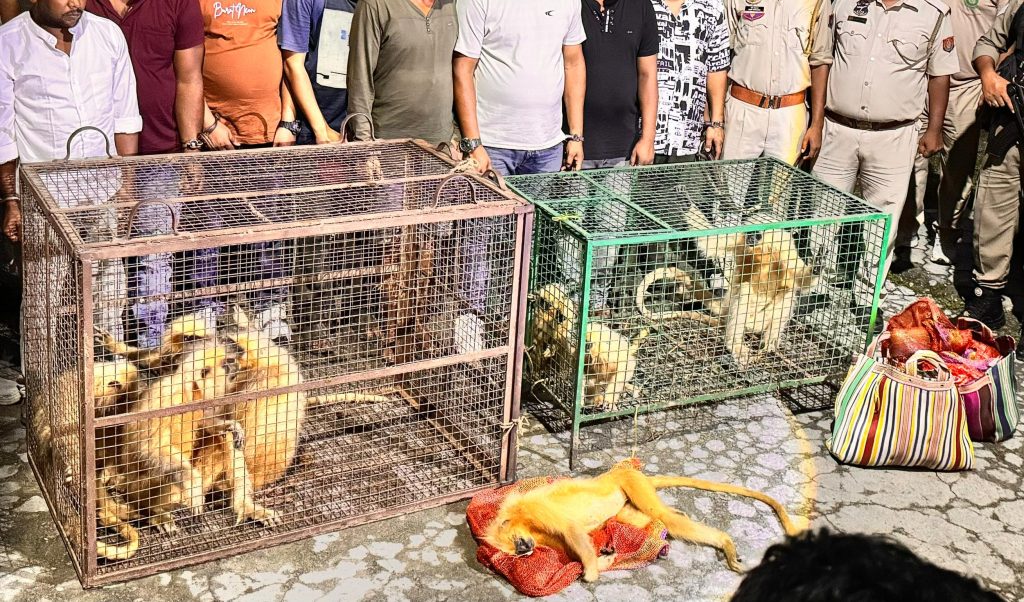
The golden langurs confiscated from the traffickers | Photograph by special Arrangement
Due to severe stress and suffocating transport conditions, one golden langur tragically died, a death made all the more tragic given that the total estimated species population is less than ten thousand individuals, spread over India and Bhutan, with around seven thousand five hundred animals in India and about two thousand five hundred animals in Bhutan.
The surviving seven individuals were handed over to the Assam Forest Department for placement under stabilization. Veterinary experts from the Wildlife Trust of India managed their health checks and scientific monitoring. Following their full recovery, the seven primates were successfully released back into the wild at the Sikhna Jwhwlao National Park in Bodoland Territorial Region in Assam on June 25, 2026.
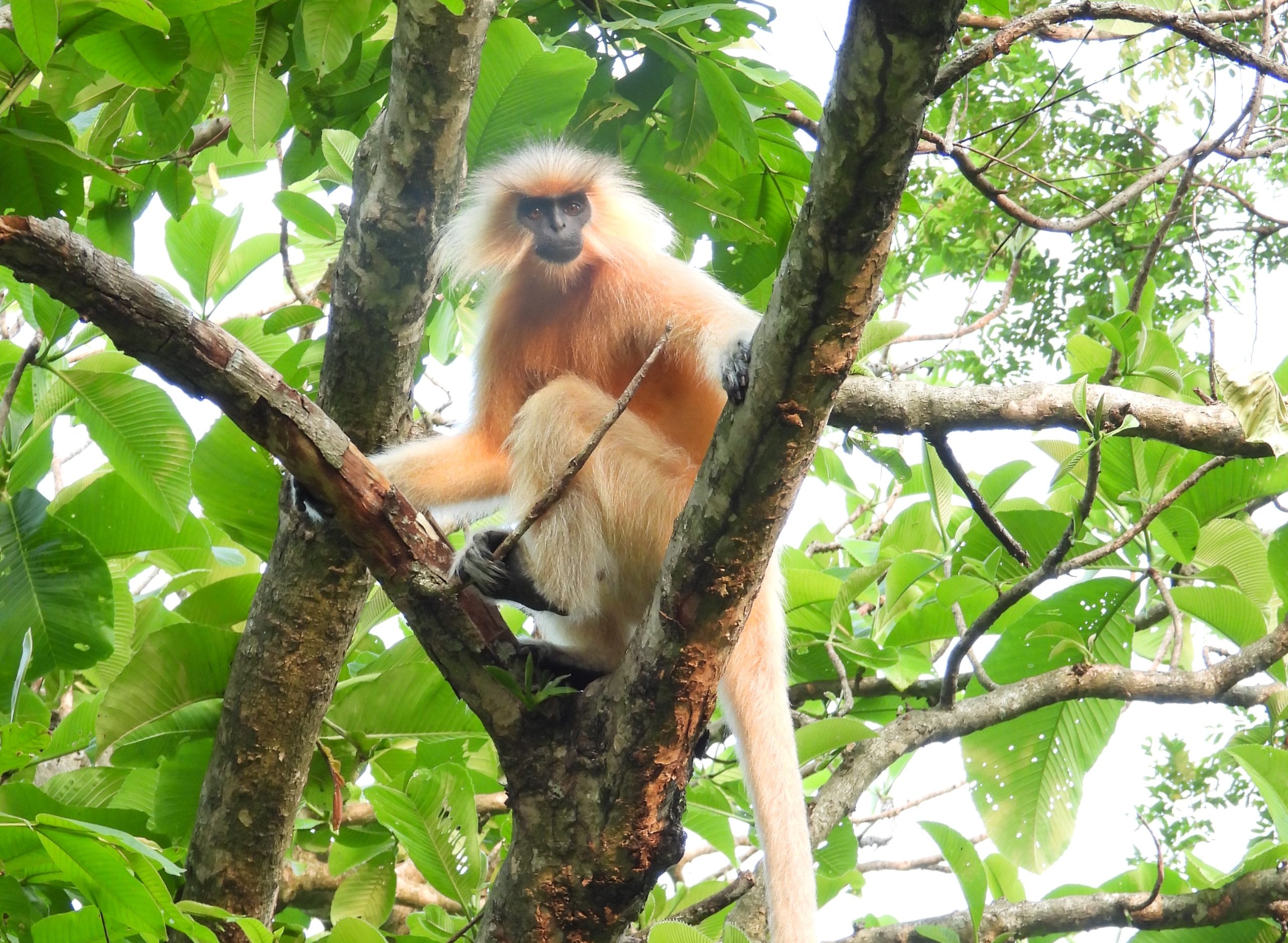
The golden langur (Trachypithecus geei) is one of the world’s most threatened primates. It is endemic to a highly restricted geographic corridor between western Assam and southern Bhutan. The species holds a strict protection status under Schedule I of India’s Wild Life (Protection) Act, 1972 and is also present in Appendix I of CITES(Convention on Trade in Endangered Species of Flora and Fauna). IUCN categorises the golden langur as Endangered. This major raid highlights the rising threat of organized cross-border trafficking networks encroaching upon their remaining fragmented habitats.
Edward Pritchard Gee, a British tea planter and amateur naturalist, officially discovered the species in 1953. While rumours of a “cream-coloured langur” near the India-Bhutan border had circulated for decades, Gee led an expedition to Assam’s Jamduar forest, capturing photographic and film evidence to prove their existence. Gee traveled to the east bank of the Sankosh River (near the India-Bhutan border) and successfully filmed groups of the stunning golden monkeys.
In 1955, Gee shared his films with the Zoological Survey of India (ZSI). In 1956, Indian zoologist Harbans Lal Khajuria formally described the animal, naming it Presbytis geei in honor of Gee’s discovery. The primate is now known scientifically as Trachypithecus geei and commonly called the golden langur.
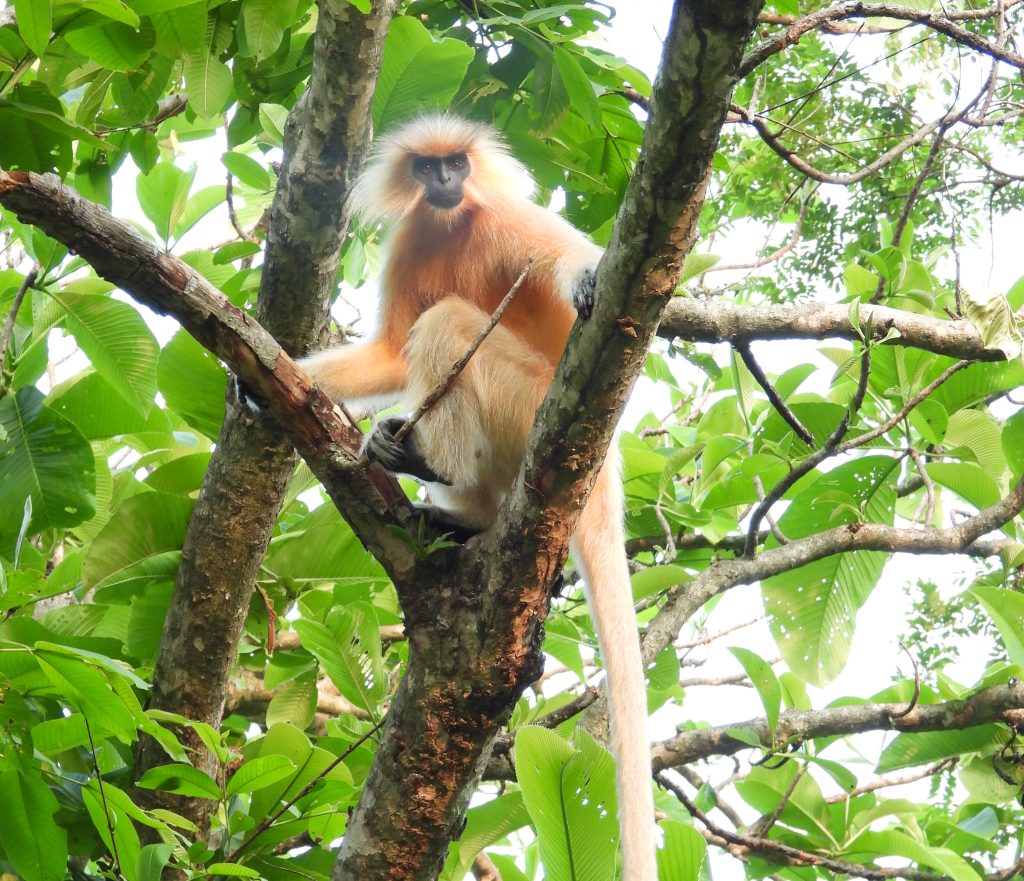
Golden Langur in Raimona NP | Photograph by Sanatan Deka/WTI
Golden langurs have historically been popular in Indian zoos. Among other zoos, they have been kept in zoos in Assam, West Bengal, Bihar and Karnataka. There was also a small colony on the Umananda Island (Peacock Island) in Guwahati in Assam. First brought to the Brahmaputra river island in the 1980s by an animal trader who had been left with some orphaned babies, the population eventually dwindled to a single male named ‘Gobinda.’ With his death in February 2020, golden langurs are no longer present on the island.
While they became a famous attraction on the world’s smallest inhabited river island, they were geographically out of place. The author has personally observed the golden langurs and have written about their enchantment with the beautiful animals there. Golden Langurs are mentioned in the book, ‘On The Brink,’ by Vivek Menon, published in 1999, whilst they were written about by Ghosh on the now defunct forum of Asian Animal Protection Network (AAPN).
Golden Langurs do not do well in captivity and have never done so, historically. One author, Ghosh, has observed the total death of colonies of Golden Langurs in zoos in West Bengal, Bihar and Karnataka over a period of just one decade. A back of the envelope calculation on the status of Golden Langurs can also be inferred from the Central Zoo Authority studbook on Golden Langurs of 2013/2014. Over a period from 1960 to 2005, one hundred and eighty six(186) Golden Langurs were kept in sixteen(16) zoos of India. There were seventeen(17) births recorded. The captive birth rate was 13.21% and the percentage of the founder stock of wild caught animals indicate that 90.86% were wild origin animals. There were one hundred and fifty two (152) deaths recorded during this period, that makes for a mortality rate of 81.72%. Moreover, it was stated that in 2013/2014, only five animals were alive in only one zoo in Assam.
This record, although taken at random is very representative of the situation with Golden Langurs in captivity throughout their history and a scanning of most available records reveal in the media and in documents on wildlife in captivity.
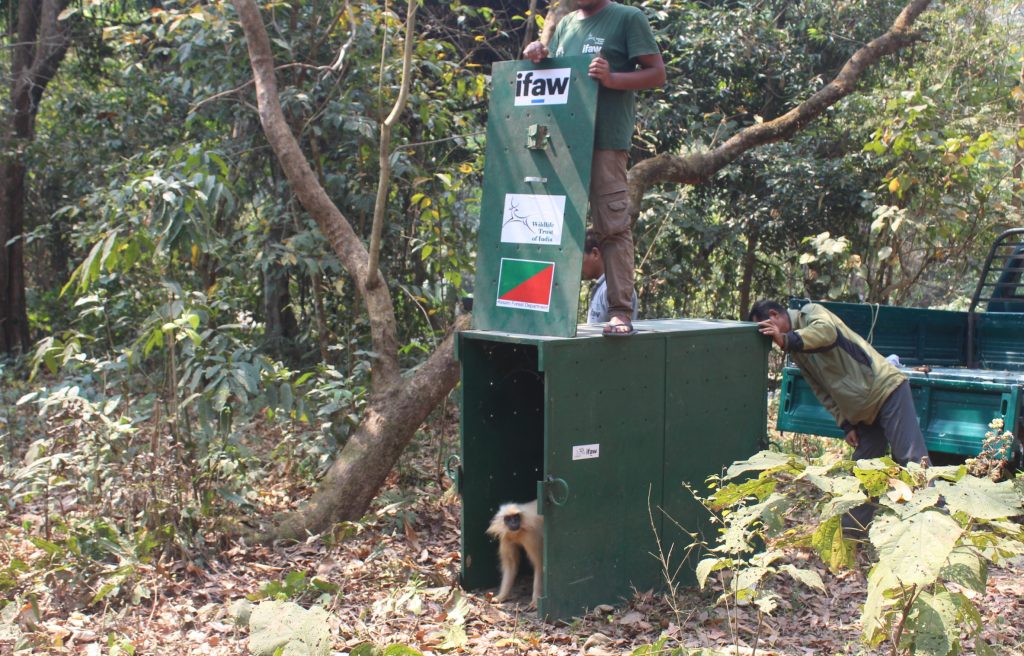
Golden Langur Rescue and release at Chakrashila WLS | Photograph by WTI
Wildlife trade is always a concern for its multifarious dimensions, which include cruelty to animals, damage to populations of endangered species, loss of biodiversity, links to transnational networks that are capable of other forms of crime, attrition of natural habitats and a whole host of other factors. The recent resurgence of trade in captive animals, including non native ‘exotic’ animals, is cause for grave concern on both animal welfare and conservation grounds. As long ago as 1978, India had taken the enlightened and compassionate decision to prohibit the export of monkeys abroad for experimental testing. Today, the evident import of large numbers of primates, including, chimpanzees, gorillas, Orangutans, Bonobos, a wide variety of Gibbon species and numerous primate species, including Old World and New World monkeys, gives us reason to think that the legal and illegal trade in primates is still alive and well. When one compares this trade with other forms of wild animals that are being confiscated in India and abroad, one cannot help but ponder if some powerful private collectors are behind this growing fetish of collecting animals as living trophies, much the way people collect coins and stamps.
The recent seizure of Golden Langurs involves an international angle with three countries involved, India and Bhutan, as the home range of the species was confiscated and Bangladesh, which is where the smugglers originated. This case might be an appropriate case study for both CITES and IUCN to focus their attention on the wildlife trade dynamics prevalent in India at this time.
Says Dr M K Ranjitsinh, pioneering conservationist, who was Deputy Secretary in the Ministry of Food and Agriculture in 1973, “I was able to stop the export of monkeys in 1973 mainly because we caught in Kolkata, golden langurs coloured dark to look like common langurs meant for export. It is unfortunate to see the resurgence of trade in this species that has historically been caught from the wild for captive institutions, to the detriment of their natural existence in the wild.”
It is a matter of great relief that the confiscated golden langurs could be rehabilitated to the wild since many confiscated animals are end up in zoos and never see the light of day. Enhanced cooperation between India, Bhutan and Bangladesh can ensure that this beautiful primate is kept secure in its contiguous wild habitat.
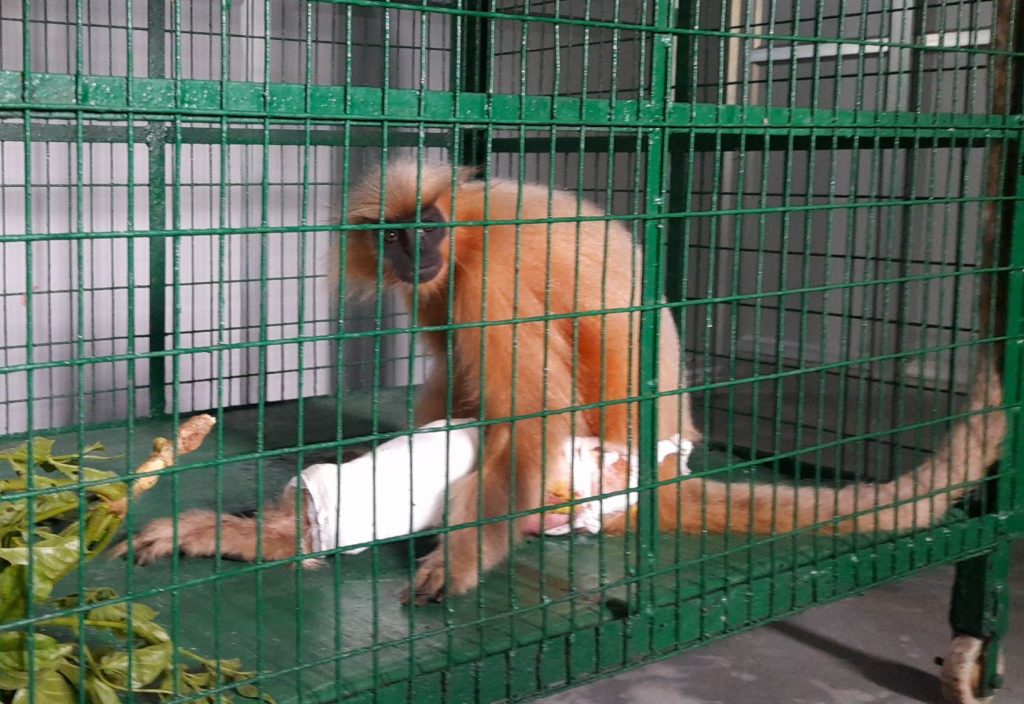
Golden Langur post operative care after rescue at the IFAW-WTI Centre for Wildlife Rehabilitation and Conservation | Photograph by WTI
The captivity of primates, including apes, presents a particularly penetrating moral question that was posed by the astronomer and popular science author, Carl Sagan, in 1977 in his book, ‘The Dragons Of Eden,’ in the chapter, ‘The Abstractions Of Beasts’, “Chimpanzees can abstract. Like other mammals, they are capable of strong emotions. They have certainly committed no crimes. I do not claim to have the answer, but I think it is certainly worthwhile to raise the question: Why, exactly, all over the civilized world, in virtually every major city, are apes in prison? If chimpanzees have consciousness, if they are capable of abstractions, do they not have what until now has been described as “human rights”? How smart does a chimpanzee have to be before killing him constitutes murder?”
The recent Golden Langur seizure in Assam makes us revisit this germane thought with regard to not only apes, but all primates.
Story by: Shubhobroto Ghosh (Wildlife Campaign Manager of World Animal Protection and author of the Indian Zoo Inquiry) and Jose Louies (Chief Executive Officer of Wildlife Trust Of India)