Wings over Water: Unveiling the Odonates of Thuruthi
Where the Perumba River slows down and meets the brackish waters around Thuruthi in Kannur, the landscape begins to move to a different rhythm. Here, the river does not simply flow towards the sea. It pauses, spreads into small channels, mixes with salt water, and moves with the rise and fall of the tides. Freshwater runoff finds its way through the wetlands, while mangrove roots stand quietly in the shallow water, holding the soil together. And above this delicate world, shaped by water itself, dragons and damsels rule the skies! These tiny aerial hunters belong to the Odonata family. Dragonflies and damselflies tell a surprisingly important story about the health of the wetland.
The Golden Visitors of Onam
For generations, dragonflies have had a quiet and almost mystical place in the lives of Kerala’s coastal and rural communities. Older generations often speak of Onathumpi, the golden-winged dragonflies, the Globe Skimmers that appear around the harvest season. Their arrival was not merely noticed; it was welcomed as a sign that something was changing in nature. Just before the arrival of the monsoon, enormous clouds of these dragonflies can sometimes be seen filling the sky. Their wings catch the light as they travel in large numbers, creating a shimmering movement above fields, wetlands and villages. For farmers, their appearance could serve as a natural signal of changing weather and approaching rain. Long before weather forecasts became part of everyday life, people watched the sky, the wind, insects and birds for signs of what was coming next.
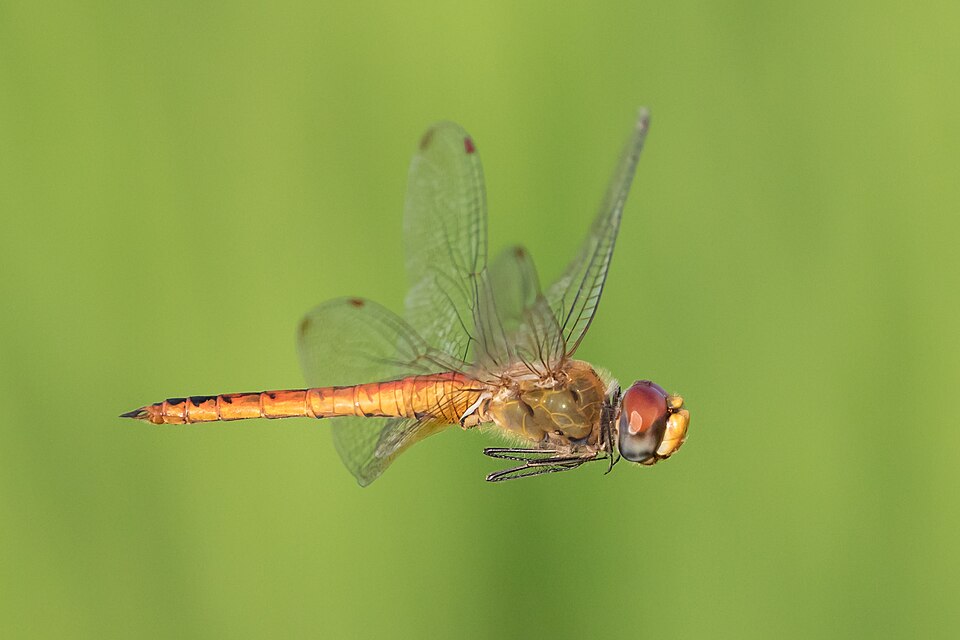
The Globe Skimmer or Onathumpi | © Basile Morin, CC BY-SA 4.0 <https://creativecommons.org/licenses/by-sa/4.0>, via Wikimedia Commons
Local legends also speak of the Onathumpi as scouts sent ahead by King Mahabali. They arrive before his annual visit during Onam to see whether the land is green and flourishing, whether the people are living peacefully, and whether the earth is ready to welcome him once again. So, when an Onathumpi appears, it is not simply an insect passing through the sky.
For some, it is a messenger.
For others, it is a memory.
Spirits on the Water
Around the coastal backwaters of North Malabar, another old belief gives dragonflies an even deeper meaning. There is a story that when a person dies, the soul stays back and takes the form of a dragonfly. The dragonfly flies low over the native waters, returning to familiar places, perhaps visiting the landscapes that it knew as a human, before continuing its journey into the next life. The dragonfly is believed to be more than a creature of the wetland but a visitor between worlds. The idea found a memorable place in Malayalam literature through the work of writer M. Mukundan. In his celebrated novel Mayyazhipuzhayude Theerangalil (On the Banks of the Mayyazhi River), departed souls are associated with glowing dragonflies returning to the shores they once knew.
The image is simple but powerful, a tiny creature hovering over familiar water, carrying memories of a life that has passed. Perhaps that’s why dragonflies have always seemed to occupy a special place in the imagination of people living beside rivers and backwaters.
Nature’s Little Rain Watchers
I have always been fascinated by butterflies. Watching them, observing their colours and behaviour, and spending time in the field have been a part of my life for years. But, interestingly, I had never really observed odonates (dragonflies and damselflies) with the same curiosity. I knew that there were people who were deeply passionate about them, but I had never imagined that these insects would one day become the focus of one of my own field studies. One day, I received a call from my professor, Mrs. Sapna Jacob, from Payyanur College. She asked me if I could help her students take up a study on any topic related to biodiversity. I was excited by the opportunity, but at the same time, I was a little confused. What topic could I give the students that would be interesting, meaningful, and connected to the biodiversity around us?
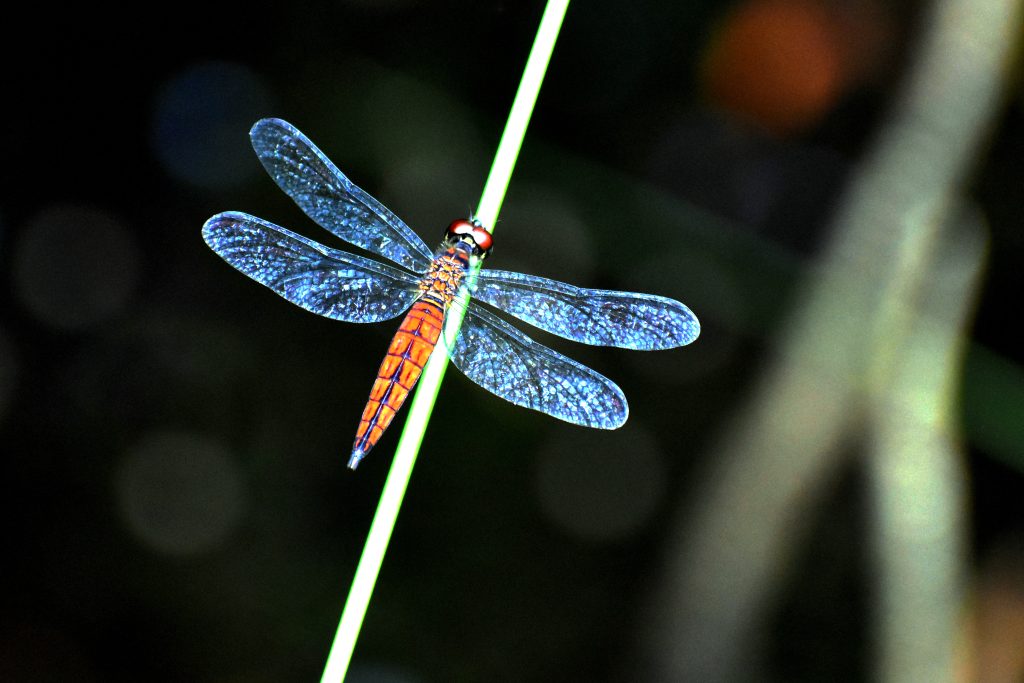
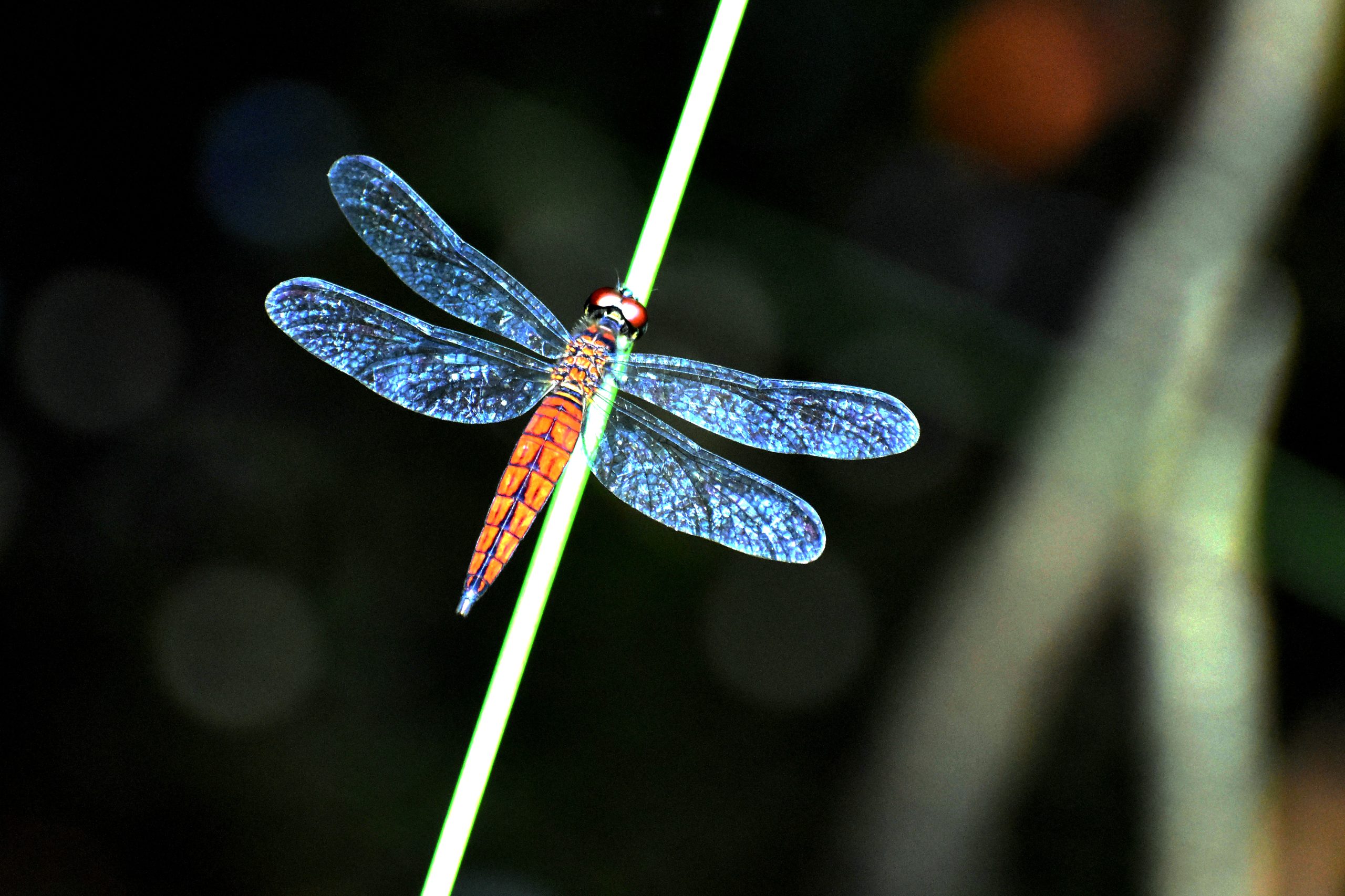
Little Bloodtail (Lyriothemis acigastra), Male
For nearly ten years, we have been guiding student projects through the Kannur Kandal Project, the Wildlife Trust of India’s mangrove conservation project in Kerala. During these years, we have explored and documented many aspects of biodiversity in the mangrove areas secured and protected by WTI. The repeated visits with students had given us an intimate familiarity with these wetlands, mainly their plants, birds, insects and countless other forms of life. Among all these years of walking through the mangroves, however, there was something I had noticed but never really stopped to study. Dragonflies and damselflies.
They were always there.
At Thuruthi, as we walked through the mangrove areas, I would often see them moving through the air, sometimes hovering over the vegetation, sometimes darting rapidly across the sky, and sometimes settling quietly on leaves and branches. They seemed to be an inseparable part of the landscape, yet we had never systematically looked at them.
That observation suddenly came back to me when Professor Sapna asked about a biodiversity topic for her students.
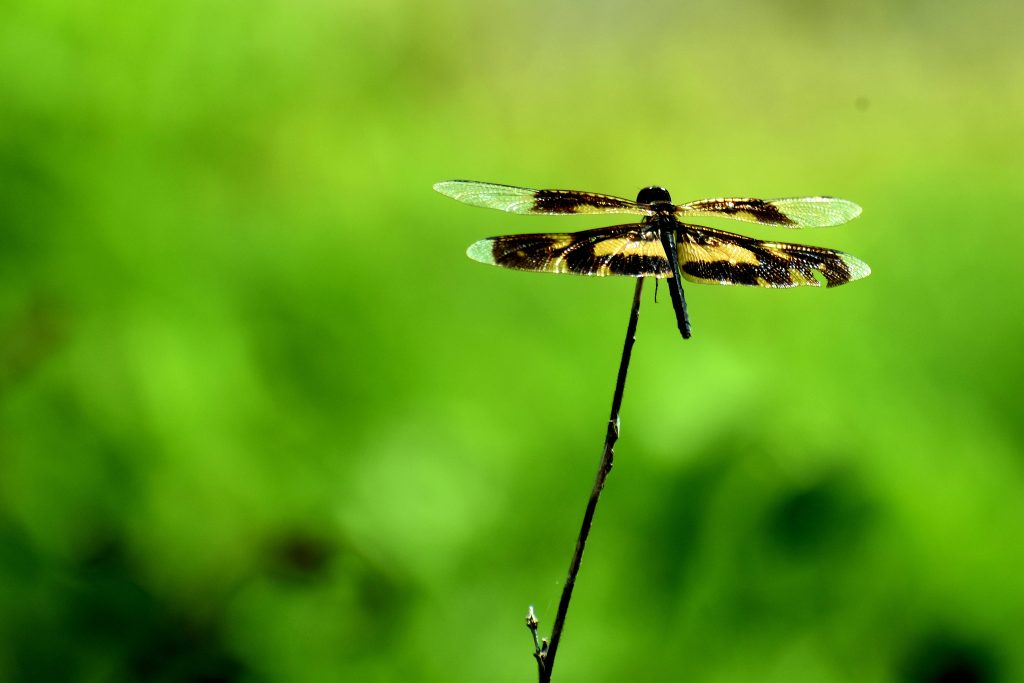
Common picture wing (Rhyothemis variegata), Female
Why not odonates?
We decided to explore the dragonflies and damselflies of Thuruthi, turning something that I had casually noticed for years into a subject of observation and study. We began our fieldwork with the students, visiting the area twice every day, once in the morning and again in the evening and spending about one and a half hours on each visit.
Dragonflies are closely connected to water. Much of their life cycle takes place in or around aquatic habitats. Their presence tells us about the condition of the environment around them. Dragonflies and damselflies thrive where there are intact water bodies, natural vegetation and food sources that serve all life forms.
In the wetlands and brackish margins of Thuruthi, freshwater pockets and runoff channels create a fascinating meeting point between different habitats. While mangroves provide shelter and the surrounding vegetation gives insects places to hunt, rest and reproduce, these water pockets also host unique aquatic life forms, including the larval stage of odonates. That makes their presence valuable bio-indicators and tiny environmental monitors. By observing which species are present, where they occur and how their numbers change, researchers can understand more about the health of the wetland itself. In Thuruthi, we documented twelve species of dragonflies and damselflies offers a small but important window into the ecological condition of this estuarine landscape.
Their presence is not just beautiful. It is information.
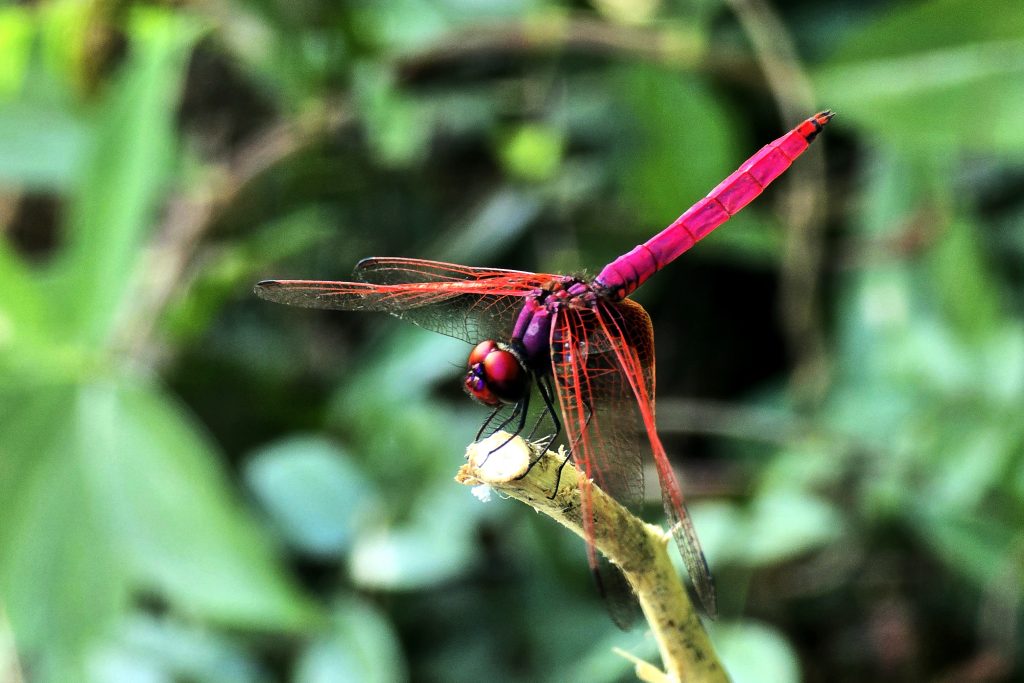
Crimson marsh glider (Trithemis aurora)
A Childhood Memory with Wings
Dragonflies have always been a part of childhood memories, in a much more playful way. For me and most my friends, catching a dragonfly was a popular pastime. We would carefully catch one and gently coax it to hold onto a small twig or pebble with its legs. It was a simple game, born from curiosity about these quick and colourful insects. But this childhood practice eventually found its way into language and everyday wisdom. A popular Malayalam idiom developed around the act of making a dragonfly carry something that was too heavy for it. The expression became a way of warning against pushing someone beyond their capacity whether that meant forcing a child to carry a burden beyond their strength or expecting an adult to take on more than they could reasonably handle. The tiny dragonfly thus became part of a larger lesson about human life. It is a striking example of how closely nature, childhood, language and everyday wisdom were once connected.
Twelve Species, One Wetland Story
Today, Thuruthi offers a remarkable setting to look closely at this world of wings. The Perumba River, its brackish estuarine waters, freshwater pockets, runoff channels and mangrove habitats come together to create a landscape where life is constantly adjusting to the tides. Here, a dragonfly may appear for only a few moments in a flash of gold, blue or red above the water. A damselfly may settle quietly on a leaf before disappearing into the vegetation. Above the mangrove roots, these hunters move quickly through the air, catching smaller insects on the wing. Yet each sighting tells a story. The twelve Odonata species we documented from these habitats are not merely a collection of beautiful insects. Together, they represent the living connections between water, vegetation, insects, climate and people. They also remind us that the health of a wetland is not always visible in the water itself. Sometimes, it can be seen in the creatures flying above it.
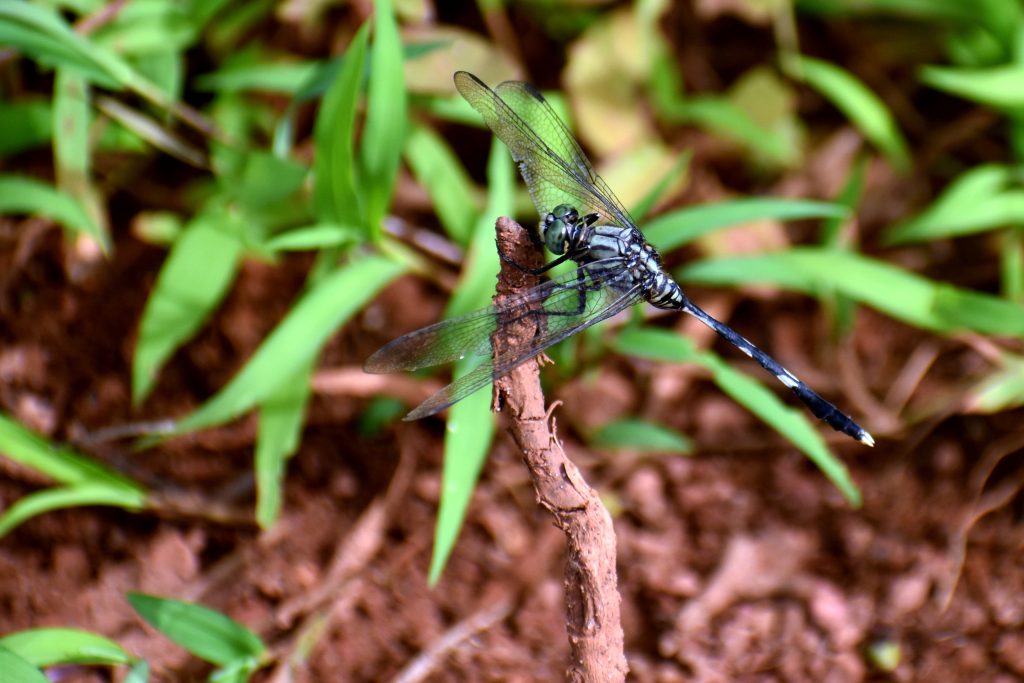
Green marsh hawk (Orthetrum sabina), Male
When the Dragonflies Arrive
Perhaps this is why the arrival of the Onathumpi still feels special. When clouds of Globe Skimmers appear before the monsoon, they can be read in many different ways.
A farmer may see a sign of approaching rain.
A storyteller may see the scouts of Mahabali.
An elder may remember an old belief about souls returning to familiar waters.
A child may simply see a beautiful insect worth chasing.
As an ecologist, we may see something even more important: a living signal from the wetland. All these meanings can exist together. The dragonfly does not need to choose between myth and science. It can be a messenger in a story and an indicator in an ecosystem. It can belong to folklore, literature, childhood memory and scientific observation at the same time. These small creatures become part of a much larger story, about a fragile wetland that continues to speak through its smallest inhabitants. If the dragonflies are still dancing over Thuruthi’s waters, perhaps the wetland is telling us that there is still life here and that the story is not over yet.
Story and photographs by Vimal Lakshmanan N V, Kannur Kandal Project, Wildlife Trust of India