The Journey to Protection: Legal Notification of Wetlands in Eastern Uttar Pradesh
Uttar Pradesh, 5th October 2026: For years, the taals and jhabars – the wetlands of eastern Uttar Pradesh have shaped the rhythms of life and livelihood around them, providing fishing grounds through the monsoon season, grazing land in the winter and being a key source of water during the scorching summer months. For the Sarus crane too, these wetlands have been their lifeline. Year after year, they have provided vital habitat for sarus cranes, which nest and rest along the edges of these wetlands. Unfortunately, until recently, these wetlands didn’t carry any weight in the eyes of the law and remained largely unprotected ecosystems. A wetland, with the fragility that it carries, has no legal protection or standing without any formal notification or recognition by law. It can be drained, filled, or built over, and no authority is obliged to intervene.
This reality changed for some wetlands in Eastern Uttar Pradesh in April 2026.
In 2019, the Uttar Pradesh State Wetland Authority (UPSWA) assigned the Wildlife Trust of India (WTI) the task of collecting and collating key information on 49 wetlands across 10 districts of Eastern Uttar Pradesh for notification: Bahraich, Balrampur, Barabanki, Ayodhya, Kushinagar, Maharajganj, Sant Kabir Nagar, Shravasti, Shahjahanpur and Siddharth Nagar. The UPSWA, a state-level government body constituted under the Wetlands (Conservation and Management) Rules, 2017, is the nodal/apex authority in the state of Uttar Pradesh responsible for overseeing the conservation and management of wetlands in the state along with their legal notification. Hence, the responsibility entrusted by the authority to WTI for surveying the wetlands led to rigorous fieldwork, ground truthing and documentation across the selected districts.
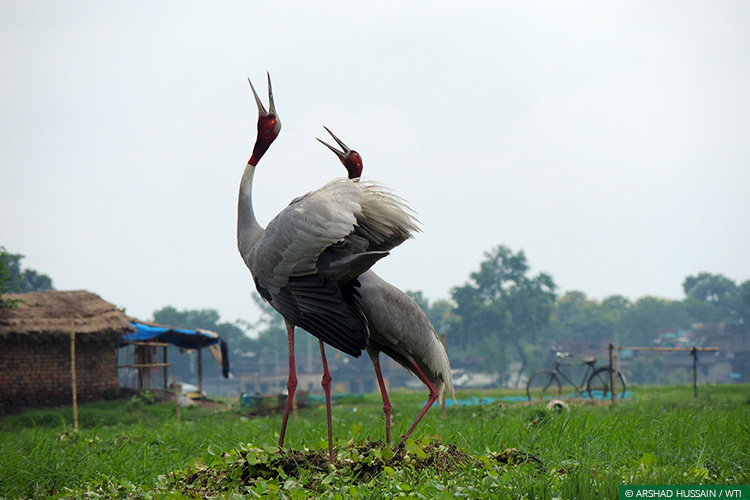
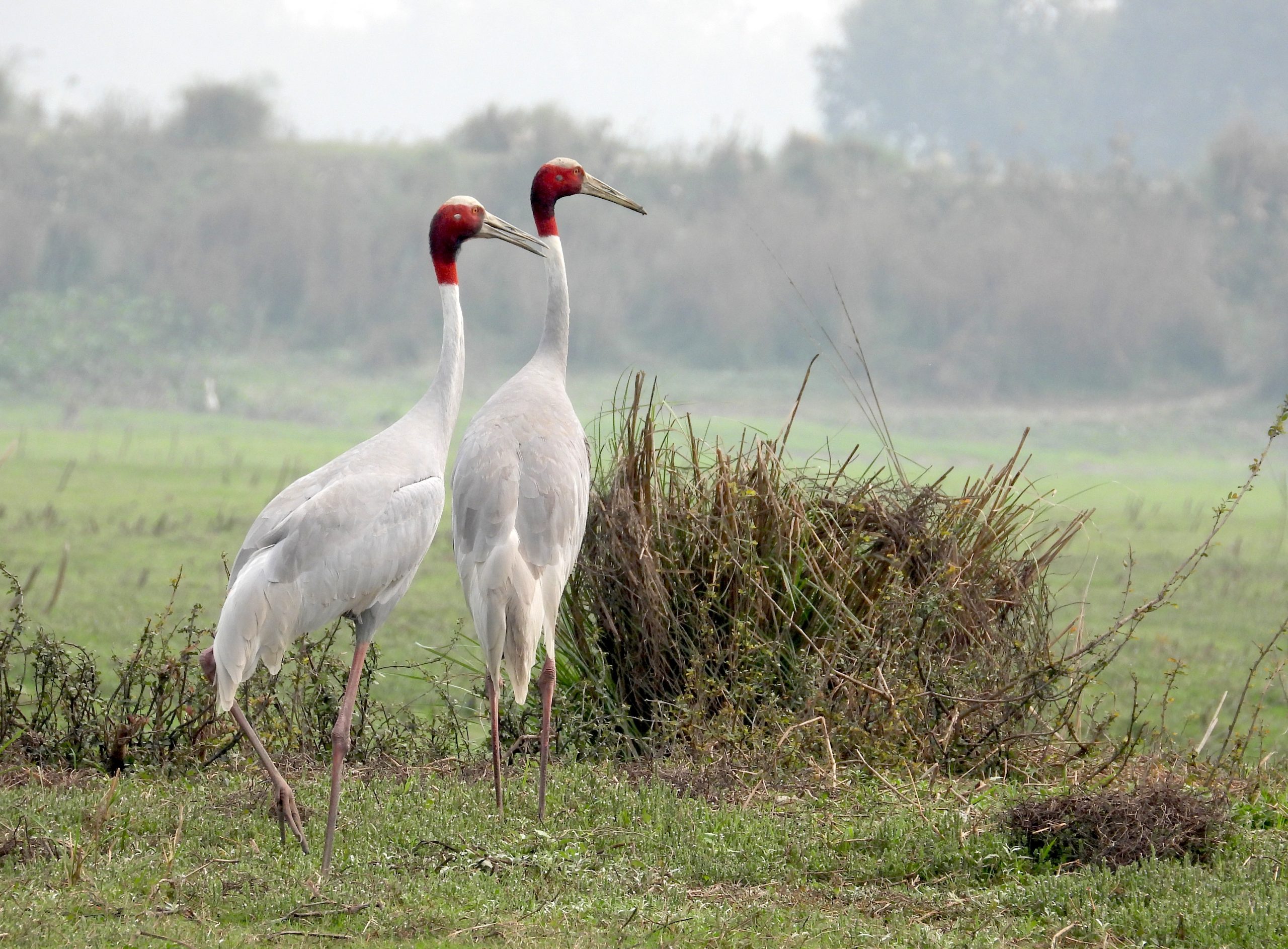
A pair of courting sarus cranes near their nest by a wetland in the Maharjganj district of eastern UP | Photo © Arshad Hussain/ WTI
The wetlands were systematically surveyed, with their geophysical characteristics, socio-cultural uses and threats mapped and documented. This information was essential to the notification process, which requires the collation of such data in accordance with guidelines issued by the Uttar Pradesh State Wetland Authority (UPSWA) and the Ministry of Environment, Forest and Climate Change (MoEFCC). Based on these surveys, concise documentation and detailed maps were prepared, capturing wetland inundation and contour patterns, as well as the surrounding zone of influence.
These documents played a critical role in facilitating the legal notification of 49 wetlands under the Wetlands (Conservation and Management) Rules, 2017. The Rules provide a framework for wetland conservation based on the principle of ‘wise use’. In simple terms, wise use does not seek to exclude people from wetlands or prohibit their traditional uses. Instead, it recognises that wetlands can continue to support local communities while being managed in ways that maintain their ecological character and functioning. The approach seeks to strike a balance between conserving these vital ecosystems and safeguarding the needs and livelihoods of the communities that depend on them.
The brief documents were reviewed and recommended by the respective District Wetland Management Committees (DWCs) and then forwarded to the Uttar Pradesh State Wetland Authority (UPSWA) for ratification and notification. The DWCs are district-level bodies chaired by the District Magistrate, with members comprising district-level officials from the agriculture, fishery and forest departments who act as a bridge between the information gathered at the ground level and the UPSWA. By adhering to each stage of review, altogether, 35 wetlands for which WTI assisted the UPSWA were formally notified in April 2026 by the UPSWA – thereby bringing 1,243.8 hectares of wetland area and their Zone of Influence under legal protection.
By doing so, legal protection is granted not only to the water body but also to the land and the frontier that keeps each wetland alive.
Each notified wetland also has a defined Zone of Influence—the catchment area that sustains it—together covering 13,888.5 hectares. While a wetland’s boundary marks the extent of the water body itself, its Zone of Influence identifies where that water comes from: the fields, drainage channels and low-lying tracts that feed it season after season. This approach extends legal protection beyond the water body itself, safeguarding the surrounding land and catchment that sustain each wetland and keep it alive.
WTI was privileged to work alongside UPSWA and the District Wetland Committees to facilitate the notification of these wetlands. The support of the Village Wetland Management Committees (voluntary groups constituted by WTI) played a critical role in collecting wetland data, monitoring these ecosystems and supporting their management on the ground. Their efforts and local knowledge made the preparation of the brief documents possible.

A nesting pair with their chicks | Photo © Arshad Hussain/ WTI
These efforts by local communities are not in vain, as the legal notification of the wetlands that sustain their lives and livelihoods will help protect the ecosystem for years to come, thereby ensuring long-term sustainability and coexistence. Legal notification provides protection against encroachment, conversion and activities that could adversely affect the wetland, including dumping of waste and untreated effluents. Additionally, in moderation and through regulation, activities such as using water from the wetlands, grazing, aquaculture/wetland conducive agriculture and harvesting of wetland resources sustainably are also permitted and encouraged. In this way, legal protection seeks to balance ecological integrity with the needs of local communities. By keeping these wetlands healthy and functional, it also helps safeguard the Sarus Crane and the many other species that depend on them, while ensuring that the people whose lives are intricately connected to these wetlands can continue to thrive alongside them.
The outcome is a quiet but consequential one. Over years rather than months, and one wetland at a time, the collective efforts of all concerned organisations have helped secure legal protection of these wetlands, along with many others across Uttar Pradesh. The sustained support of private partners such as Tata Trusts and World Land Trust was critical to making this possible. Their continued and patient support enabled the work on the ground to be carried forward over the years, helping ensure that these wetlands continue to function, sustain biodiversity and support the communities and species that depend on them.