Not So Simple: Understanding the roots of illegal wildlife trade
The fight against illegal wildlife trade has been going on for a long time, and our united efforts have certainly produced results. Yet, at times, it is painful to observe how humans continue to transgress boundaries and exploit wildlife and wild spaces —driven by greed or simply an urge to feel valued. To ensure that our natural heritage is protected, we still have a long way to go, despite the advancements we have achieved.
As a conservationist, many a times, I wonder if we are really able to change anything.
The answer I beleive is probably quite simple – “We fear the wild, so we build cages around it.”
We, as human beings, are nothing more than fragile masses of blood and flesh. For all the confidence we carry, a sudden fall, a disease, or even a wild animal can remind us how little control we truly have over our own bodies. We are weak, breakable and painfully mortal.
Perhaps that is why we have always searched for ways to feel powerful.
At some point, someone had the brilliant idea of displaying a statue carved from elephant ivory. Someone else thought, Why not a tiger skin hanging on my wall? Or deer antlers mounted above the fireplace? Why not keep a parakeet in a cage, tame an owl or own an aggressive snakehead just to have something wild within our walls?
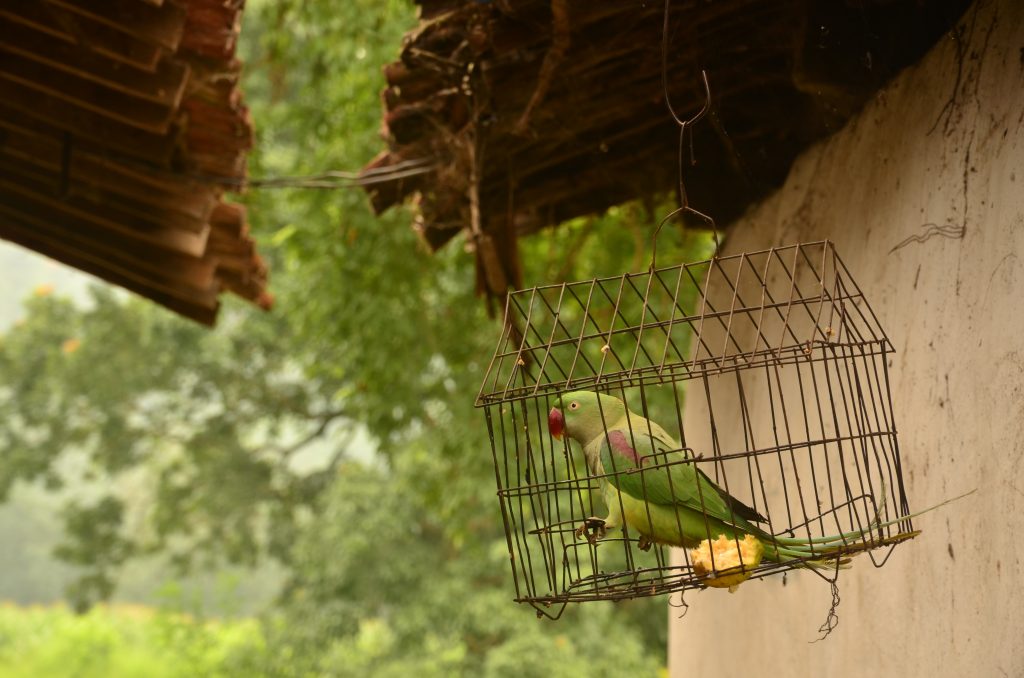
Alexandrine parakeet in a cage in rural Chhattisgarh | Photograph by Madhumay Mallik/WTI
And then imagine the pride when people come to visit.
I can point toward it and say, “I killed it”, or “I own it”.
You are no longer just another person. You become, in the eyes of the audience as someone who can overpower the wild, someone who get what he wants and someone who should not be crossed. Perhaps that reputation brings fear. Perhaps fear brings respect. Perhaps that respect adds to my social standing, my image, my sense of importance.
And maybe that is the real trophy. Not the ivory. Not the skin. Not the antlers. Not even the animal itself.
The trophy might be the feeling of power. But here are two seemingly unrelated stories that point to the roots of such crime.
Case Study 1: The Plight of a Bird Trader
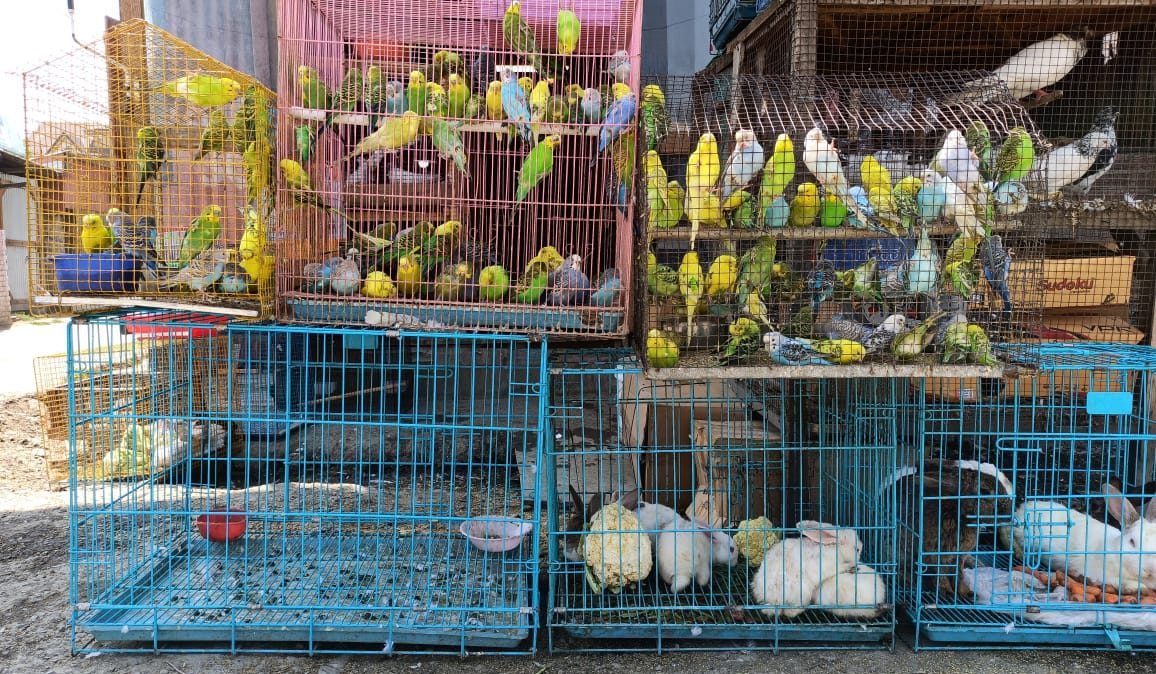
It was sometime back that I went to a particular local pet shop and was taken aback to see the variety of birds in captivity. Some were even protected under India’s Wild Life (Protection) Act, 1972. I went up to a person, seemingly the owner, sitting outside the shop on a red plastic chair and a conversation ensued…
“Is this shop yours?”
“No, I am not the owner, I have just rented the space”
His eyes fell upon me while I scanned the market place.
“Rent!!” My eyes widened. “The shop is in the middle of a busy marketplace, a prime location! How do you….manage?”, hinting at the lack of customers during the time.
“I am able to make do by the grace of the Almighty”
“May I sit?”, I asked him politely, indicating I had more questions.
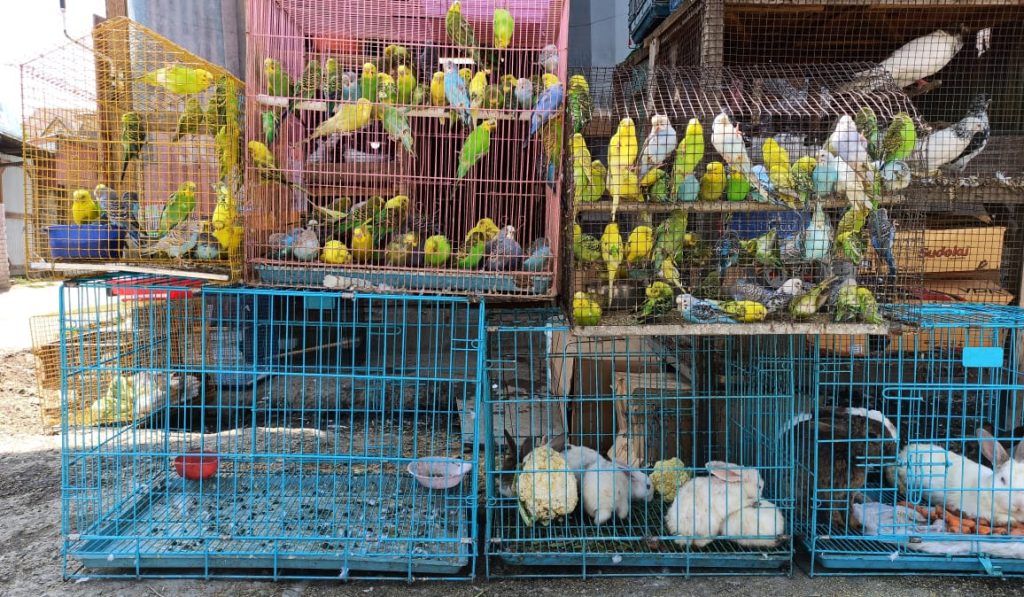
Representative image of a pet shop
He pulled out a chair (I guess there was just the adequate amount of space).
“Had Lunch?” I asked him.
“No I don’t eat in the noon. My wife is unable to cook as she suffers from cataract (motiyabin). To be able to get up in the morning and pack the daughter’s lunch is enough. I eat dinner though.”
“Your daughter is in which grade?”, I enquired further.
“She is in twelfth (12) standard and aspires to be a fashion designer. She want to get admission into NIFT”, he replied with a sparkle in his eyes. The National Institute of Fashion Technology is one of the premiere institutes in the country and getting into it requires both talent and resources.
I glanced at the birds, the shop and the person, and asked “How much rent do you pay?, if you don’t mind telling”.
“1800, every month” he replied. It was a big amount, considering the kind of space he has for his goods, the birds in this case.
“And how much you sell?”
“Selling” he siged, taking a deep breath.
“Most birds, the common pets like the finches and lovebirds, are in the price range of 200-800. It actually depends how beautiful the bird is and the unique qualities it possesses. Most of the pairs get spoilt (probably he meant that many birds die due to exhaustion) and the ones that are left, I sell them at half the amount. Many customers also come looking for parakeets (tota) and munias.”
After a brief pause, he continues…
“We get all sorts of customers. Some comes in and bargain a lot. Some come back to return, if the bird gets ill or any their new Tota is not speaking or they are fighting with fellow cage mates. Some even demand their money back or want to exchange it for a new bird. We are always left with a few pairs.”
“That must be quite difficult to manage” I exclaim.
Looking up, he exclaimed ” whatever I earn goes in maintenance of cages and the animals. I pay for education of my daughter, school fee, uniform and stationery. I suffer from conditions like diabeties and blood pressure and the same is for my wife and we don’t have enough to even get the operation done. Then, there is rent for the shop, of our home and food expenses. At times, government officials come in and threaten to take things away and I have to pay them off as well. Sometimes, they take all the birds and return the ones that are not in good condition anymore. Everyone wants a parakeet in a cage.”
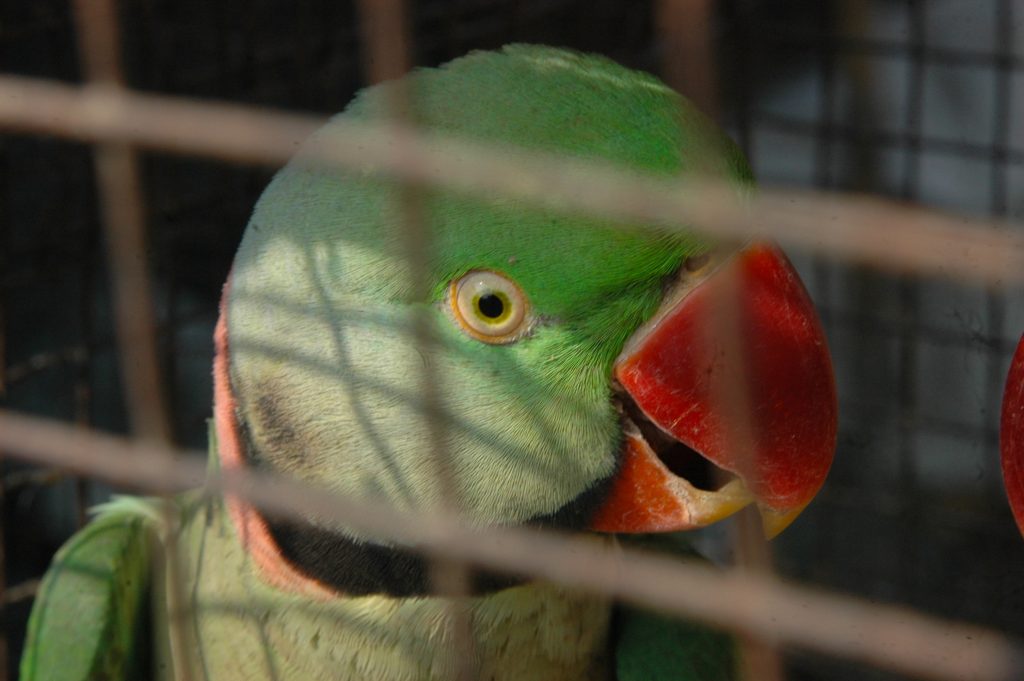
Parakeet in a cage | Photograph by Jose Louies/WTI
I was listening intently and then I asked, “People still come in after such incidents even after knowing that they might get in trouble?”
“Since there is demand, I supply. I have to raise the prices to cover up!!”
“So, you know that you can get into trouble. Why do it then? Why not a different profession?”
“I am not interested in setting up a food stall or sell clothes. There is too much convincing that needs to be done there (Majh-Majh)”. I laughed! “Still” I said, indicating that it might be a better livelihood option.
“My father never sent me to school and I can only write my name in English. This was my line of work when I started really young (abhi aur kuch samjh ni aata) and nothing else fascinates me. I just keep up with this”
“Anyone else in family who helps you out?”
“All my nephews work with me here (points me to a guy who had made his way in a few minutes earlier). While my father remains bed ridden, our families, including my brothers, depend on this shop”
“Your nephew is educated?” I enquire again.
“Educated enough to do the calculations and keep our register gong, The shop is everything” he laughed.
“You are not one of those greenies right?”, changing the course of the conversation and his expression.
“Do i look like one?” I asked smiling.
“Get some tea for us” He orders his nephew.
We talked more over a cup of tea before it was time for me to leave.
“Goodbye!! Come Again and bring me some customers who will at least buy something, unlike you”. He said with a laugh.
I waved my hand and walked off.
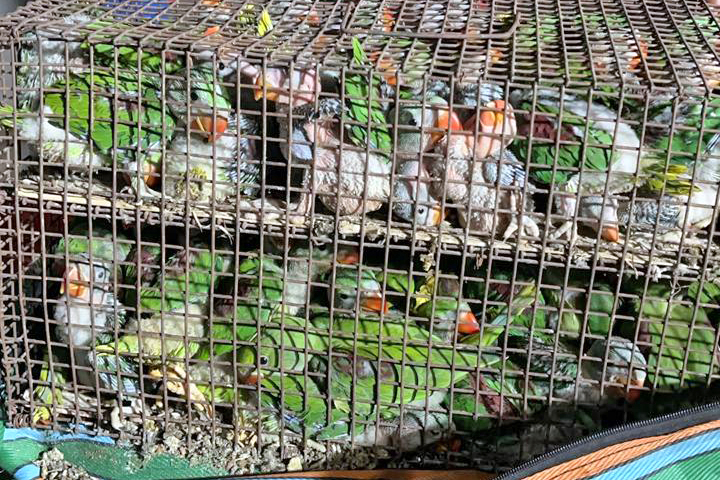
Parakeets seized from illegal wildlife trade at Raipur railway station | Photo by Satvik Sharma
Case Study 2: The Cattle, The Road and The Jungle
If you go through The Wild Life (Protection) Act, 1972, you will realize that Section 27 and 29 primarily prohibit tresspassing and destruction of habitat within protected areas.
This takes me back to the time when I was in a certain tiger reserve
There we were the 21 of us sitting in bus, half asleep and burned out. There was some field work to be done and after that, we had the chance of meeting the ranger, the officer in charge of the forest.
“The duties…” he paused, to sip on a glass of water, before continuing and we listened attentively.
“…of a Forest Ranger is to safeguard wilderness, ensure law enforcement and engage communities” he exclaimed.
“Law enforcement?” I said to myself. I just saw cattle coming out from the sanctuary. The law says, you can’t take them inside just to begin with? A jungle has both carnivores and big herbivores, that could be quite dangerous, if you cross paths. “You can get your cattle killed, get yourself killed and it’s a straight up offence!” I thought.
“But, I’ll give you an example of a family around the Reserve, a family of six (father-mother-sister and two brothers)…”, probably noticing my eyes move in the direction of the cattle that were still making its way to the village by the road along the range office. “…whose main occupation is farming and livestock. Manoj, the eldest son, takes up all the laborious tasks and basically is the backbone that is feeding and holding the family together.” the ranger continued.
“So one day, quite recetnly, Manoj takes his cattle for grazing into the jungle, spends the whole day there and in evening, he starts walking back home along with his majestic black buffaloes. Unfortunately, he crossed paths with me”, he recollects.
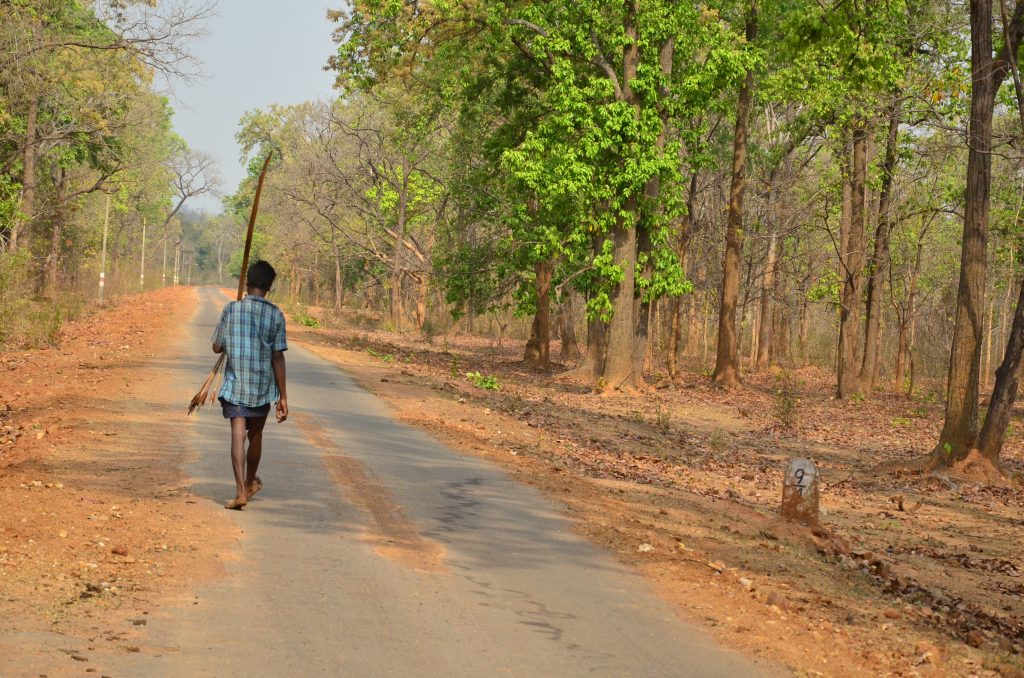
A man walking with his bow and arrows on the fringes of a protected area. At the roots of illegal wildlife trade often are underpriviledged communities | Photograph by Madhumay Mallik/WTI
“Manoj was put behind bars. Our officers did their duty. Someone who committed an offence against the law is behind bars now. That is how it should be, right?”.
“But remember what I told earlier of Manoj being the backbone of the household and holding the family together”, he continues explaining.
“Fast forward a few days and I was woken up one night by distress calls of my colleagues. I walks out and see my staff bringing in Manoj’s younger brother and with them, a sack (bora). Upon enquiring I got to know that Manoj’s younger brother was handed over to us by the staff of the neighbouring range office. To my surprise, I found softshell turtles along with a dozen roof turtles – species protected under India’s Wildlife (Protection) Act.
“When Manoj got arrested, his brother decided to poach to arrange his bail and earn bread for the family. His brother couldn’t let the family starve nor could he afford for his brother to be under arrest. But instead of learning from his brother’s mistake, he decided to “rob the same forest again to pay the price for a crime the forest had already suffered for. Think about it” he finished and walked back to his office.
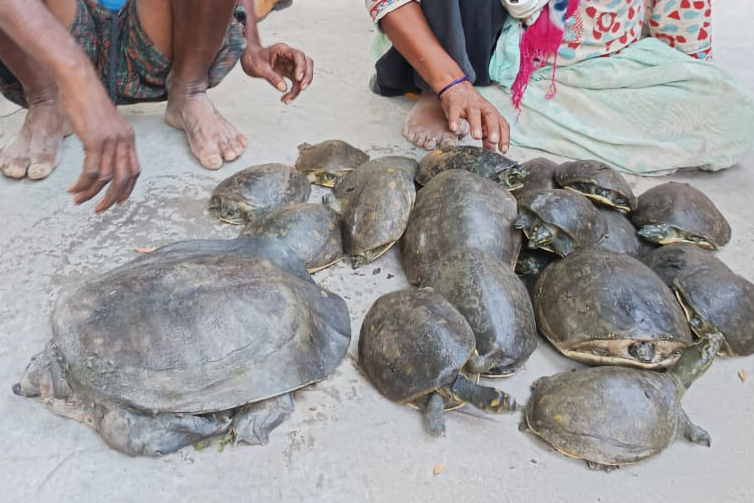
Turtles seized by the forest department
Two individuals, Two Stories, Two Perspectives
Sitting outside his bird shop, the seller did not see himself as a wildlife offender. He saw himself as the man of the house who needs to provide for everything. Manoj’s brother, in his desperation, turned to the forest to find a way to bring him back.
From the perspective of the animal, it is the victim. From the perspective of the law we have an offender. And from the perspective of the offender, it was about sustenance. But these stories aren’t so simple afterall.
The crime, at its roots, is driven by someone’s wish to possess a living wild animal as a pet or as a status symbol or as a conversation starter and is ready to pay for it. Many a times, social beliefs also turn wild animals into commodities. In all the cases, a consumer keeps the entire chain alive. The fight against illegal wildlife trade cannot be reduced to arrests and seizures alone. Enforcement alone cannot dismantle a trade whose roots are running through livelihoods, emotions, status and human desperation. A trader is replaceable as the demand still exists. If we remove a poacher, another will enter the forest.
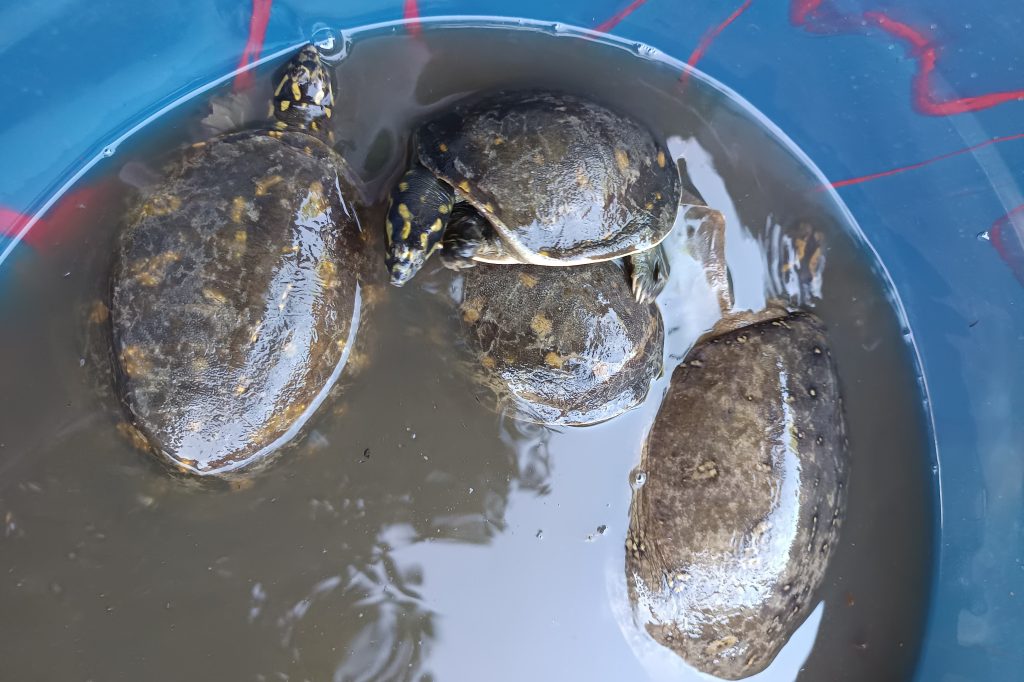
The turtles before release by the forest department
The solution, cannot be chosen between empathy and Enforcement. We need both. We need to be firm on the protection of wildlife, but thoughtful about the ways in which we achieve it. While emotions and compassion must never become an excuse for wildlife crime, the fight against illegal wildlife trade is a fight against an entire chain. And until then, we may keep winning individual battles while another animal is being picked up from the wild.
Story by Shaariq Ashar, Field Officer, Pan-India Enforcement Assistance