
Too close for comfort – the case of the Sonitpur elephant
As a wildlife photographer, I have often wondered what it would be like to be invisible to the forest – to be able to access places that humans cannot reach or to be close enough to wild animals for that perfect close-up shot. In practicality, even thinking of being in close proximity to a wild elephant or a tiger is neither achievable nor advisable. But there are exceptions.
Over the past month, there have been at least a hundred unique posts on social media, primarily Instagram, that showcase a full grown adult male wild elephant in critical distress. An injury on its left foreleg, seemingly the result of a sharp weapon, and severely compromised vision led to a huge outcry for help. “This is the first time in my life that I have encountered a wild elephant, of that size, so easily approachable”, exclaims Bikey Kachuwa, a local teacher who has been following the elephant near his village since day one. Perhaps the elephant knew help would be available close to human habitation, or it might have simply ventured out of its usual route due to compromised vision; the elephant found shelter under a tree in the Kacharigaon Tea Estate at the heart of Sonitpur Village, in Assam, accepting racks of bananas and human touch.
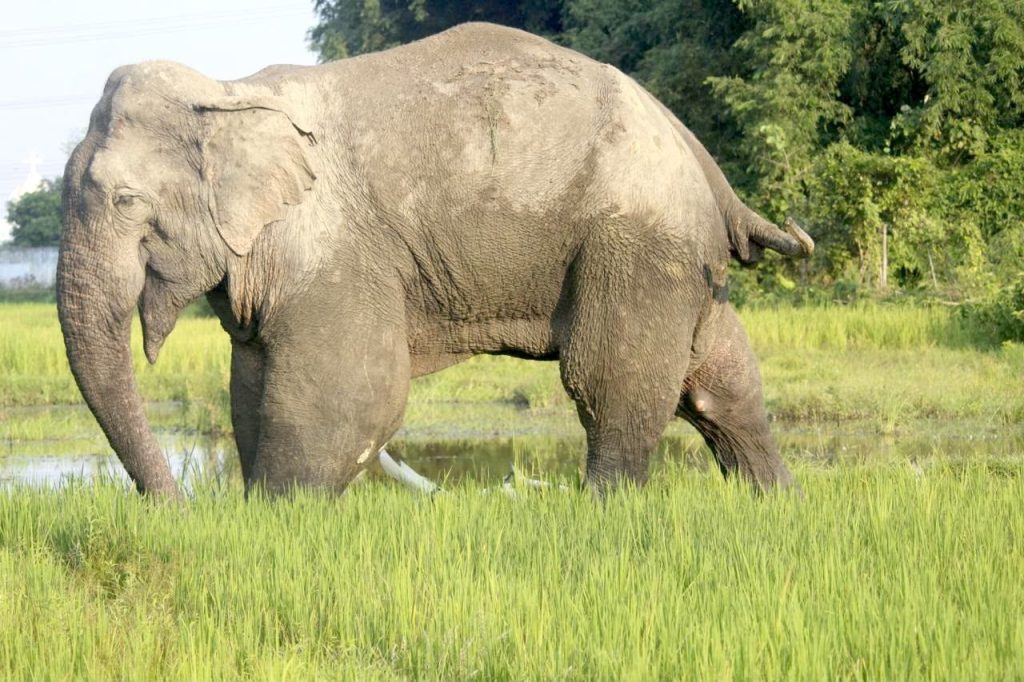
The injured elephant in a nearby Wetland | Photograph by Bikey Kachuwa
A social outcry by animal lovers
“There have been many who have just come in, travelling as long as five hours, to just be able to see and express their sympathy for this enormous, yet incapacitated individual. To be able to touch a wild elephant without consequences is probably an opportunity of a lifetime, and when such an opportunity presents itself, why not also talk about it on Instagram”, adds Mr. Bikey with a hint of sarcasm in his voice. “All my life, we have been taught that a wild elephant is perhaps the most dangerous of animals. They have been many cases, locally and across the country, when people have lost their lives after accidentally crossing paths with these giants” says Dibakar Mahato, another resident of the village. “This is the same place where in 2006, an elephant was shot dead on official order after 27 people lost their lives and there was widespread damage to property”, he added. Even as this case in ongoing, two people have been killed in a different part of the Sonitpur District after they got in close proximity to wild elephants.
As a Schedule I animal, the local forest department has been careful, as is the usual protocol, when putting out details of the case on public platforms. But neither the laws nor the risk of proximity has been a limitation for the hundreds of locals who have been amplifying the call for help. “Everyone wants the same thing – to see that the elephant recovers and returns to its natural habitat”, adds Mr. Mahato.
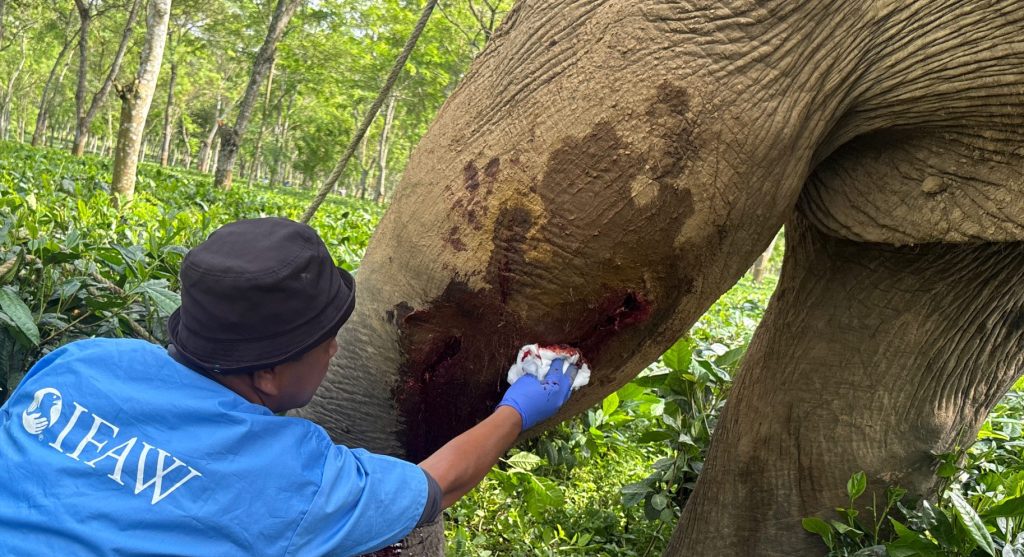
Treatment of the injured elephant by Dr. Panjit Basumatary | Photograph by Bikey Kachuwa
“The forest department had actually been prompt in providing veterinary treatment to the elephant, but wounds like this take time to heal”, explains Dr. Panjit Basumatary, the lead veterinarian from the Wildlife Trust of India. Dr. Panjit was called in from the Centre for Bear Rehabilitation (CBRC), Arunachal Pradesh, and after the first examination, Dr. Panjit’s team chemically immobilised the elephant for safe examination and treatment. Surgical intervention was undertaken on the injured left foreleg, and the pus-filled wounds were thoroughly cleaned and dressed, while appropriate antimicrobial ointment was applied. The team also administered injectable antibiotics and other necessary supportive treatment, including a subconjunctival injection in the left eye, which was affected by corneal opacity. Mr. Biswa Jyoti Das, AFS, Divisional Forest Officer (DFO), Sonitpur West Division, Tezpur, said, “The individual has been under our close observation since 25th August2026, when the animal was first seen in the area. Accordingly, on 29th August Dr. Daoharu Boro and Dr. Mehedi Hasan of IFAW-WTI, along with Dr. Amarjyoti Boro, the department veterinarian, intervened and provided preliminary treatment. This was followed by a major surgical intervention on 12 September 2026 led by Dr. Basumatary.”
Too close for comfort
“The animal seems to be recovering now. It is able to use its injured foreleg to crush food before lifting it into its mouth with the trunk and has also started travelling short distances after about a month of being immobile. This certainly gives us hope for its future and its return back into the wild”, says Mr. Kashyab. However, people haven’t stopped trying to feed the animal and getting close to it. “There is always the risk of the animal reacting adversely to people and the crowd, but we hope that this doesn’t turn into another 2006 story.
Cases aren’t few when in an attempt to take a photograph of wild elephants, sometimes even daring for a selfie, have resulted in fatalities on the human side. A wild animal is not to be blamed and neither the forest department who are referred to as the official custodians of wildlife in our country. In such scenarios, it is important to understand why the casualty happened in the first place and why it is important to respect the boundaries between wildlife and not get too close for comfort.

Locals in close proximity to the injured wild elephant in Sonitpur | Photograph by Bikey Kchuwa
The elephant is already receiving the required treatment, and the same is showing the desired results. The team on ground is ensuring that the necessary oral medications are taken by the elephant while they are continuously monitoring its condition. Enough cannot be said about the efforts put in by the Forest Department, of people like Miss Sabina Yasmin, Forest Range Officer, Central Range, Sonitpur West Division, Tezpur and her entire staff, who are now trying to guide the elephant away from human populated areas and into the wilderness of the Kameng Elephant Reserve.
However, this is also the time when one should ask why this situation came to be and how an injury, induced most probably by a sharp weapon, turned its fate. An important part of re-wilding is also to ensure that the elephant is kept away from human proximity and that it doesn’t become dependent and habituated to the food and ‘love’ provided by caring humans. While local communities are vital to the conservation of wildlife and wild spaces, it is also important to understand that there should be strategic restraint to be able to actually help, especially in cases as critical as this Makhna of Sonitpur.
The Sonitpur Makhna | Photograph by Bikey Kachuwa
What gets viral
A deeper dive into media coverage reveals that the elephant has not been consistently reported as a news story. The media attention appears to have been very low initially and then sharply concentrated around 23–25 September 2026, when the treatment and surgery story and social-media appeal began circulating. Although the animal was under the observation of the Forest Department since 25 August, with preliminary treatment starting on 29 August and the major surgery performed on 12 September by Dr. Panjit, the story did not appear to generate much searchable news coverage during this period. The animal had actually been receiving treatment for weeks before the story became prominent. This failed to get attention in the social posts and consequently was invisible in the public news cycle. “Perhaps this added to the appeals that the animal needed help and no one was intervening”, explains Jose Louies, the CEO of the Wildlife Trust of India. “There’s a lot of potential in public perception and appeals, and this time perhaps it would be towards why the elephant got injured in the first place”, he added.
Distress, trauma, injury and helplessness are the perfect adjectives for an appeal to go ‘viral’. It is also, however, the responsibility of both the public and the media to share verified and updated information and not exploit a part of an event for its potential to be ‘sharable’ – just because there was an exception.
Story by Madhumay Mallik, WTI Communications